Department of Biochemistry, Molecular Biology and Biophysics, University of Minnesota, Minneapolis, Minnesota, USA.
Nat Chem Biol. 2010 Nov;6(11):821-8. doi: 10.1038/nchembio.452. Epub 2010 Oct 3.
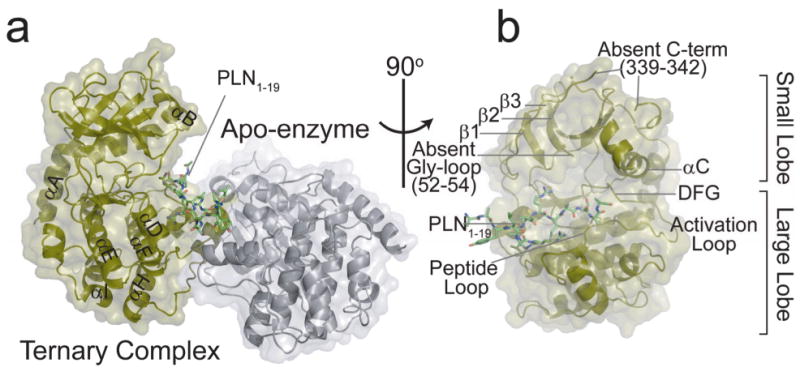
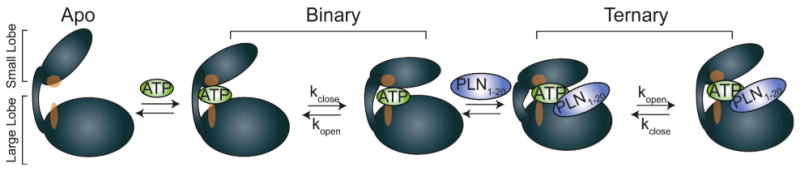
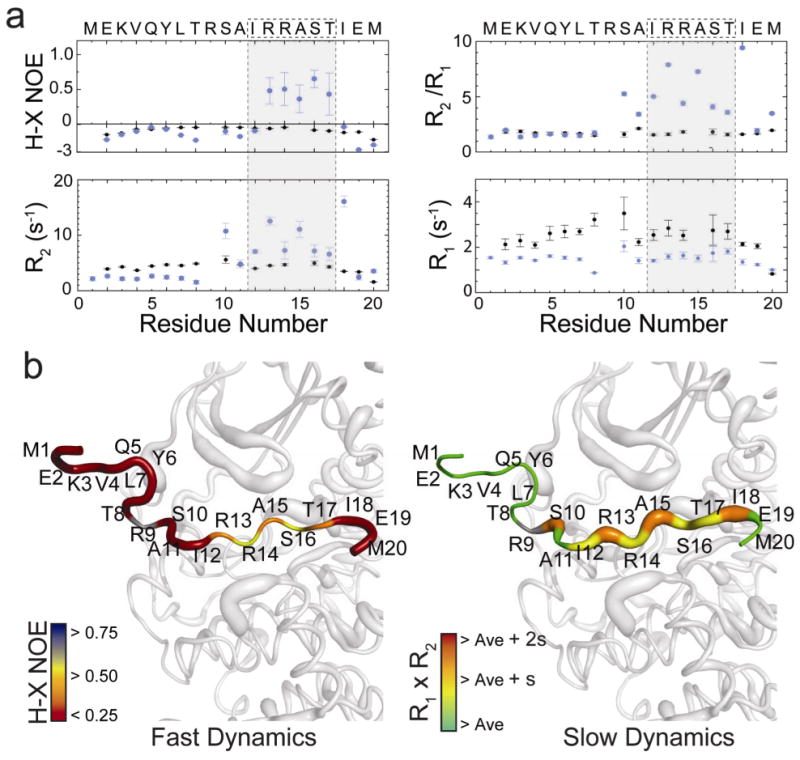
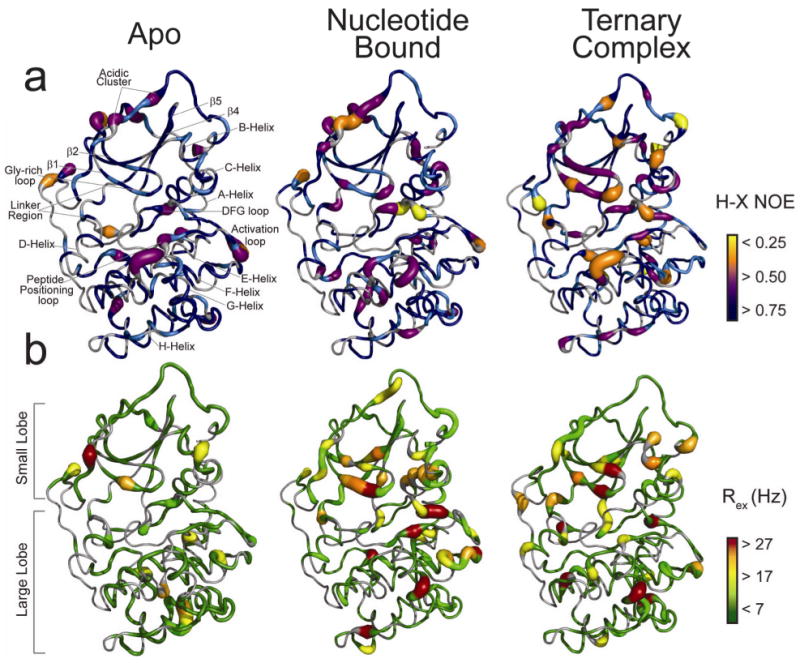
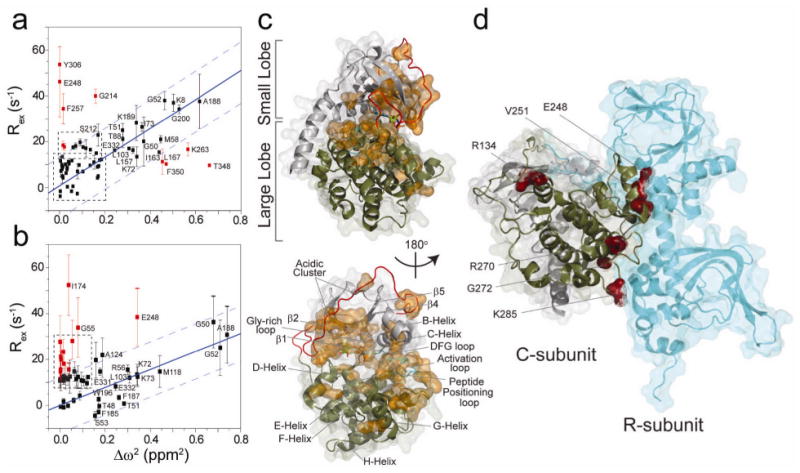
Atomic resolution studies of protein kinases have traditionally been carried out in the inhibitory state, limiting our current knowledge on the mechanisms of substrate recognition and catalysis. Using NMR, X-ray crystallography and thermodynamic measurements, we analyzed the substrate recognition process of cAMP-dependent protein kinase (PKA), finding that entropy and protein dynamics play a prominent role. The nucleotide acts as a dynamic and allosteric activator by coupling the two lobes of apo PKA, enhancing the enzyme dynamics synchronously and priming it for catalysis. The formation of the ternary complex is entropically driven, and NMR spin relaxation data reveal that both substrate and PKA are dynamic in the closed state. Our results show that the enzyme toggles between open and closed states, which indicates that a conformational selection rather than an induced-fit mechanism governs substrate recognition.
蛋白质激酶的原子分辨率研究传统上是在抑制状态下进行的,这限制了我们目前对底物识别和催化机制的了解。我们使用 NMR、X 射线晶体学和热力学测量分析了 cAMP 依赖性蛋白激酶(PKA)的底物识别过程,发现熵和蛋白质动力学起着重要作用。核苷酸通过连接 apo PKA 的两个叶,充当动态别构激活剂,同步增强酶动力学,并为催化作用做好准备。三元复合物的形成是熵驱动的,NMR 自旋弛豫数据表明,在封闭状态下,底物和 PKA 都是动态的。我们的结果表明,酶在开放和封闭状态之间切换,这表明构象选择而不是诱导契合机制控制底物识别。