Department of Physiology, University of California, San Francisco, 1550 4th Street, San Francisco, CA 94158-23241, USA.
BMC Biol. 2010 Sep 28;8:126. doi: 10.1186/1741-7007-8-126.
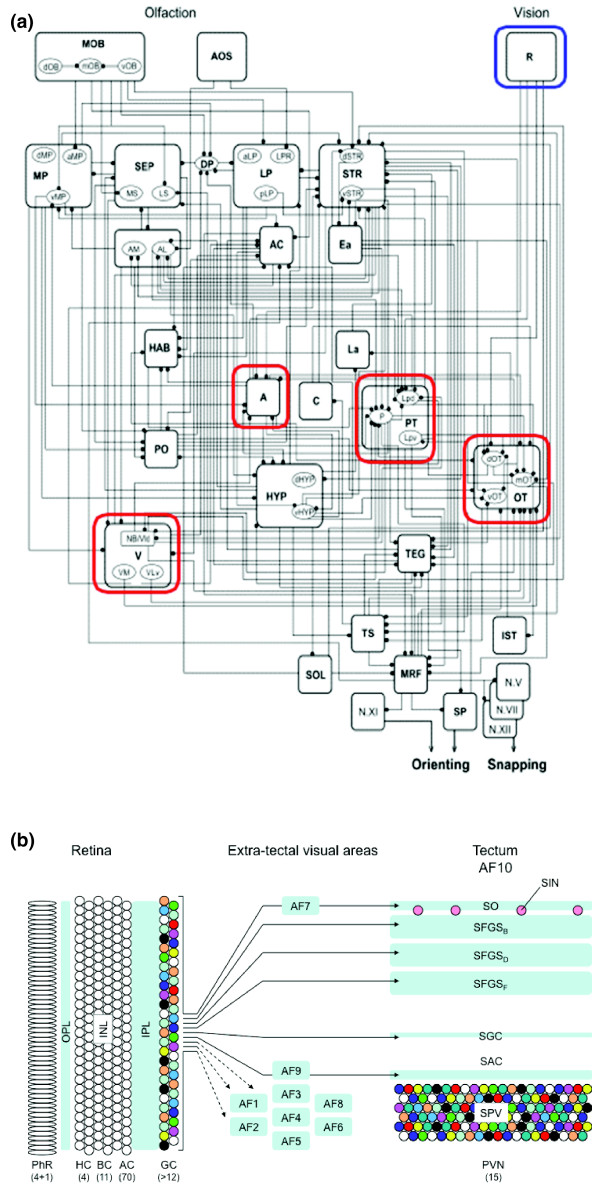
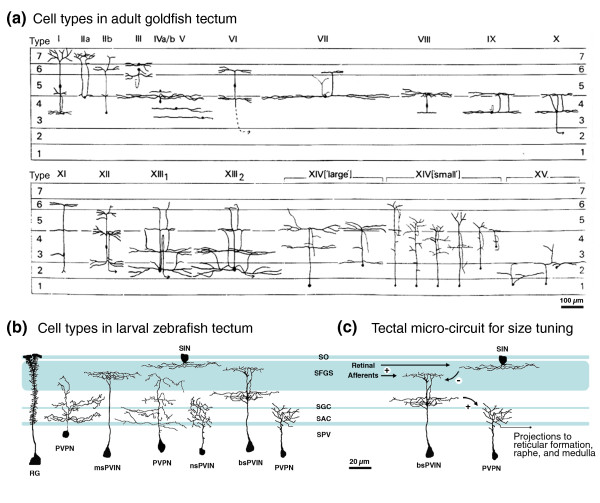
The visual pathway is tasked with processing incoming signals from the retina and converting this information into adaptive behavior. Recent studies of the larval zebrafish tectum have begun to clarify how the 'micro-circuitry' of this highly organized midbrain structure filters visual input, which arrives in the superficial layers and directs motor output through efferent projections from its deep layers. The new emphasis has been on the specific function of neuronal cell types, which can now be reproducibly labeled, imaged and manipulated using genetic and optical techniques. Here, we discuss recent advances and emerging experimental approaches for studying tectal circuits as models for visual processing and sensorimotor transformation by the vertebrate brain.
视觉通路的任务是处理来自视网膜的传入信号,并将这些信息转化为适应性行为。最近对幼虫斑马鱼顶盖的研究开始阐明这个高度组织化的中脑结构的“微电路”如何过滤视觉输入,这些输入到达浅层,并通过深层的传出投射来指导运动输出。新的重点是神经元细胞类型的特定功能,现在可以使用遗传和光学技术可重复地标记、成像和操作。在这里,我们讨论了研究顶盖电路作为脊椎动物大脑视觉处理和感觉运动转换模型的最新进展和新兴实验方法。