Forsthofer Michael, Gordy Clayton, Kolluri Meghna, Straka Hans
Faculty of Biology, Ludwig-Maximilians-University Munich, Planegg 82152, Germany
Graduate School of Systemic Neurosciences, Ludwig-Maximilians-University Munich, Planegg 82152, Germany.
eNeuro. 2024 Jan 26;11(1). doi: 10.1523/ENEURO.0371-23.2023. Print 2024 Jan.
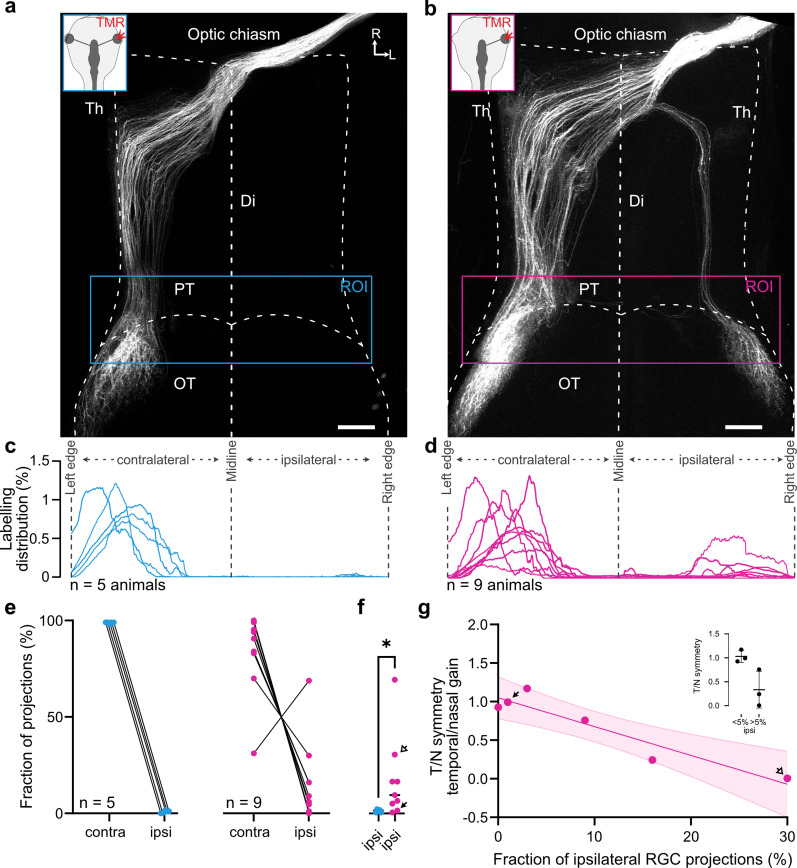
To generate a coherent visual percept, information from both eyes must be appropriately transmitted into the brain, where binocular integration forms the substrate for visuomotor behaviors. To establish the anatomical substrate for binocular integration, the presence of bilateral eyes and interaction of both optic nerves during retinotectal development play a key role. However, the extent to which embryonic monocularly derived visual circuits can convey visuomotor behaviors is unknown. In this study, we assessed the retinotectal anatomy and visuomotor performance of embryonically generated one-eyed tadpoles. In one-eyed animals, the axons of retinal ganglion cells from the singular remaining eye exhibited striking irregularities in their central projections in the brain, generating a noncanonical ipsilateral retinotectal projection. This data is indicative of impaired pathfinding abilities. We further show that these novel projections are correlated with an impairment of behavioral compensation for the loss of one eye.
为了产生连贯的视觉感知,来自双眼的信息必须被适当地传输到大脑中,在那里双眼整合形成视觉运动行为的基础。为了建立双眼整合的解剖学基础,双侧眼睛的存在以及视网膜顶盖发育过程中两条视神经的相互作用起着关键作用。然而,胚胎期单眼衍生的视觉回路能够传达视觉运动行为的程度尚不清楚。在本研究中,我们评估了胚胎期产生的独眼蝌蚪的视网膜顶盖解剖结构和视觉运动表现。在独眼动物中,来自仅存的一只眼睛的视网膜神经节细胞的轴突在大脑中的中央投射表现出明显的不规则性,产生了一种非典型的同侧视网膜顶盖投射。这些数据表明其寻路能力受损。我们进一步表明,这些新的投射与单眼丧失后的行为补偿受损相关。