Villanueva Manuel, Ríos-Luna Antonio, Pereiro Javier, Fahandez-Saddi Homid, Pérez-Caballer Antonio
Department of Orthopedics, Hospital General Universitario Gregorio Marañón, Madrid, Spain.
Indian J Orthop. 2010 Oct;44(4):438-43. doi: 10.4103/0019-5413.69318.
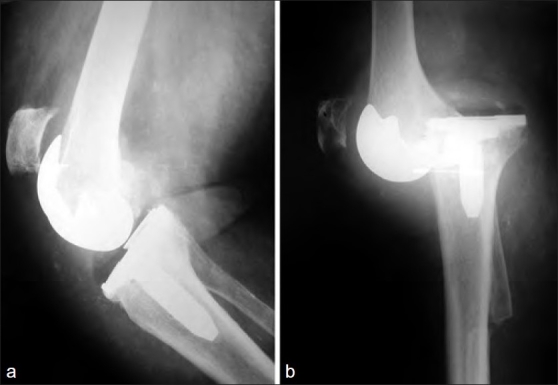
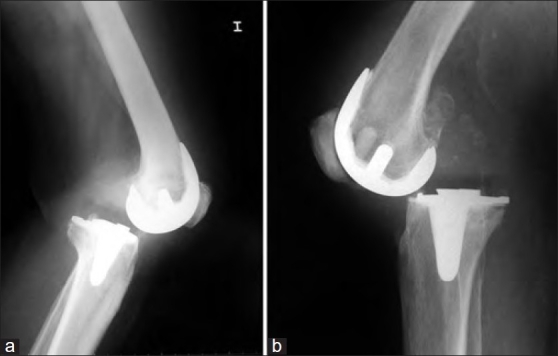
Dislocation following total knee arthroplasty (TKA) is the worst form of instability. The incidence is from 0.15 to 0.5%. We report six cases of TKA dislocation and analyze the patterns of dislocation and the factors related to each of them.
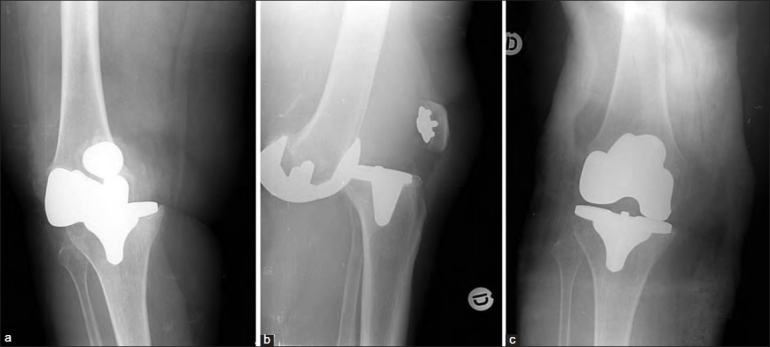
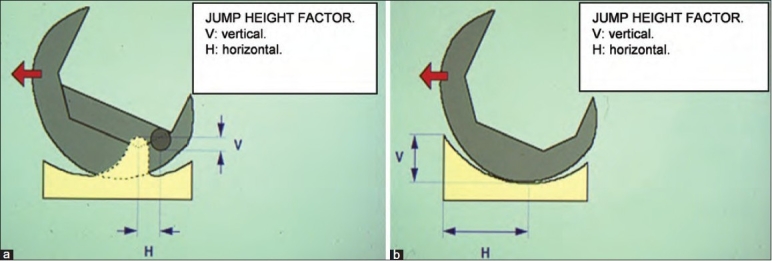
Six patients with dislocation of knee following TKA are reported. The causes for the dislocations were an imbalance of the flexion gap (n=4), an inadequate selection of implants (n=1), malrotation of components (n=1) leading to incompetence of the extensor mechanism, or rupture of the medial collateral ligament (MCC). The patients presented complained of pain, giving way episodes, joint effusion and difficulty in climbing stairs. Five patients suffered posterior dislocation while one anterior dislocation. An urgent closed reduction of dislocation was performed under general anaesthesia in all patients. All patients were operated for residual instability by revision arthroplasty after a period of conservative treatment.
One patient had deep infection and knee was arthrodesed. Two patients have a minimal residual lag for active extension, including a patient with a previous patellectomy. Result was considered excellent or good in four cases and fair in one, without residual instability. Five out of six patients in our series had a cruciate retaining (CR) TKA designs: four were revised to a posterior stabilized (PS) TKA and one to a rotating hinge design because of the presence of a ruptured MCL.
Further episodes of dislocation or instability will be prevented by identifying and treating major causes of instability. The increase in the level of constraint and correction of previous technical mistakes is mandatory.
全膝关节置换术(TKA)后脱位是最严重的不稳定形式。发生率为0.15%至0.5%。我们报告6例TKA脱位病例,并分析脱位模式及与之相关的因素。
报告6例TKA术后膝关节脱位患者。脱位原因包括屈曲间隙不平衡(n = 4)、假体选择不当(n = 1)、组件旋转不良(n = 1)导致伸肌机制功能不全或内侧副韧带(MCC)断裂。患者表现为疼痛、打软腿、关节积液及爬楼梯困难。5例为后脱位,1例为前脱位。所有患者均在全身麻醉下紧急进行脱位闭合复位。所有患者在经过一段时间的保守治疗后,因残留不稳定接受翻修关节成形术。
1例患者发生深部感染,膝关节行关节融合术。2例患者主动伸直有轻微残留滞后,其中1例曾行髌骨切除术。4例结果为优或良,1例为尚可,无残留不稳定。我们系列中的6例患者中有5例采用了保留交叉韧带(CR)的TKA设计:4例因存在MCL断裂而翻修为后稳定型(PS)TKA,1例翻修为旋转铰链设计。
通过识别和治疗不稳定的主要原因可预防进一步的脱位或不稳定发作。必须增加约束水平并纠正先前的技术失误。