Center for Integrated Human Brain Science, Brain Research Institute, University of Niigata, 1 Asahimachi, Chuoh-ku, Niigata, 951-8585, Japan.
Neurol Sci. 2011 Feb;32(1):113-6. doi: 10.1007/s10072-010-0431-1. Epub 2010 Oct 6.
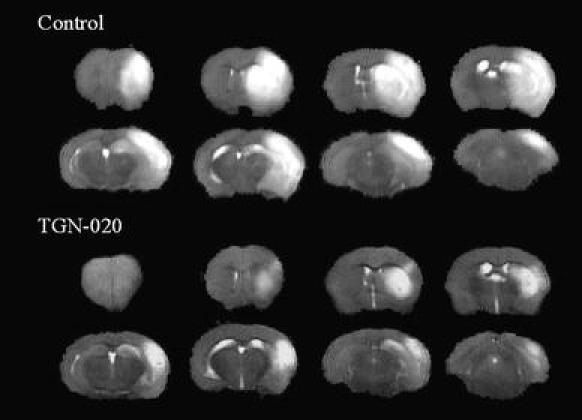
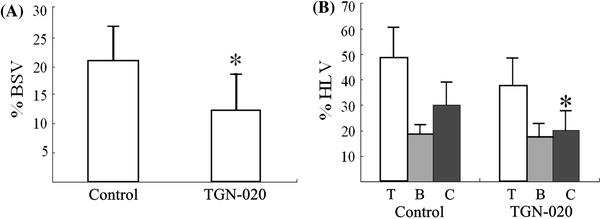
We investigated the in vivo effects of a novel aquaporin 4 (AQP4) inhibitor 2-(nicotinamide)-1,3,4-thiadiazole, TGN-020, in a mouse model of focal cerebral ischemia using 7.0-T magnetic resonance imaging (MRI). Pretreatment with TGN-020 significantly reduced brain edema associated with brain ischemia, as reflected by percentage of brain swelling volume (%BSV), 12.1 ± 6.3% in the treated group, compared to (20.8 ± 5.9%) in the control group (p < 0.05), and in the size of cortical infarction as reflected by the percentage of hemispheric lesion volume (%HLV), 20.0 ± 7.6% in the treated group, compared to 30.0 ± 9.1% in the control group (p < 0.05). The study indicated the potential pharmacological use of AQP4 inhibition in reducing brain edema associated with focal ischemia.
我们使用 7.0-T 磁共振成像 (MRI) 研究了新型水通道蛋白 4 (AQP4) 抑制剂 2-(烟酰胺)-1,3,4-噻二唑 (TGN-020) 在局灶性脑缺血小鼠模型中的体内作用。TGN-020 的预处理显著降低了与脑缺血相关的脑水肿,反映在脑肿胀体积百分比 (%BSV) 中,治疗组为 12.1±6.3%,而对照组为 20.8±5.9%(p<0.05),在皮质梗死的大小方面,反映在半球病变体积百分比 (%HLV) 中,治疗组为 20.0±7.6%,而对照组为 30.0±9.1%(p<0.05)。研究表明,AQP4 抑制在减轻与局灶性缺血相关的脑水肿方面具有潜在的药理作用。