Department of Medicine, SUNY Upstate Medical University, Syracuse, NY 13210, USA.
Behav Brain Funct. 2010 Oct 6;6:56. doi: 10.1186/1744-9081-6-56.
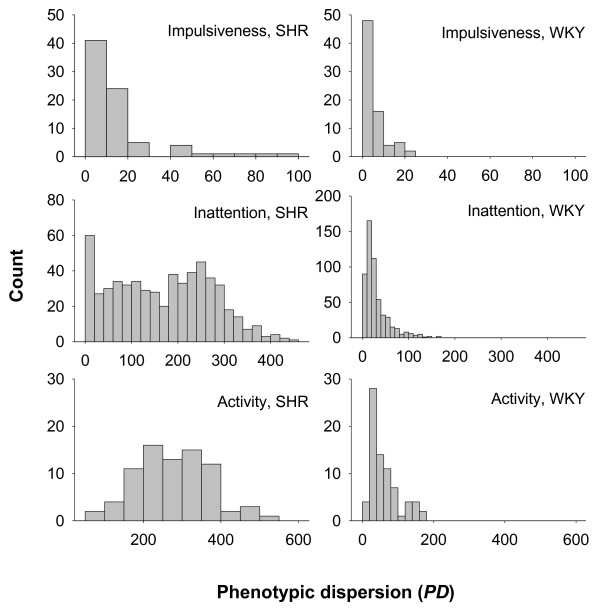
Attention-deficit/hyperactivity disorder (ADHD) is characterized by numerous behaviors including inattention, hyperactivity and impulsiveness. ADHD-affected individuals also have high intra-individual variability (IIV) in reaction time. The genetic control of IIV is not well understood. The single study of the genetics of this phenomenon in humans detected only marginal associations between genotypes at two candidate genes for ADHD and variability in response time. The Spontaneously Hypertensive Rat (SHR/NCrl) is an animal model of ADHD, expressing high activity, inattention and impulsive behavior during operant and task tests. The SHR might be useful for identifying genes for variability, but it is not known whether it also expresses high IIV, as is symptomatic of ADHD. We therefore conducted an investigation of IIV in the SHR. We used 16 SHR/NCrl rats and 15 Wistar-Kyoto (WKY/Nico) controls applying a reinforcement schedule used in the validation of the SHR as an animal model of ADHD. We represented IIV as the average absolute deviation of individual behavior within the five 18-min segments of each experimental session from the average behavioral trait value within that session ('individual phenotypic dispersion', PDi). PDi for hyperactivity, impulsiveness and inattention in the SHR and WKY rats was analyzed using nonparametric ranking by experimental session. SHR/NCrl rats had higher PDi than WKY/Nico controls for impulsiveness and inattention. There was a significant upward trend for PDi over experimental segments within sessions for attention in SHR rats, but not in WKY. PDi for hyperactivity was correlated with PDi for impulsiveness and we therefore excluded observations associated with short IRTs (< 0.67 s); dispersion in hyperactivity outside this interval was also significantly higher in SHR rats than in WKY rats. Some studies indicate the sharing of symptoms of hyperactivity and impulsiveness in SHR and ADHD-affected humans; high IIV in operant behavioral metrics suggests that the SHR may be useful in elucidating the genetic basis for IIV in humans.
注意缺陷多动障碍(ADHD)的特征是存在许多行为,包括注意力不集中、多动和冲动。ADHD 患者的反应时间也存在较高的个体内变异性(IIV)。IIV 的遗传控制尚不清楚。人类对这一现象的遗传研究仅在两个 ADHD 候选基因的基因型与反应时间变异性之间发现了一些边缘关联。自发性高血压大鼠(SHR/NCrl)是一种 ADHD 动物模型,在操作性和任务测试中表现出高活动、注意力不集中和冲动行为。SHR 可能有助于识别变异性的基因,但尚不清楚它是否也表现出 ADHD 的高 IIV。因此,我们对 SHR 中的 IIV 进行了研究。我们使用了 16 只 SHR/NCrl 大鼠和 15 只 Wistar-Kyoto(WKY/Nico)对照,应用了在 SHR 作为 ADHD 动物模型的验证中使用的强化方案。我们将 IIV 表示为每个实验时段内个体行为的平均绝对偏差,即该时段内个体行为特征值的平均值(“个体表型离散度”,PDi)。我们使用非参数排序法按实验时段对 SHR 和 WKY 大鼠的多动、冲动和注意力不集中的 PDi 进行了分析。与 WKY/Nico 对照相比,SHR/NCrl 大鼠的冲动和注意力不集中的 PDi 更高。在 SHR 大鼠中,注意力的 PDi 在实验段内有显著的上升趋势,但在 WKY 大鼠中没有。SHR 大鼠的多动 PDi 与冲动 PDi 相关,因此我们排除了与短 IRT(<0.67s)相关的观察结果;在此间隔之外,多动的离散度在 SHR 大鼠中也显著高于 WKY 大鼠。一些研究表明 SHR 和 ADHD 患者存在多动和冲动症状的共享;操作性行为测量中的高 IIV 表明 SHR 可能有助于阐明人类 IIV 的遗传基础。