Subramanian Arulselvi, Rangarajan Kanchana, Kumar Sudeep, Sharma Vijay, Farooque Kamran, Misra Mahesh Chandra
Blood Bank & Department of Laboratory Medicine, Jai Prakash Narayan Apex Trauma Centre, All India Institute of Medical Sciences, AIIMS, New Delhi, India.
J Emerg Trauma Shock. 2010 Jul;3(3):225-30. doi: 10.4103/0974-2700.66521.
Patients undergoing elective orthopedic surgeries often incur excess blood loss necessitating transfusion. The preoperative placement of blood requests frequently overshoots the actual need resulting in unnecessary crossmatching.
Our primary goal was to audit the blood utilization in elective orthopedic surgeries in our hospital over a 1-year period and recommend a blood ordering schedule.
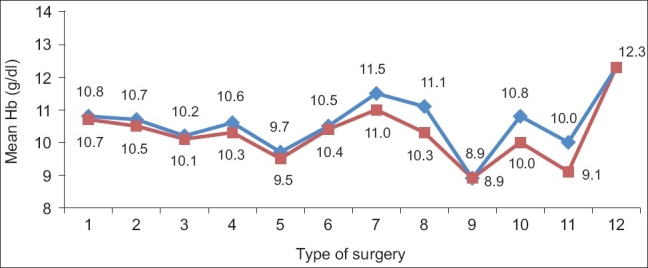
A retrospective analysis of patients who underwent elective orthopedic surgeries over a period of 1 year was done. The data collected include patients' age, sex, type of surgical procedure, pre- and postoperative hemoglobin (Hb) levels, number of units crossmatched, returned, transfused, crossmatch to transfusion ratio (C:T), transfusion indices, estimated blood loss for each surgical procedure, and the actual and predicted fall in Hb. We propose a blood ordering schedule based on surgical blood ordering equation.
A total of 487 patients with a median age of 37±17 years (mean ± standard deviation) were evaluated. One thousand three hundred and seventy-seven units of blood were crossmatched and only 564 units were transfused to 260 patients. Fifty-nine percent of the units crossmatched were not transfused. Six of the 12 elective procedures had a C:T ratio higher than 2.5. Ten of the 12 procedures (83.3%) had a low transfusion index (TI < 0.5). The calculated red blood cell units were less than 0.5 in 5 of the 12 elective procedures, and hence we recommend a group and save policy for these procedures. Blood ordering schedule based on patient and surgical variables would provide an efficient way of blood utilization and management of resources.
接受择期骨科手术的患者常常会出现失血过多的情况,需要输血。术前申请的血液量常常超过实际需求,导致不必要的交叉配血。
我们的主要目标是审核我院1年内择期骨科手术的用血情况,并推荐一种用血订购方案。
对1年内接受择期骨科手术的患者进行回顾性分析。收集的数据包括患者的年龄、性别、手术类型、术前和术后血红蛋白(Hb)水平、交叉配血的单位数、退回的单位数、输注的单位数、交叉配血与输血比例(C:T)、输血指数、每种手术的估计失血量以及Hb的实际和预测下降情况。我们基于手术用血订购方程提出一种用血订购方案。
共评估了487例患者,中位年龄为37±17岁(均值±标准差)。共交叉配血1377单位血液,仅向260例患者输注了564单位。交叉配血的单位中有59%未被输注。12种择期手术中有6种的C:T比例高于2.5。12种手术中有10种(83.3%)的输血指数较低(TI<0.5)。12种择期手术中有5种计算出的红细胞单位数小于0.5,因此我们建议对这些手术采用备血方案。基于患者和手术变量的用血订购方案将提供一种有效的用血方式和资源管理方法。