Division of Medicine, Akershus University Hospital, Sykehusveien 27, 1478 Lørenskog, Norway.
Intensive Care Med. 2011 Jan;37(1):77-85. doi: 10.1007/s00134-010-2051-x. Epub 2010 Oct 12.
To assess the clinical utility of a recently developed highly sensitive cardiac troponin T (hs-cTnT) assay for providing prognostic information on patients with sepsis.
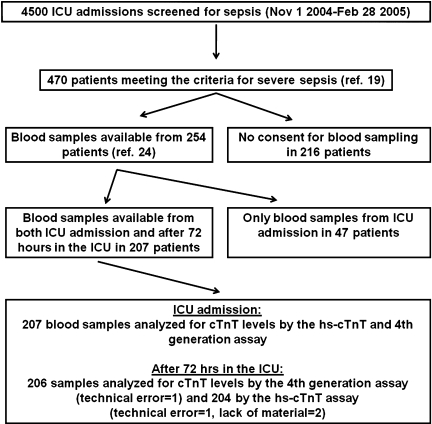
cTnT levels were measured by the novel hs-cTnT assay at two time points (inclusion and 72 h thereafter) in a subgroup of patients from the FINNSEPSIS study and associations with clinical outcomes were examined. Results for the hs-cTnT assay were compared to those of the established fourth-generation cTnT assay.
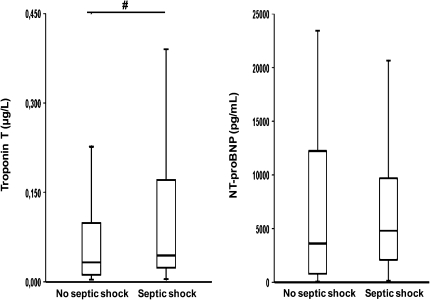
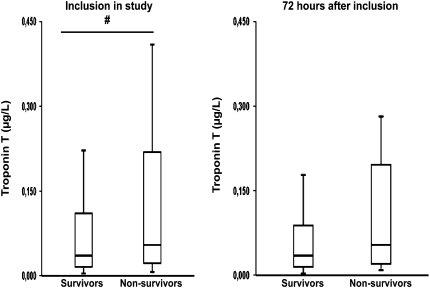
cTnT measured by the fourth-generation and hs-cTnT assay was detectable in 124 (60%) and 207 (100%) patients, respectively, on inclusion in this study. hs-cTnT levels on inclusion correlated with several indices of risk in sepsis, including the simplified acute physiology score (SAPS) II and sequential organ failure assessment (SOFA) scores. The level of hs-cTnT on inclusion was higher in hospital non-survivors (n = 47) than survivors (n = 160) (median 0.054 [Q1-3, 0.022-0.227] versus 0.035 [0.015-0.111] μg/L, P = 0.047), but hs-cTnT level was not an independent predictor of in-hospital mortality. hs-cTnT levels on inclusion were also higher in patients with septic shock during the hospitalization (0.044 [0.024-0.171] versus 0.033 [0.012-0.103] μg/L, P = 0.03), while this was not the case for the fourth-generation cTnT assay or NT-proBNP levels.
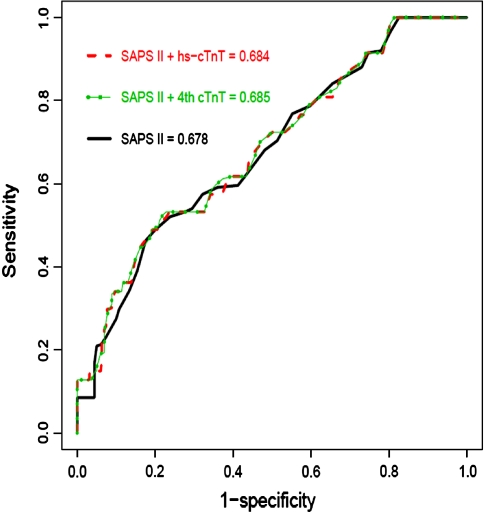
Circulating hs-cTnT is present in patients with severe sepsis and septic shock, associates with disease severity and survival, but does not add to SAPS II score for prediction of mortality. hs-cTnT measurement could still have a role in sepsis as an early marker of shock.
评估最近开发的高敏心肌肌钙蛋白 T(hs-cTnT)检测方法在脓毒症患者预后评估中的临床应用价值。
在 FINNSEPSIS 研究的亚组患者中,于两个时间点(纳入时和之后的 72 小时)使用新型 hs-cTnT 检测方法测量 cTnT 水平,并检查与临床结局的相关性。将 hs-cTnT 检测方法的结果与第四代 cTnT 检测方法的结果进行比较。
在本研究纳入时,分别有 124(60%)和 207(100%)例患者可检测到第四代和 hs-cTnT 检测方法检测的 cTnT。纳入时 hs-cTnT 水平与脓毒症的几个风险指数相关,包括简化急性生理学评分(SAPS)II 和序贯器官衰竭评估(SOFA)评分。在住院期间非幸存者(n=47)的 hs-cTnT 纳入水平高于幸存者(n=160)(中位数 0.054[Q1-3,0.022-0.227]比 0.035[0.015-0.111]μg/L,P=0.047),但 hs-cTnT 水平不是住院死亡率的独立预测因素。住院期间脓毒性休克患者的 hs-cTnT 纳入水平也较高(0.044[0.024-0.171]比 0.033[0.012-0.103]μg/L,P=0.03),而第四代 cTnT 检测方法或 NT-proBNP 水平则不是如此。
循环 hs-cTnT 存在于严重脓毒症和脓毒性休克患者中,与疾病严重程度和存活率相关,但不能增加 SAPS II 评分对死亡率的预测。hs-cTnT 测量仍可作为休克的早期标志物在脓毒症中发挥作用。