Biophysics Graduate Group, University of California, Berkeley, California 94720, USA.
Nature. 2010 Oct 14;467(7317):805-10. doi: 10.1038/nature09423.
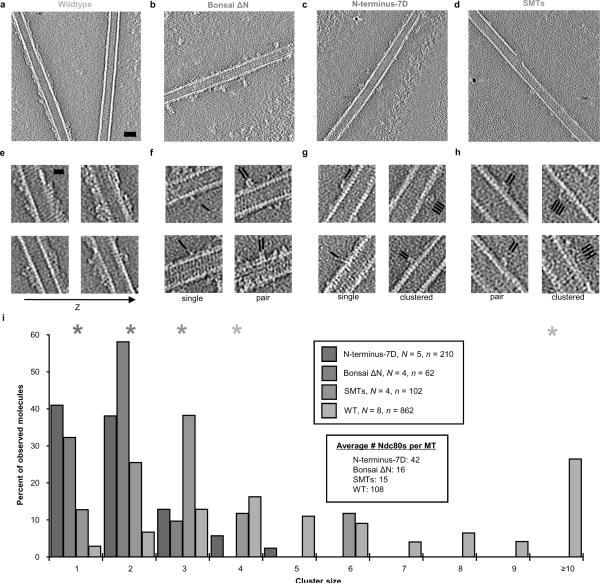
The Ndc80 complex is a key site of regulated kinetochore-microtubule attachment (a process required for cell division), but the molecular mechanism underlying its function remains unknown. Here we present a subnanometre-resolution cryo-electron microscopy reconstruction of the human Ndc80 complex bound to microtubules, sufficient for precise docking of crystal structures of the component proteins. We find that the Ndc80 complex binds the microtubule with a tubulin monomer repeat, recognizing α- and β-tubulin at both intra- and inter-tubulin dimer interfaces in a manner that is sensitive to tubulin conformation. Furthermore, Ndc80 complexes self-associate along protofilaments through interactions mediated by the amino-terminal tail of the NDC80 protein, which is the site of phospho-regulation by Aurora B kinase. The complex's mode of interaction with the microtubule and its oligomerization suggest a mechanism by which Aurora B could regulate the stability of load-bearing kinetochore-microtubule attachments.
Ndc80 复合物是一个关键的调控着动粒-微管附着的位点(细胞分裂所必需的过程),但其功能的分子机制仍然未知。在这里,我们呈现了一个亚纳米分辨率的冷冻电镜重构的人源 Ndc80 复合物与微管结合的结构,足以精确对接组成蛋白的晶体结构。我们发现 Ndc80 复合物以微管的一个微管蛋白单体重复为结合单位,以一种对微管构象敏感的方式,识别 α-和 β-微管蛋白,在微管蛋白二聚体的内和界面上。此外,Ndc80 复合物通过 NDC80 蛋白氨基端尾巴介导的相互作用沿着原纤维自我组装,该尾巴是 Aurora B 激酶磷酸化调节的位点。该复合物与微管的相互作用方式及其寡聚化表明了 Aurora B 可以调节承载重的动粒-微管附着的稳定性的机制。