Chandramouli Kondethimmanahalli, Qian Pei-Yuan
Department of Biology, The Hong Kong University of Science and Technology, Kowloon, Hong Kong.
Hum Genomics Proteomics. 2009 Dec 8;2009:239204. doi: 10.4061/2009/239204.
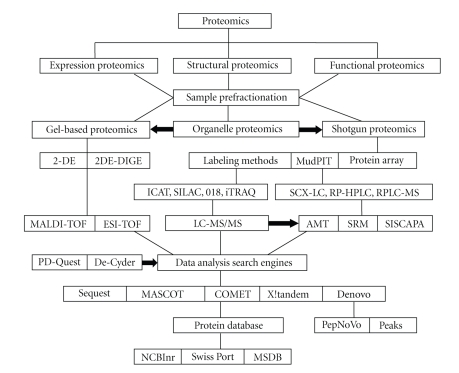
Proteomics is the large-scale study of the structure and function of proteins in complex biological sample. Such an approach has the potential value to understand the complex nature of the organism. Current proteomic tools allow large-scale, high-throughput analyses for the detection, identification, and functional investigation of proteome. Advances in protein fractionation and labeling techniques have improved protein identification to include the least abundant proteins. In addition, proteomics has been complemented by the analysis of posttranslational modifications and techniques for the quantitative comparison of different proteomes. However, the major limitation of proteomic investigations remains the complexity of biological structures and physiological processes, rendering the path of exploration paved with various difficulties and pitfalls. The quantity of data that is acquired with new techniques places new challenges on data processing and analysis. This article provides a brief overview of currently available proteomic techniques and their applications, followed by detailed description of advantages and technical challenges. Some solutions to circumvent technical difficulties are proposed.
蛋白质组学是对复杂生物样品中蛋白质的结构和功能进行大规模研究。这种方法对于理解生物体的复杂本质具有潜在价值。当前的蛋白质组学工具允许对蛋白质组进行大规模、高通量分析,以检测、鉴定和进行功能研究。蛋白质分级分离和标记技术的进展提高了蛋白质鉴定能力,能够鉴定出含量最少的蛋白质。此外,蛋白质组学还通过对翻译后修饰的分析以及不同蛋白质组定量比较技术得到了补充。然而,蛋白质组学研究的主要限制仍然是生物结构和生理过程的复杂性,这使得探索之路充满各种困难和陷阱。新技术获取的数据量给数据处理和分析带来了新的挑战。本文简要概述了当前可用的蛋白质组学技术及其应用,随后详细描述了其优点和技术挑战。还提出了一些规避技术难题的解决方案。