Department of Community and Preventive Dentistry, Universidade Federal de Minas Gerais, Belo Horizonte, MG, Brazil.
Int J Environ Res Public Health. 2010 Aug;7(8):3115-28. doi: 10.3390/ijerph7083115. Epub 2010 Aug 6.
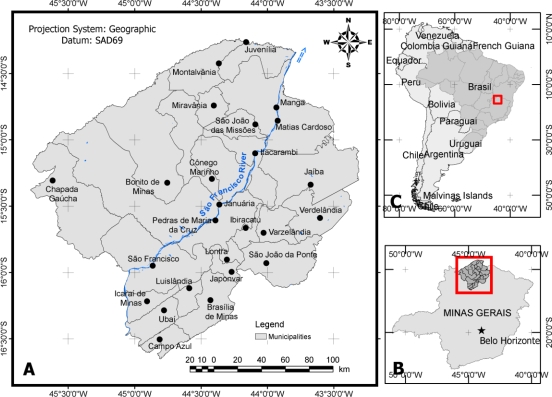
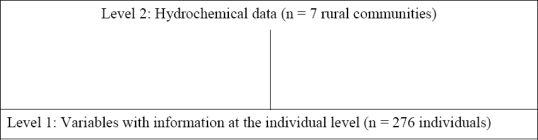
The present paper examines the relationship between hydrochemical characteristics and endemic dental fluorosis, controlling for variables with information on an individual level. An epidemiological survey was carried out in seven rural communities in two municipalities in the state of Minas Gerais, Brazil. The Thystrup & Fejerskov index was employed by a single examiner for the diagnosis of dental fluorosis. A sampling campaign of deep groundwater in the rural communities of interest was carried out concomitantly to the epidemiological survey for the determination of physiochemical parameters. Multilevel modeling of 276 individuals from seven rural communities was achieved using the non-linear logit link function. Parameters were estimated using the restricted maximum likelihood method. Analysis was carried out considering two response variables: presence (TF 1 to 9) or absence (TF = 0) of any degree of dental fluorosis; and presence (TF ≥ 5-with loss of enamel structure) or absence of severe dental fluorosis (TF ≤ 4-with no loss of enamel structure). Hydrogeological analyses revealed that dental fluorosis is influenced by the concentration of fluoride (OR = 2.59 CI95% 1.07-6.27; p = 0.073) and bicarbonate (OR = 1.02 CI95% 1.01-1.03; p = 0.060) in the water of deep wells. No other variable was associated with this prevalence (p > 0.05). More severe dental fluorosis (TF ≥ 5) was only associated with age group (p < 0.05). No other variable was associated to the severe dental fluorosis (p > 0.05). Dental fluorosis was found to be highly prevalent and severe. A chemical element besides fluoride was found to be associated (p > 0.05) to the prevalence of dental fluorosis, although this last finding should be interpreted with caution due to its p value.
本研究旨在探讨水化学特征与地方性氟斑牙之间的关系,并控制个体水平的变量。在巴西米纳斯吉拉斯州的两个市的七个农村社区进行了一项流行病学调查。采用单一检查者的 Thystrup & Fejerskov 指数进行氟斑牙诊断。在流行病学调查的同时,对感兴趣的农村社区进行了深层地下水采样,以测定理化参数。采用非线性对数链接函数对来自七个农村社区的 276 名个体进行了多水平建模。使用受限极大似然法估计参数。分析考虑了两个因变量:存在(TF 1 至 9)或不存在(TF = 0)任何程度的氟斑牙;以及存在(TF≥5-有釉质结构丧失)或不存在严重氟斑牙(TF≤4-无釉质结构丧失)。水文地质分析表明,氟斑牙受深井水氟浓度(OR = 2.59,95%CI95% 1.07-6.27;p = 0.073)和碳酸氢盐(OR = 1.02,95%CI95% 1.01-1.03;p = 0.060)的影响。其他变量与该流行率无关(p > 0.05)。更严重的氟斑牙(TF≥5)仅与年龄组相关(p < 0.05)。其他变量与严重氟斑牙无关(p > 0.05)。氟斑牙的流行率和严重程度都很高。除了氟化物之外,还发现另一种化学元素与氟斑牙的流行率相关(p > 0.05),尽管由于其 p 值,最后一个发现应该谨慎解释。