Department of Zoology, University of British Columbia, Canadian Institute for Advanced Research, Program in Integrated Microbial Biodiversity, Vancouver, Canada.
PLoS One. 2010 Oct 8;5(10):e13220. doi: 10.1371/journal.pone.0013220.
Interrelationships among dinoflagellates in molecular phylogenies are largely unresolved, especially in the deepest branches. Ribosomal DNA (rDNA) sequences provide phylogenetic signals only at the tips of the dinoflagellate tree. Two reasons for the poor resolution of deep dinoflagellate relationships using rDNA sequences are (1) most sites are relatively conserved and (2) there are different evolutionary rates among sites in different lineages. Therefore, alternative molecular markers are required to address the deeper phylogenetic relationships among dinoflagellates. Preliminary evidence indicates that the heat shock protein 90 gene (Hsp90) will provide an informative marker, mainly because this gene is relatively long and appears to have relatively uniform rates of evolution in different lineages.
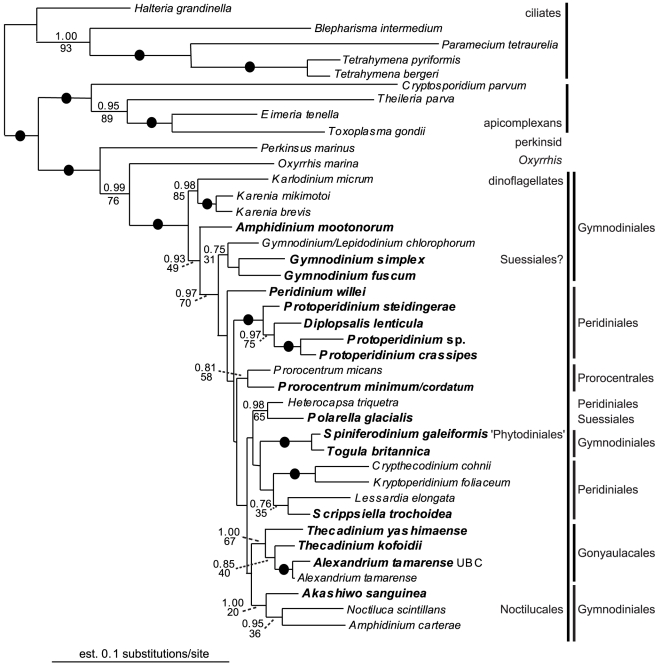
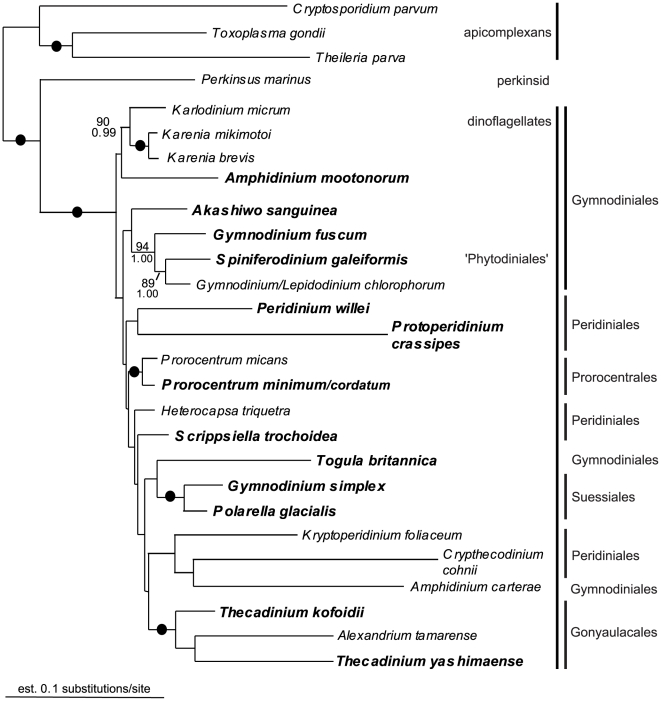
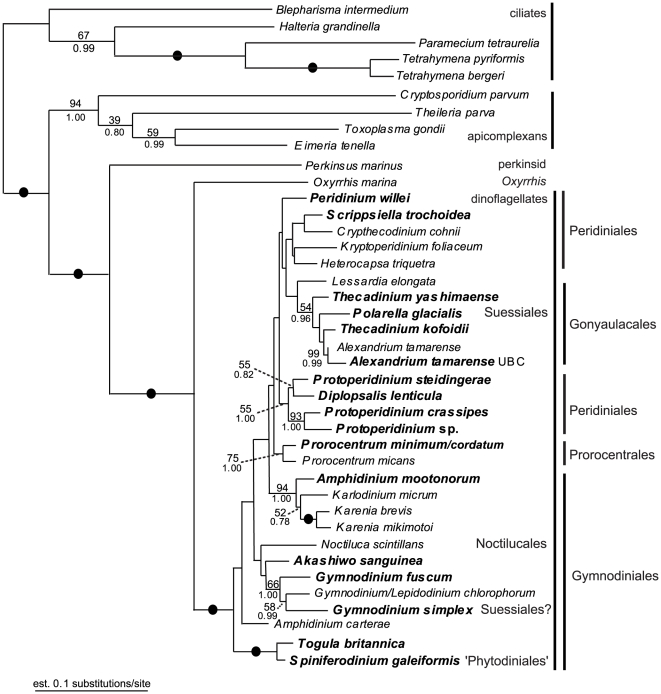
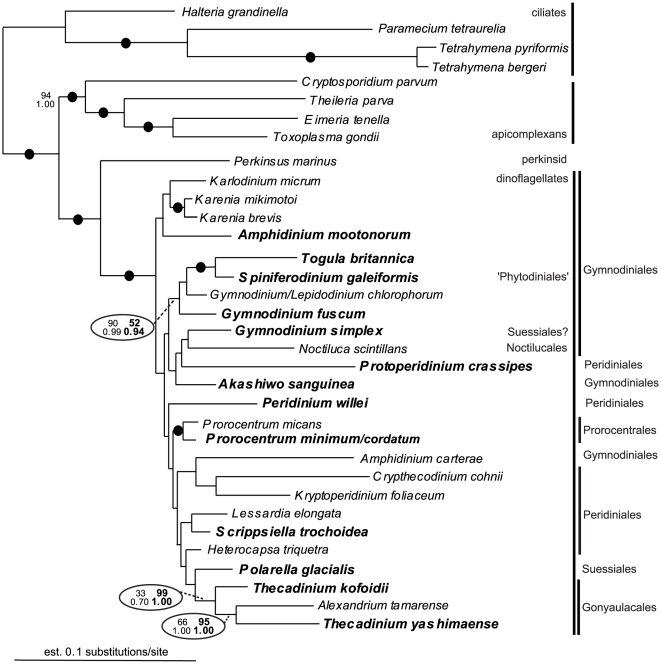
METHODOLOGY/PRINCIPAL FINDINGS: We more than doubled the previous dataset of Hsp90 sequences from dinoflagellates by generating additional sequences from 17 different species, representing seven different orders. In order to concatenate the Hsp90 data with rDNA sequences, we supplemented the Hsp90 sequences with three new SSU rDNA sequences and five new LSU rDNA sequences. The new Hsp90 sequences were generated, in part, from four additional heterotrophic dinoflagellates and the type species for six different genera. Molecular phylogenetic analyses resulted in a paraphyletic assemblage near the base of the dinoflagellate tree consisting of only athecate species. However, Noctiluca was never part of this assemblage and branched in a position that was nested within other lineages of dinokaryotes. The phylogenetic trees inferred from Hsp90 sequences were consistent with trees inferred from rDNA sequences in that the backbone of the dinoflagellate clade was largely unresolved.
CONCLUSIONS/SIGNIFICANCE: The sequence conservation in both Hsp90 and rDNA sequences and the poor resolution of the deepest nodes suggests that dinoflagellates reflect an explosive radiation in morphological diversity in their recent evolutionary past. Nonetheless, the more comprehensive analysis of Hsp90 sequences enabled us to infer phylogenetic interrelationships of dinoflagellates more rigorously. For instance, the phylogenetic position of Noctiluca, which possesses several unusual features, was incongruent with previous phylogenetic studies. Therefore, the generation of additional dinoflagellate Hsp90 sequences is expected to refine the stem group of athecate species observed here and contribute to future multi-gene analyses of dinoflagellate interrelationships.
分子系统发育学中腰鞭毛虫之间的相互关系在很大程度上尚未解决,尤其是在最深的分支中。核糖体 DNA(rDNA)序列仅在腰鞭毛虫树的末端提供系统发育信号。使用 rDNA 序列解析深层腰鞭毛虫关系的两个原因是:(1)大多数位点相对保守,(2)不同谱系中的位点进化速度不同。因此,需要替代的分子标记来解决腰鞭毛虫之间更深层次的系统发育关系。初步证据表明,热休克蛋白 90 基因(Hsp90)将提供一个信息丰富的标记,主要是因为这个基因相对较长,并且在不同的谱系中似乎具有相对均匀的进化速度。
方法/主要发现:我们通过从 17 个不同的物种中生成额外的序列,将以前的腰鞭毛虫 Hsp90 序列数据集增加了一倍以上,这些物种代表了七个不同的目。为了将 Hsp90 数据与 rDNA 序列串联起来,我们用三个新的 SSU rDNA 序列和五个新的 LSU rDNA 序列补充了 Hsp90 序列。新的 Hsp90 序列部分来自四个额外的异养腰鞭毛虫和六个不同属的模式种。分子系统发育分析导致在腰鞭毛虫树的基部形成一个除了无甲藻物种外的并系集合。然而,夜光藻从未属于这个集合,而是分支在一个嵌套在其他有核甲藻谱系中的位置。从 Hsp90 序列推断出的系统发育树与从 rDNA 序列推断出的系统发育树一致,即腰鞭毛虫类群的主干在很大程度上没有解决。
结论/意义:Hsp90 和 rDNA 序列的序列保守性以及最深节点的分辨率较差表明,腰鞭毛虫在其最近的进化过程中反映了形态多样性的爆发式辐射。尽管如此,对 Hsp90 序列的更全面分析使我们能够更严格地推断腰鞭毛虫的系统发育关系。例如,具有一些不寻常特征的夜光藻的系统发育位置与以前的系统发育研究不一致。因此,产生更多的腰鞭毛虫 Hsp90 序列有望细化这里观察到的无甲藻物种的茎群,并为未来的腰鞭毛虫系统发育关系的多基因分析做出贡献。