Lilly Research Laboratories, Eli Lilly and Company, Indianapolis, IN, USA.
Calcif Tissue Int. 2010 Dec;87(6):485-92. doi: 10.1007/s00223-010-9424-6. Epub 2010 Oct 16.
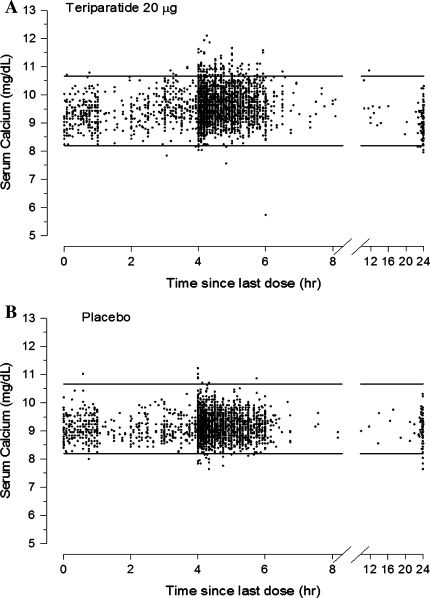
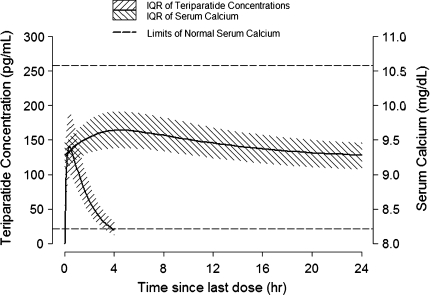
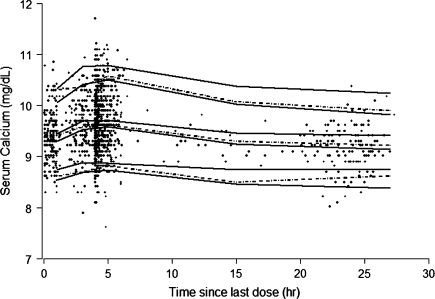
Teriparatide (rhPTH[1-34]) affects calcium metabolism in a pattern consistent with the known actions of endogenous parathyroid hormone (PTH). This report describes the pharmacokinetics and resulting serum calcium response to teriparatide in postmenopausal women with osteoporosis. Pharmacokinetic samples for this analysis were obtained from 360 women who participated in the Fracture Prevention Trial. Postmenopausal women with osteoporosis received daily subcutaneous injections of either teriparatide 20 μg (4.86 μmol) or placebo, median 21 months' treatment. Serum teriparatide and calcium concentrations were measured throughout the study. An indirect-response model was developed to describe the pharmacokinetic-pharmacodynamic relationship between teriparatide concentrations and serum calcium response. The pharmacokinetics of teriparatide were characterized by rapid absorption (maximum concentration achieved within 30 min) and rapid elimination (half-life of 1 h), resulting in a total duration of exposure to the peptide of approximately 4 h. Teriparatide transiently increased serum calcium, with the maximum effect observed at approximately 4.25 h (median increase 0.4 mg/dl [0.1 mmol/l]). Calcium concentrations returned to predose levels by 16-24 h after each dose. Persistent hypercalcemia was not observed; one teriparatide 20 μg-treated patient had a predose serum calcium value above the normal range but <11.0 mg/dl (2.75 mmol/l). Following once-daily subcutaneous administration, teriparatide produces a modest but transient increase in serum calcium, consistent with the known effects of endogenous PTH on mineral metabolism. The excursion in serum calcium is brief, due to the short length of time that teriparatide concentrations are elevated.
特立帕肽(rhPTH[1-34])影响钙代谢的模式与内源性甲状旁腺激素(PTH)的已知作用一致。本报告描述了骨质疏松症绝经后妇女中特立帕肽的药代动力学和由此产生的血清钙反应。本分析的药代动力学样本来自 360 名参加骨折预防试验的妇女。骨质疏松症绝经后妇女每日接受特立帕肽 20μg(4.86μmol)或安慰剂皮下注射,中位数治疗 21 个月。在整个研究过程中测量血清特立帕肽和钙浓度。开发了间接反应模型来描述特立帕肽浓度与血清钙反应之间的药代动力学-药效学关系。特立帕肽的药代动力学特征为快速吸收(30 分钟内达到最大浓度)和快速消除(半衰期 1 小时),导致肽的总暴露时间约为 4 小时。特立帕肽短暂增加血清钙,最大效应约在 4.25 小时观察到(中位数增加 0.4mg/dl[0.1mmol/l])。每次给药后 16-24 小时,钙浓度恢复至给药前水平。未观察到持续性高钙血症;一名特立帕肽 20μg 治疗患者的预剂量血清钙值高于正常范围但<11.0mg/dl[2.75mmol/l]。每日皮下一次给药后,特立帕肽可使血清钙适度但短暂升高,与内源性 PTH 对矿物质代谢的已知作用一致。由于特立帕肽浓度升高的时间很短,因此血清钙的波动时间很短。