Department of Neurology, University of California, San Francisco, CA 94143-0114, USA.
J Neurol. 2011 Mar;258(3):440-8. doi: 10.1007/s00415-010-5775-1. Epub 2010 Oct 16.
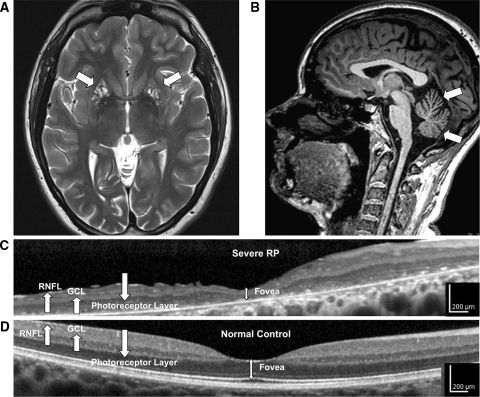
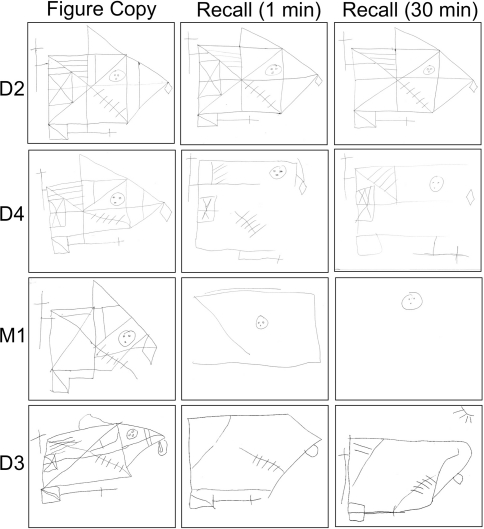
Point mutations at m.8993T>C and m.8993T>G of the mtDNA ATPase 6 gene cause the neurogenic weakness, ataxia and retinitis pigmentosa (NARP) syndrome, a mitochondrial disorder characterized by retinal, central and peripheral neurodegeneration. We performed detailed neurological, neuropsychological and ophthalmological phenotyping of a mother and four daughters with NARP syndrome from the mtDNA m.8993T>C ATPase 6 mutation, including 3-T brain MRI, spectral domain optical coherence tomography (SD-OCT), adaptive optics scanning laser ophthalmoscopy (AOSLO), electromyography and nerve conduction studies (EMG-NCS) and formal neuropsychological testing. The degree of mutant heteroplasmy for the m.8993T>C mutation was evaluated by real-time allele refractory mutation system quantitative PCR of mtDNA from hair bulbs (ectoderm) and blood leukocytes (mesoderm). There were marked phenotypic differences between family members, even between individuals with the greatest degrees of ectodermal and mesodermal heteroplasmy. 3-T MRI revealed cerebellar atrophy and cystic and cavitary T2 hyperintensities in the basal ganglia. SD-OCT demonstrated similarly heterogeneous areas of neuronal and axonal loss in inner and outer retinal layers. AOSLO showed increased cone spacing due to photoreceptor loss. EMG-NCS revealed varying degrees of length-dependent sensorimotor axonal polyneuropathy. On formal neuropsychological testing, there were varying deficits in processing speed, visual-spatial functioning and verbal fluency and high rates of severe depression. Many of these cognitive deficits likely localize to cerebellar and/or basal ganglia dysfunction. High-resolution retinal and brain imaging in NARP syndrome revealed analogous patterns of tissue injury characterized by heterogeneous areas of neuronal loss.
点突变 m.8993T>C 和 m.8993T>G 的 mtDNA 三磷酸腺苷酶 6 基因导致神经肌肉衰弱、共济失调和视网膜色素变性(NARP)综合征,这是一种以视网膜、中枢和周围神经退行性变为特征的线粒体疾病。我们对来自 mtDNA m.8993T>C 三磷酸腺苷酶 6 突变的 NARP 综合征的一位母亲和四位女儿进行了详细的神经学、神经心理学和眼科表型分析,包括 3-T 脑部 MRI、光谱域光学相干断层扫描(SD-OCT)、自适应光学扫描激光检眼镜(AOSLO)、肌电图和神经传导研究(EMG-NCS)和正式的神经心理学测试。通过实时等位基因难治性突变系统定量聚合酶链反应(PCR)评估毛球(外胚层)和血液白细胞(中胚层)mtDNA 中 m.8993T>C 突变的突变异质性程度。家庭成员之间存在明显的表型差异,即使是在具有最大外胚层和中胚层异质性的个体之间也是如此。3-T MRI 显示小脑萎缩和基底节囊性和空洞性 T2 高信号。SD-OCT 显示内、外视网膜层神经元和轴突丧失的类似异质区域。AOSLO 显示由于光感受器丧失,视锥细胞间距增加。EMG-NCS 显示程度不同的长度依赖性感觉运动轴突多发性神经病。在正式的神经心理学测试中,存在不同程度的处理速度、视觉空间功能和词语流畅性缺陷以及严重抑郁的高发生率。许多这些认知缺陷可能定位于小脑和/或基底节功能障碍。NARP 综合征的高分辨率视网膜和脑部成像显示类似的组织损伤模式,其特征是神经元丧失的异质区域。