Department of Biochemistry I - Receptor Biochemistry, Ruhr University Bochum, Universitaetsstrasse 150, D-44780 Bochum, Germany.
BMC Neurosci. 2010 Oct 19;11:133. doi: 10.1186/1471-2202-11-133.
Members of the complex N-methyl-D-aspartate receptor (NMDAR) subfamily of ionotropic glutamate receptors (iGluRs) conventionally assemble from NR1 and NR2 subunits, the composition of which determines receptor properties. Hallmark features of conventional NMDARs include the requirement for a coagonist, voltage-dependent block by Mg2+, and high permeability for Ca2+. Both Mg2+ sensitivity and Ca2+ permeability are critically dependent on the amino acids at the N and N+1 positions of NR1 and NR2. The recently discovered NR3 subunits feature an unprecedented glycine-arginine combination at those critical sites within the pore. Diheteromers assembled from NR1 and NR3 are not blocked by Mg2+ and are not permeable for Ca2+.
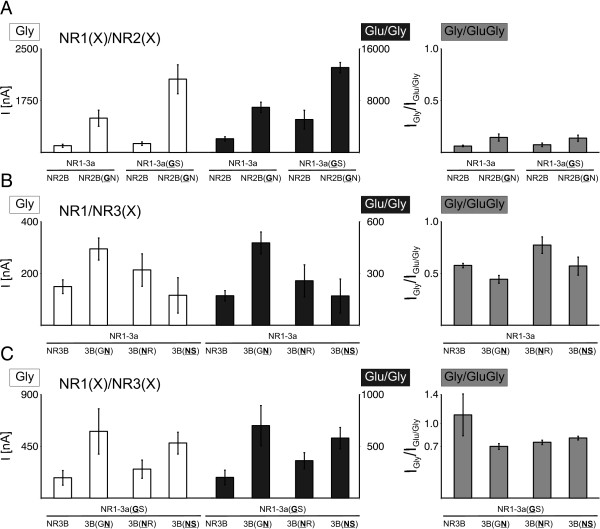
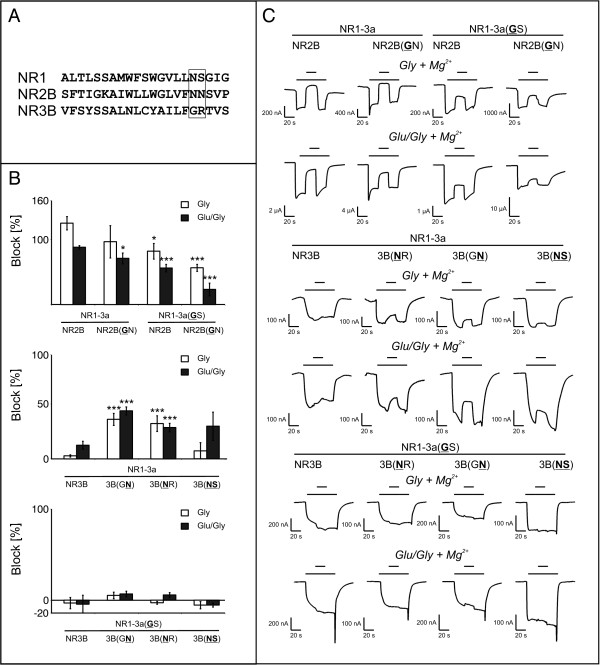
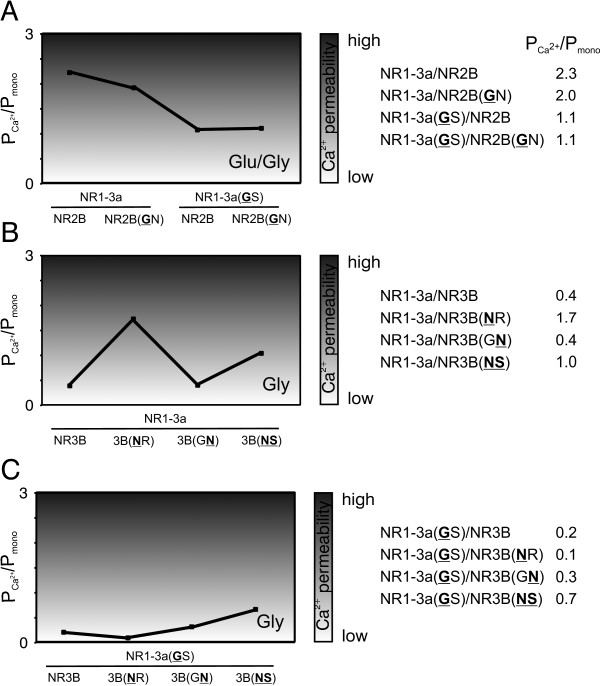
Employing site-directed mutagenesis of receptor subunits, electrophysiological characterization of mutants in a heterologous expression system, and molecular modeling of the NMDAR pore region, we have investigated the contribution of the unusual NR3 N and N+1 site residues to the unique functional characteristics of receptors containing these subunits. Contrary to previous studies, we provide evidence that both the NR3 N and N+1 site amino acids are critically involved in mediating the unique pore properties. Ca2+ permeability could be rescued by mutating the NR3 N site glycine to the NR1-like asparagine. Voltage-dependent Mg2+ block could be established by providing an Mg2+ coordination site at either the NR3 N or N+1 positions. Conversely, "conventional" receptors assembled from NR1 and NR2 could be made Mg2+ insensitive and Ca2+ impermeable by equipping either subunit with the NR3-like glycine at their N positions, with a stronger contribution of the NR1 subunit.
This study sheds light on the structure-function relationship of the least characterized member of the NMDAR subfamily. Contrary to previous reports, we provide evidence for a critical functional involvement of the NR3 N and N+1 site amino acids, and propose them to be the essential determinants for the unique pore properties mediated by this subunit.
离子型谷氨酸受体(iGluRs)的复杂 N-甲基-D-天冬氨酸受体(NMDAR)亚家族成员通常由 NR1 和 NR2 亚基组成,其组成决定了受体的特性。传统 NMDAR 的特征包括需要共激动剂、电压依赖性 Mg2+阻断以及对 Ca2+的高通透性。Mg2+敏感性和 Ca2+通透性都严重依赖于 NR1 和 NR2 的 N 和 N+1 位置的氨基酸。最近发现的 NR3 亚基在孔内的这些关键部位具有前所未有的甘氨酸-精氨酸组合。由 NR1 和 NR3 组成的异二聚体不受 Mg2+阻断,并且对 Ca2+不可渗透。
通过对受体亚基进行定点突变、在异源表达系统中对突变体进行电生理特性表征以及对 NMDAR 孔区进行分子建模,我们研究了这些亚基中不寻常的 NR3 N 和 N+1 位置残基对含有这些亚基的受体的独特功能特性的贡献。与先前的研究相反,我们提供的证据表明,NR3 N 和 N+1 位置的氨基酸都对介导独特的孔特性至关重要。通过将 NR3 N 位置的甘氨酸突变为 NR1 样天冬酰胺,可以恢复 Ca2+通透性。通过在 NR3 N 或 N+1 位置提供 Mg2+ 配位位点,可以建立电压依赖性 Mg2+ 阻断。相反,通过在其 N 位置为每个亚基配备 NR3 样甘氨酸,可以使由 NR1 和 NR2 组装的“传统”受体对 Mg2+不敏感且对 Ca2+不可渗透,NR1 亚基的贡献更强。
本研究揭示了 NMDAR 亚家族中特征最不明显的成员的结构-功能关系。与先前的报告相反,我们提供了证据表明 NR3 N 和 N+1 位置的氨基酸具有关键的功能参与,并提出它们是该亚基介导的独特孔特性的基本决定因素。