Université Victor Segalen Bordeaux 2, Centre National de la Recherche Scientifique, Bordeaux Institute of Neuroscience, UMR 5227, Bordeaux, France.
PLoS One. 2010 Oct 13;5(10):e13306. doi: 10.1371/journal.pone.0013306.
The A11 diencephalospinal pathway is crucial for sensorimotor integration and pain control at the spinal cord level. When disrupted, it is thought to be involved in numerous painful conditions such as restless legs syndrome and migraine. Its anatomical organization, however, remains largely unknown in the non-human primate (NHP). We therefore characterized the anatomy of this pathway in the NHP.
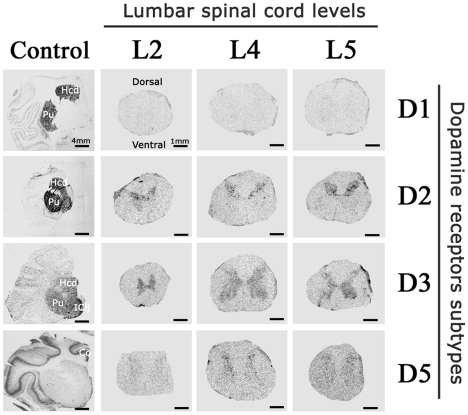
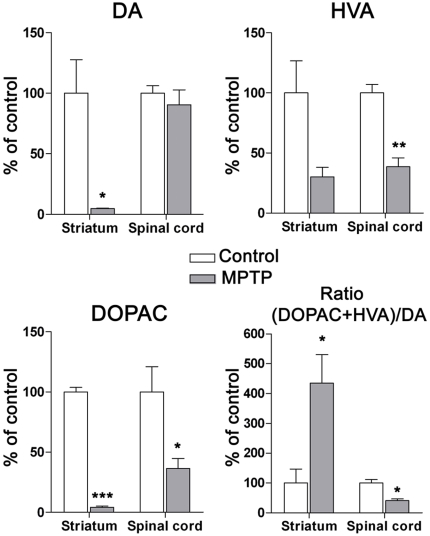
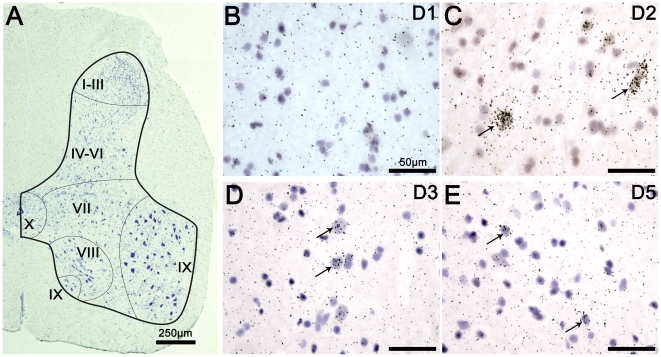
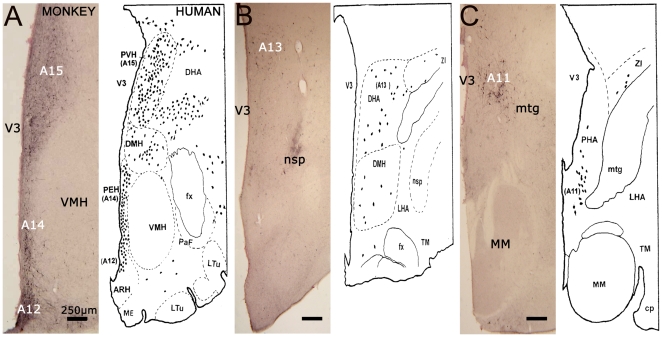
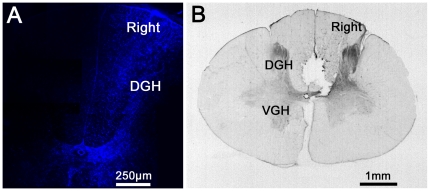
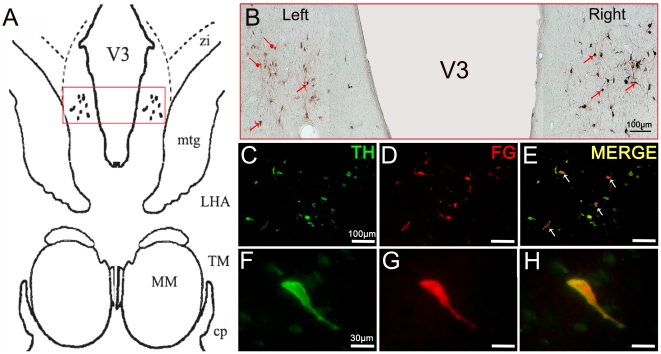
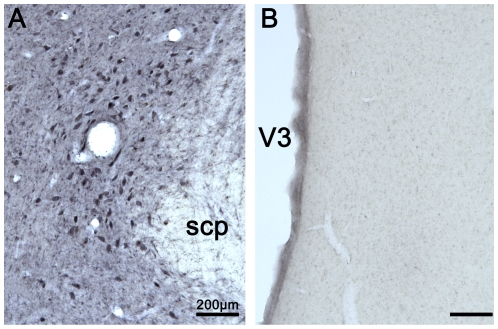
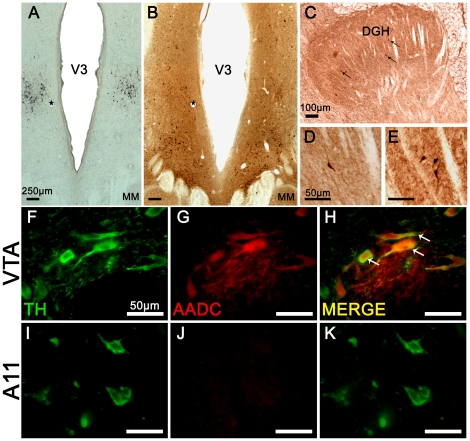
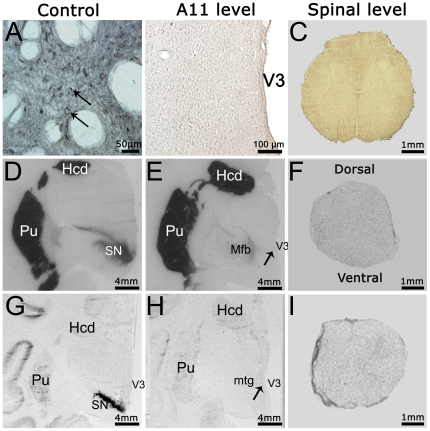
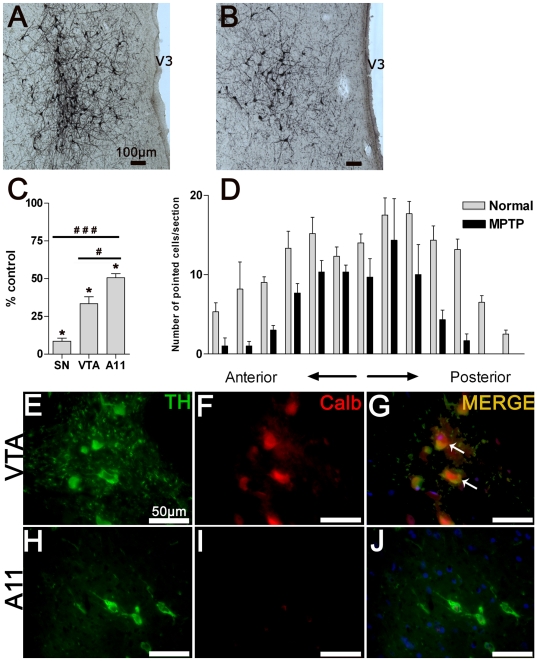
In situ hybridization of spinal dopamine receptors showed that D1 receptor mRNA is absent while D2 and D5 receptor mRNAs are mainly expressed in the dorsal horn and D3 receptor mRNA in both the dorsal and ventral horns. Unilateral injections of the retrograde tracer Fluoro-Gold (FG) into the cervical spinal enlargement labeled A11 hypothalamic neurons quasi-exclusively among dopamine areas. Detailed immunohistochemical analysis suggested that these FG-labeled A11 neurons are tyrosine hydroxylase-positive but dopa-decarboxylase and dopamine transporter-negative, suggestive of a L-DOPAergic nucleus. Stereological cell count of A11 neurons revealed that this group is composed by 4002±501 neurons per side. A 1-methyl-4-phenyl-1, 2, 3, 6-tetrahydropyridine (MPTP) intoxication with subsequent development of a parkinsonian syndrome produced a 50% neuronal cell loss in the A11 group.
The diencephalic A11 area could be the major source of L-DOPA in the NHP spinal cord, where it may play a role in the modulation of sensorimotor integration through D2 and D3 receptors either directly or indirectly via dopamine formation in spinal dopa-decarboxylase-positives cells.
A11 脑-脊髓投射通路对于脊髓水平的感觉运动整合和疼痛控制至关重要。当它被破坏时,被认为与许多疼痛状况有关,如不宁腿综合征和偏头痛。然而,其在非人类灵长类动物(NHP)中的解剖组织仍然知之甚少。因此,我们对该通路在 NHP 中的解剖结构进行了描述。
脊髓多巴胺受体的原位杂交显示,D1 受体 mRNA 缺失,而 D2 和 D5 受体 mRNA 主要在背角表达,D3 受体 mRNA 在背角和腹角均有表达。将逆行示踪剂 Fluoro-Gold(FG)单侧注射到颈脊髓扩张部,仅在多巴胺区域准确定位到 A11 下丘脑神经元。详细的免疫组织化学分析表明,这些 FG 标记的 A11 神经元是酪氨酸羟化酶阳性,但多巴胺脱羧酶和多巴胺转运体阴性,提示为 L-DOPA 能核。A11 神经元的立体学细胞计数显示,该核团由每侧 4002±501 个神经元组成。1-甲基-4-苯基-1,2,3,6-四氢吡啶(MPTP)中毒后出现帕金森综合征,导致 A11 神经元群中有 50%的神经元丧失。
丘脑的 A11 区可能是 NHP 脊髓中 L-DOPA 的主要来源,它可能通过 D2 和 D3 受体直接或通过脊髓 dopa-decarboxylase-阳性细胞中的多巴胺形成间接调节感觉运动整合,从而在其中发挥作用。