Bavarian State Collection of Zoology, Münchhausenstrasse 21, Munich, Germany.
BMC Evol Biol. 2010 Oct 25;10:323. doi: 10.1186/1471-2148-10-323.
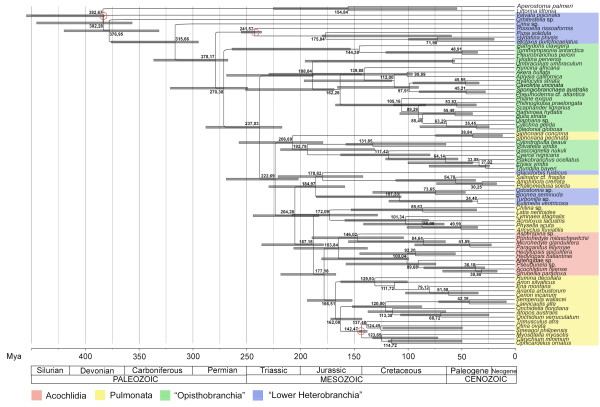
A robust phylogenetic hypothesis of euthyneuran gastropods, as a basis to reconstructing their evolutionary history, is still hindered by several groups of aberrant, more or less worm-like slugs with unclear phylogenetic relationships. As a traditional "order" in the Opisthobranchia, the Acochlidia have a long history of controversial placements, among others influenced by convergent adaptation to the mainly meiofaunal habitats. The present study includes six out of seven acochlidian families in a comprehensive euthyneuran taxon sampling with special focus on minute, aberrant slugs. Since there is no fossil record of tiny, shell-less gastropods, a molecular clock was used to estimate divergence times within Euthyneura.
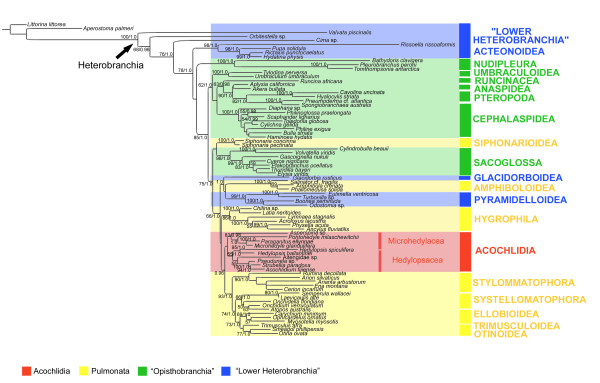
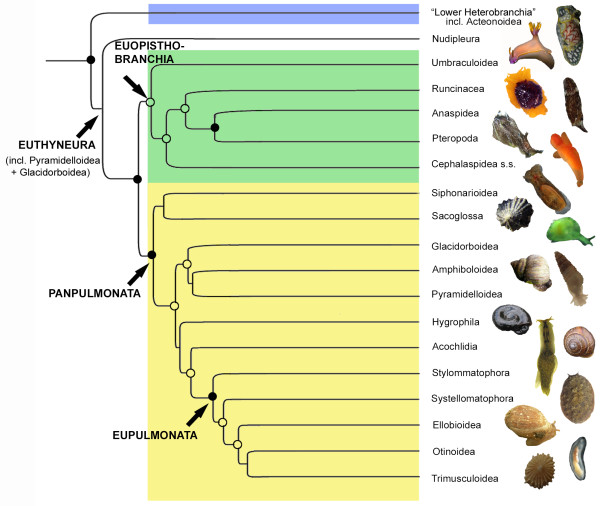
Our multi-locus molecular study confirms Acochlidia in a pulmonate relationship, as sister to Eupulmonata. Previous hypotheses of opisthobranch relations, or of a common origin with other meiofaunal Euthyneura, are clearly rejected. The enigmatic amphibious and insectivorous Aitengidae incerta sedis clusters within Acochlidia, as sister to meiofaunal and brackish Pseudunelidae and limnic Acochlidiidae. Euthyneura, Opisthobranchia and Pulmonata as traditionally defined are non-monophyletic. A relaxed molecular clock approach indicates a late Palaeozoic diversification of Euthyneura and a Mesozoic origin of the major euthyneuran diversity, including Acochlidia.
The present study shows that the inclusion of small, enigmatic groups is necessary to solve deep-level phylogenetic relationships, and underlines that "pulmonate" and "opisthobranch" phylogeny, respectively, cannot be solved independently from each other. Our phylogenetic hypothesis requires reinvestigation of the traditional classification of Euthyneura: morphological synapomorphies of the traditionally defined Pulmonata and Opisthobranchia are evaluated in light of the presented phylogeny, and a redefinition of major groups is proposed. It is demonstrated that the invasion of the meiofaunal habitat has occurred several times independently in various euthyneuran taxa, leading to convergent adaptations previously misinterpreted as synapomorphies. The inclusion of Acochlidia extends the structural and biological diversity in pulmonates, presenting a remarkable flexibility concerning habitat choice.
作为重建其进化历史的基础,真有肺目腹足动物的稳健系统发育假说仍然受到几组异常的、或多或少具有不明确系统发育关系的类似蠕虫的蛞蝓的阻碍。作为后鳃类中的一个传统“目”,翼足目具有长期存在的争议性位置,除其他因素外,还受到主要在中型动物区系栖息地中的趋同适应的影响。本研究包括真有肺目分类群综合取样中的七个翼足目科中的六个,特别关注微小的、异常的蛞蝓。由于没有微小、无壳腹足动物的化石记录,因此使用分子钟来估计真有肺目内部的分歧时间。
我们的多基因座分子研究证实翼足目在有肺类中与肺螺类关系密切,是后鳃类的姊妹群。以前的后鳃类关系假说,或与其他中型动物区系真有肺目具有共同起源的假说,均被明确否定。位置不确定的两栖类和食虫类 Aitengidae incerta sedis 聚类在翼足目内,与中型动物区系和半咸水伪贝类以及淡水翼足目科为姊妹群。传统定义的真有肺目、后鳃类和肺螺类是非单系的。放松的分子钟方法表明,真有肺目的多样化发生在晚古生代,中生代起源了包括翼足目在内的主要真有肺目多样性。
本研究表明,包括小型、神秘的群体对于解决深层次的系统发育关系是必要的,并强调“有肺”和“后鳃”的系统发育分别不能独立于彼此进行。我们的系统发育假说需要重新调查真有肺目的传统分类:根据所提出的系统发育,评估传统定义的肺螺类和后鳃类的形态学共衍征,并提出主要类群的重新定义。本研究表明,中型动物区系栖息地的入侵在各种真有肺目类群中已经独立发生了多次,导致了以前被错误解释为共衍征的趋同适应。翼足目科的纳入扩展了有肺类的结构和生物学多样性,表现出对栖息地选择的显著灵活性。