Paulovich Amanda G, Whiteaker Jeffrey R, Hoofnagle Andrew N, Wang Pei
Fred Hutchinson Cancer Research Center, Seattle, WA, USA.
Proteomics Clin Appl. 2008 Oct 1;2(10-11):1386-1402. doi: 10.1002/prca.200780174.
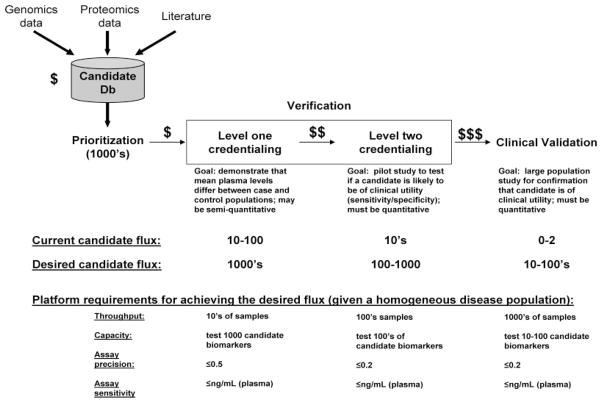
The application of "omics" technologies to biological samples generates hundreds to thousands of biomarker candidates; however, a discouragingly small number make it through the pipeline to clinical use. This is in large part due to the incredible mismatch between the large numbers of biomarker candidates and the paucity of reliable assays and methods for validation studies. We desperately need a pipeline that relieves this bottleneck between biomarker discovery and validation. This paper reviews the requirements for technologies to adequately credential biomarker candidates for costly clinical validation and proposes methods and systems to verify biomarker candidates. Models involving pooling of clinical samples, where appropriate, are discussed. We conclude that current proteomic technologies are on the cusp of significantly affecting translation of molecular diagnostics into the clinic.
将“组学”技术应用于生物样本会产生成百上千个生物标志物候选物;然而,令人沮丧的是,只有极少数能够通过流程进入临床应用。这在很大程度上是由于大量生物标志物候选物与用于验证研究的可靠检测方法和手段的匮乏之间存在惊人的不匹配。我们迫切需要一个能够缓解生物标志物发现与验证之间这一瓶颈的流程。本文回顾了为代价高昂的临床验证充分鉴定生物标志物候选物所需的技术要求,并提出了验证生物标志物候选物的方法和系统。还讨论了在适当情况下涉及临床样本汇集的模型。我们得出结论,当前的蛋白质组学技术正处于显著影响分子诊断向临床转化的关键节点。