Antonets Denis V, Nepomnyashchikh Tatyana S, Shchelkunov Sergei N
State Research Center of Virology and Biotechnology "Vector" Rospotrebnadzor, Novosibirsk region, Koltsovo, Russian Federation.
BMC Res Notes. 2010 Oct 27;3:271. doi: 10.1186/1756-0500-3-271.
Variola virus (VARV) the causative agent of smallpox, eradicated in 1980, have wide spectrum of immunomodulatory proteins to evade host immunity. Recently additional biological activity was discovered for VARV CrmB protein, known to bind and inhibit tumour necrosis factor (TNF) through its N-terminal domain homologous to cellular TNF receptors. Besides binding TNF, this protein was also shown to bind with high affinity several chemokines which recruit B- and T-lymphocytes and dendritic cells to sites of viral entry and replication. Ability to bind chemokines was shown to be associated with unique C-terminal domain of CrmB protein. This domain named SECRET (Smallpox virus-Encoded Chemokine Receptor) is unrelated to the host proteins and lacks significant homology with other known viral chemokine-binding proteins or any other known protein.
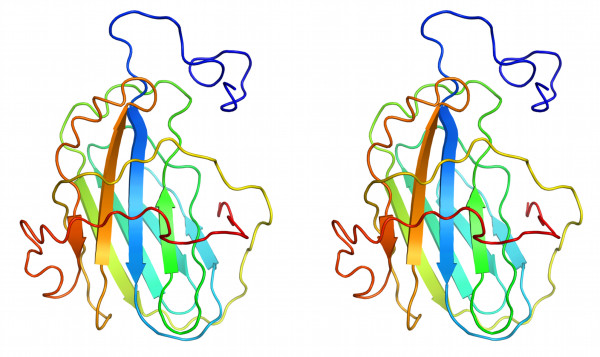
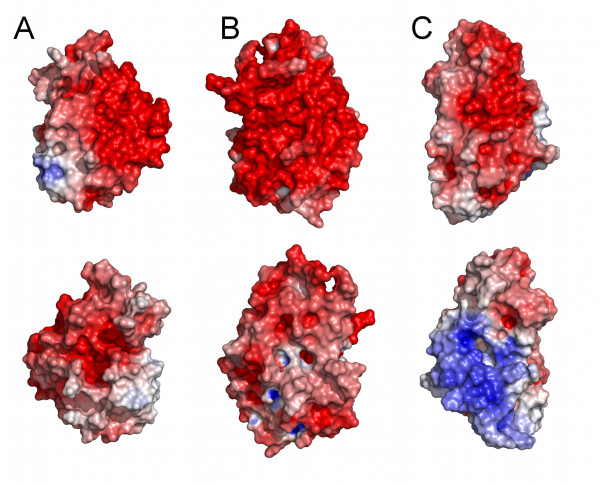
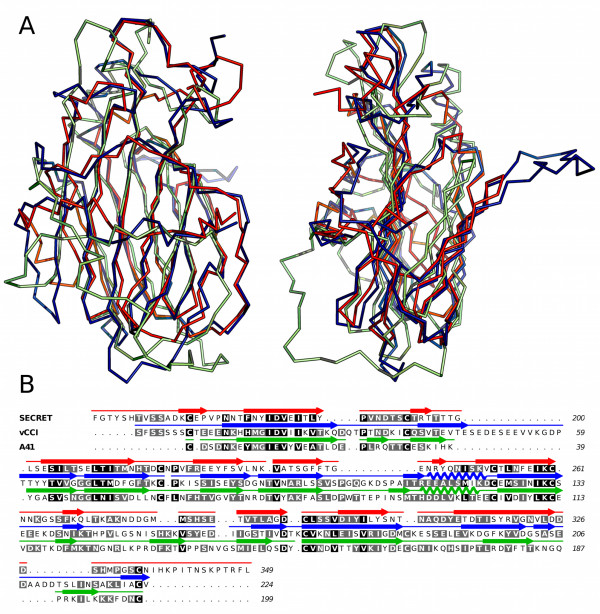
De novo modelling of VARV-CrmB SECRET domain spatial structure revealed its apparent structural homology with cowpox virus CC-chemokine binding protein (vCCI) and vaccinia virus A41 protein, despite low sequence identity between these three proteins. Potential ligand-binding surface of modelled VARV-CrmB SECRET domain was also predicted to bear prominent electronegative charge which is characteristic to known orthopoxviral chemokine-binding proteins.
Our results suggest that SECRET should be included into the family of poxviral type II chemokine-binding proteins and that it might have been evolved from the vCCI-like predecessor protein.
天花病毒(VARV)是天花的病原体,已于1980年被根除,它具有多种免疫调节蛋白以逃避宿主免疫。最近发现VARV CrmB蛋白具有额外的生物学活性,已知该蛋白通过其与细胞肿瘤坏死因子(TNF)受体同源的N端结构域结合并抑制TNF。除了结合TNF外,该蛋白还被证明能与几种趋化因子高亲和力结合,这些趋化因子可将B淋巴细胞、T淋巴细胞和树突状细胞募集到病毒进入和复制的部位。CrmB蛋白独特的C端结构域被证明具有结合趋化因子的能力。这个名为SECRET(天花病毒编码的趋化因子受体)的结构域与宿主蛋白无关,与其他已知的病毒趋化因子结合蛋白或任何其他已知蛋白缺乏显著同源性。
对VARV-CrmB SECRET结构域空间结构的从头建模显示,尽管这三种蛋白之间的序列同一性较低,但它与牛痘病毒CC趋化因子结合蛋白(vCCI)和痘苗病毒A41蛋白具有明显的结构同源性。建模的VARV-CrmB SECRET结构域的潜在配体结合表面也被预测带有显著的负电荷,这是已知正痘病毒趋化因子结合蛋白的特征。
我们的结果表明,SECRET应被纳入痘病毒II型趋化因子结合蛋白家族,并且它可能是从类似vCCI的前体蛋白进化而来的。