Bioinformatics Program, University of Michigan, Ann Arbor, MI 48109, USA.
BMC Med Genomics. 2010 Oct 27;3:49. doi: 10.1186/1755-8794-3-49.
Reactive oxygen species (ROS) are known mediators of cellular damage in multiple diseases including diabetic complications. Despite its importance, no comprehensive database is currently available for the genes associated with ROS.
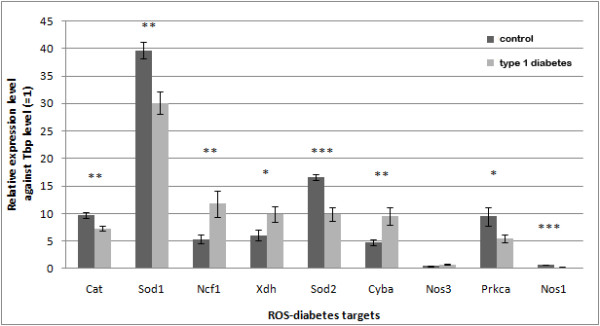
We present ROS- and diabetes-related targets (genes/proteins) collected from the biomedical literature through a text mining technology. A web-based literature mining tool, SciMiner, was applied to 1,154 biomedical papers indexed with diabetes and ROS by PubMed to identify relevant targets. Over-represented targets in the ROS-diabetes literature were obtained through comparisons against randomly selected literature. The expression levels of nine genes, selected from the top ranked ROS-diabetes set, were measured in the dorsal root ganglia (DRG) of diabetic and non-diabetic DBA/2J mice in order to evaluate the biological relevance of literature-derived targets in the pathogenesis of diabetic neuropathy.
SciMiner identified 1,026 ROS- and diabetes-related targets from the 1,154 biomedical papers (http://jdrf.neurology.med.umich.edu/ROSDiabetes/). Fifty-three targets were significantly over-represented in the ROS-diabetes literature compared to randomly selected literature. These over-represented targets included well-known members of the oxidative stress response including catalase, the NADPH oxidase family, and the superoxide dismutase family of proteins. Eight of the nine selected genes exhibited significant differential expression between diabetic and non-diabetic mice. For six genes, the direction of expression change in diabetes paralleled enhanced oxidative stress in the DRG.
Literature mining compiled ROS-diabetes related targets from the biomedical literature and led us to evaluate the biological relevance of selected targets in the pathogenesis of diabetic neuropathy.
活性氧(ROS)是多种疾病包括糖尿病并发症中细胞损伤的已知介质。尽管它很重要,但目前尚无与 ROS 相关的基因的综合数据库。
我们通过文本挖掘技术从生物医学文献中呈现与 ROS 和糖尿病相关的靶标(基因/蛋白质)。应用基于网络的文献挖掘工具 SciMiner,对 PubMed 中索引的 1154 篇与糖尿病和 ROS 相关的生物医学论文进行分析,以识别相关的靶标。通过与随机选择的文献进行比较,获得 ROS-糖尿病文献中过度表达的靶标。为了评估文献中衍生的靶标在糖尿病神经病变发病机制中的生物学相关性,我们在糖尿病和非糖尿病 DBA/2J 小鼠的背根神经节(DRG)中测量了从 ROS-糖尿病排名最高的靶标集中选择的 9 个基因的表达水平。
SciMiner 从 1154 篇生物医学论文中鉴定出 1026 个与 ROS 和糖尿病相关的靶标(http://jdrf.neurology.med.umich.edu/ROSDiabetes/)。与随机选择的文献相比,ROS-糖尿病文献中 53 个靶标显著过度表达。这些过度表达的靶标包括过氧化氢酶、NADPH 氧化酶家族和超氧化物歧化酶家族等氧化应激反应的知名成员。在糖尿病和非糖尿病小鼠之间,所选 9 个基因中有 8 个表现出显著的差异表达。对于 6 个基因,糖尿病中表达变化的方向与 DRG 中氧化应激的增强平行。
文献挖掘从生物医学文献中整理出与 ROS 和糖尿病相关的靶标,并使我们能够评估所选靶标在糖尿病神经病变发病机制中的生物学相关性。