Department of Emergency Medicine and Intensive Care, Jeroen Bosch Ziekenhuis, Tolbrugstraat 11, 5200 ME 's-Hertogenbosch, the Netherlands.
Crit Care. 2010;14(5):R192. doi: 10.1186/cc9309. Epub 2010 Oct 29.
Absolute lymphocytopenia has been reported as a predictor of bacteremia in medical emergencies. Likewise, the neutrophil-lymphocyte count ratio (NLCR) has been shown a simple promising method to evaluate systemic inflammation in critically ill patients.
We retrospectively evaluated the ability of conventional infection markers, lymphocyte count and NLCR to predict bacteremia in adult patients admitted to the Emergency Department with suspected community-acquired bacteremia. The C-reactive protein (CRP) level, white blood cell (WBC) count, neutrophil count, lymphocyte count and NLCR were compared between patients with positive blood cultures (n = 92) and age-matched and gender-matched patients with negative blood cultures (n = 92) obtained upon Emergency Department admission.
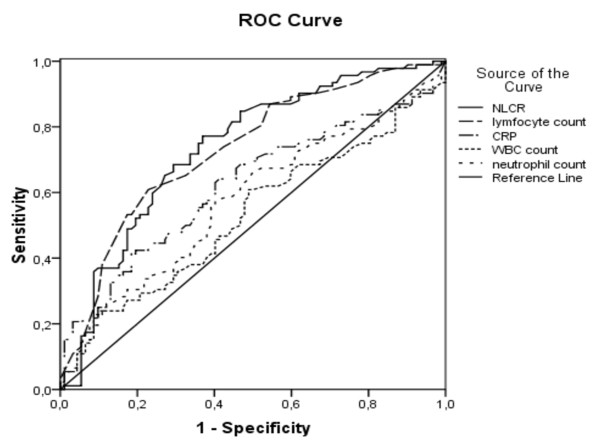
Significant differences between patients with positive and negative blood cultures were detected with respect to the CRP level (mean ± standard deviation 176 ± 138 mg/l vs. 116 ± 103 mg/l; P = 0.042), lymphocyte count (0.8 ± 0.5 × 10⁹/l vs. 1.2 ± 0.7 × 10⁹/l; P < 0.0001) and NLCR (20.9 ± 13.3 vs. 13.2 ± 14.1; P < 0.0001) but not regarding WBC count and neutrophil count. Sensitivity, specificity, positive and negative predictive values were highest for the NLCR (77.2%, 63.0%, 67.6% and 73.4%, respectively). The area under the receiver operating characteristic curve was highest for the lymphocyte count (0.73; confidence interval: 0.66 to 0.80) and the NLCR (0.73; 0.66 to 0.81).
In an emergency care setting, both lymphocytopenia and NLCR are better predictors of bacteremia than routine parameters like CRP level, WBC count and neutrophil count. Attention to these markers is easy to integrate in daily practice and without extra costs.
绝对淋巴细胞减少症已被报道为医学急症中菌血症的预测指标。同样,中性粒细胞与淋巴细胞比值(NLCR)已被证明是一种简单而有前途的方法,可以评估危重症患者的全身炎症。
我们回顾性评估了常规感染标志物、淋巴细胞计数和 NLCR 在疑似社区获得性菌血症的成年患者急诊就诊时预测菌血症的能力。比较了血培养阳性(n=92)和急诊就诊时年龄和性别匹配的血培养阴性(n=92)患者的 C 反应蛋白(CRP)水平、白细胞(WBC)计数、中性粒细胞计数、淋巴细胞计数和 NLCR。
与血培养阴性患者相比,血培养阳性患者的 CRP 水平(均值±标准差 176±138mg/L 比 116±103mg/L;P=0.042)、淋巴细胞计数(0.8±0.5×109/L 比 1.2±0.7×10⁹/L;P<0.0001)和 NLCR(20.9±13.3 比 13.2±14.1;P<0.0001)差异均有统计学意义,但 WBC 计数和中性粒细胞计数差异无统计学意义。NLCR 的敏感性、特异性、阳性预测值和阴性预测值最高(分别为 77.2%、63.0%、67.6%和 73.4%)。淋巴细胞计数(0.73;95%置信区间:0.66 至 0.80)和 NLCR(0.73;0.66 至 0.81)的受试者工作特征曲线下面积最高。
在急诊环境中,淋巴细胞减少症和 NLCR 比 CRP 水平、WBC 计数和中性粒细胞计数等常规参数更能预测菌血症。关注这些标志物易于整合到日常实践中,且无额外费用。