Division of Pathophysiological and Experimental Pathology, Department of Pathology, Graduate School of Medical Sciences, Kyushu University, Fukuoka, Japan.
Mol Cancer. 2010 Oct 31;9:287. doi: 10.1186/1476-4598-9-287.
Podoplanin, a mucin-like transmembrane glycoprotein, is reportedly expressed in a variety of malignant cells and is generally regarded as a factor for promoting tumor progression in conventional studies. By contrast, a clinicopathologically conflicting role for podoplanin, namely as a favorable prognostic factor for patients with lung/cervical squamous cell carcinoma (SCC), has recently been reported. Here, we investigated the role of podoplanin expressed in lung squamoid cancer cells (LSCCs) in experimental tumor progression.
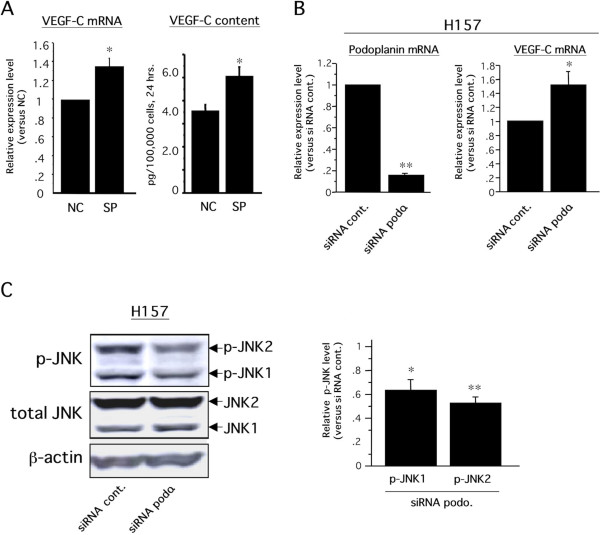
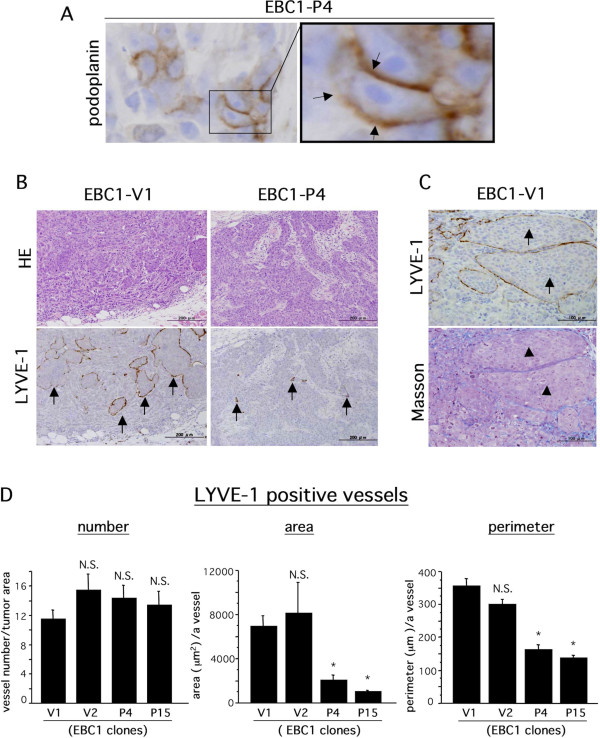
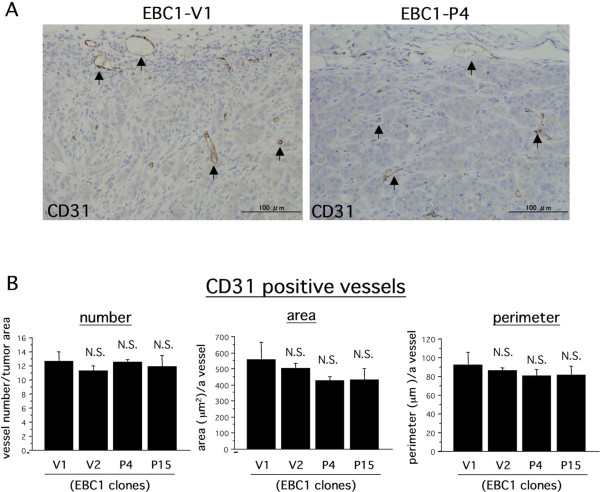
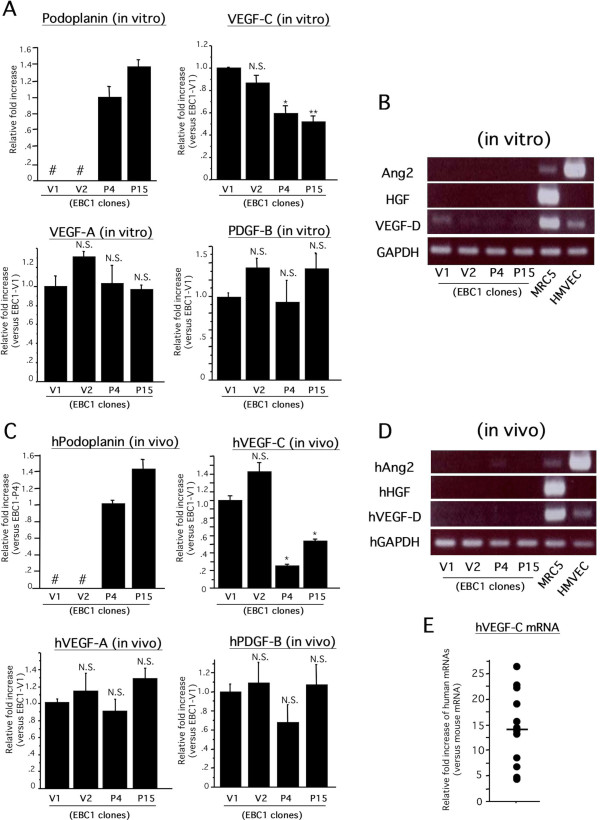
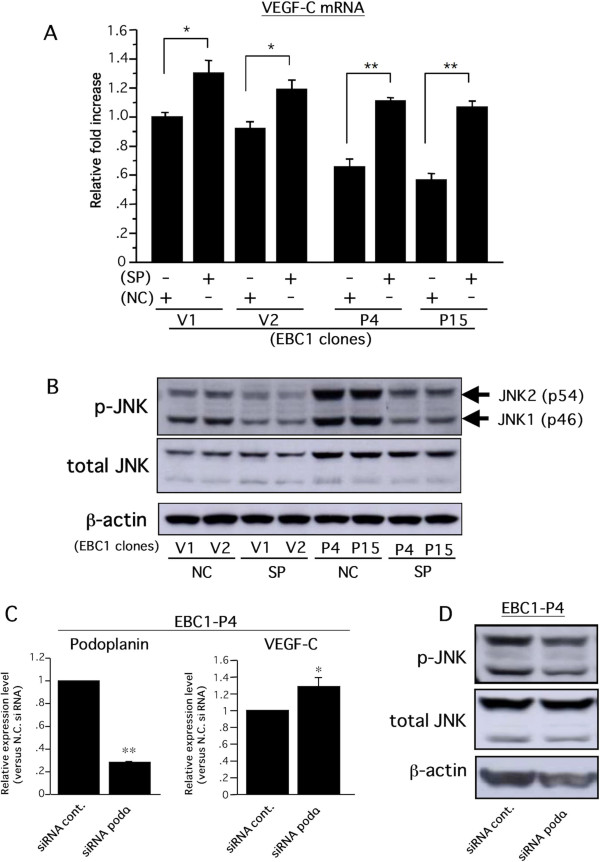
Using EBC-1 cells, a lung SCC cell line without podoplanin expression and with lymphogenous metastatic potential, stable transformants with or without an exogenous human podoplanin gene were established and applied to a mouse tumor implantation model. In vivo examinations revealed that exogenous podoplanin had no influence on tumor growth, whereas it significantly restrained axillary lymph node metastasis associated with the suppression of lymphangiogenesis but not angiogenesis and with the downregulation of EBC-1-derived VEGF-C but not other lymphangiogenesis-related factor mRNAs in implanted tumor tissue. In vitro examinations to clarify the mechanisms underlying the in vivo phenomena revealed that exogenous podoplanin significantly suppressed the expression of VEGF-C mRNA and of the protein, and also increased the level of phosphorylated c-jun N terminal kinase (JNK) in EBC-1 cells. The former effect of exogenous podoplanin was impaired by treatment with either JNK inhibitor sp600125 or podoplanin-siRNA, and the latter effect was impaired by treatment with podoplanin-siRNA, suggesting that podoplanin was able to activate JNK, thereby downregulating VEGF-C gene expression in LSCCs (podoplanin-JNK-VEGF-C axis). Furthermore, supporting evidence in regard to the axis present in LSCCs was obtained from similar experiments using H157 cells, another lung SCC cell line expressing endogenous podoplanin.
Our findings suggested that LSCC-associated podoplanin was functional and could attenuate the potential for lymph node metastasis, possibly based on the suppression of tumor lymphangiogenesis; thus, podoplanin in cancer cells may become a useful biomarker to measure the malignancy of lung SCC.
Podoplanin 是一种黏蛋白样跨膜糖蛋白,据报道在多种恶性细胞中表达,通常被认为是促进常规研究中肿瘤进展的因素。相比之下,最近有报道称,Podoplanin 在临床病理上具有冲突的作用,即作为肺/宫颈鳞状细胞癌 (SCC) 患者的有利预后因素。在这里,我们研究了在实验肿瘤进展中表达于肺鳞癌细胞 (LSCCs) 中的 Podoplanin 的作用。
使用缺乏 Podoplanin 表达且具有淋巴转移潜力的肺 SCC 细胞系 EBC-1,建立了具有或不具有外源性人 Podoplanin 基因的稳定转化体,并将其应用于小鼠肿瘤植入模型。体内检查表明,外源性 Podoplanin 对肿瘤生长没有影响,但显著抑制了与淋巴管生成抑制而非血管生成相关的腋窝淋巴结转移,并下调了植入肿瘤组织中 EBC-1 衍生的 VEGF-C 但不影响其他淋巴管生成相关因子 mRNAs。为了阐明体内现象的机制,进行了体外检查,结果表明外源性 Podoplanin 显著抑制了 VEGF-C mRNA 和蛋白质的表达,并增加了 EBC-1 细胞中磷酸化 c-jun N 末端激酶 (JNK) 的水平。外源性 Podoplanin 的前一作用可被 JNK 抑制剂 sp600125 或 Podoplanin-siRNA 处理所破坏,后一作用可被 Podoplanin-siRNA 处理所破坏,这表明 Podoplanin 能够激活 JNK,从而下调 LSCCs 中的 VEGF-C 基因表达(Podoplanin-JNK-VEGF-C 轴)。此外,使用另一种表达内源性 Podoplanin 的肺 SCC 细胞系 H157 进行的类似实验提供了该轴存在于 LSCCs 中的证据。
我们的发现表明,与 LSCC 相关的 Podoplanin 具有功能,能够减弱淋巴结转移的潜力,可能基于肿瘤淋巴管生成的抑制;因此,癌细胞中的 Podoplanin 可能成为衡量肺 SCC 恶性程度的有用生物标志物。