Department of Pathology and Laboratory Medicine, Boston University School of Medicine, Boston, MA 02118, USA.
J Immunol. 2010 Dec 1;185(11):6930-8. doi: 10.4049/jimmunol.1002300. Epub 2010 Nov 1.
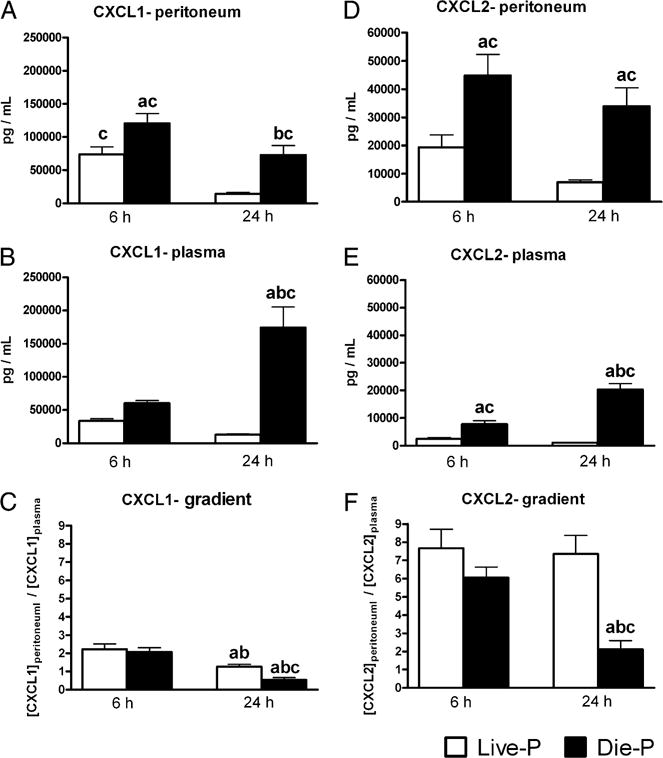
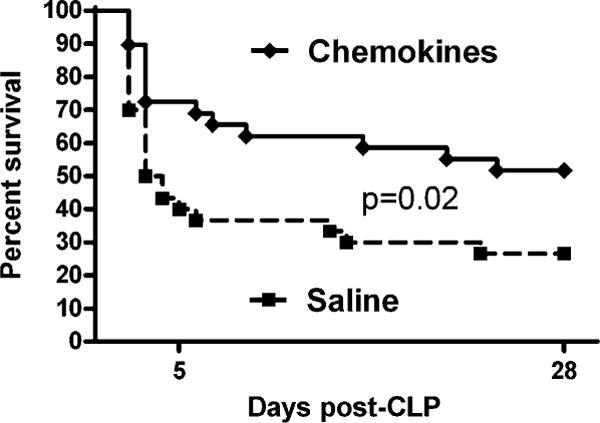
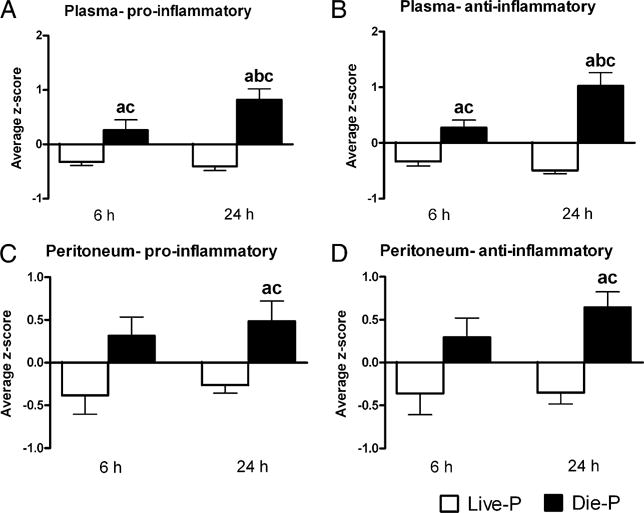
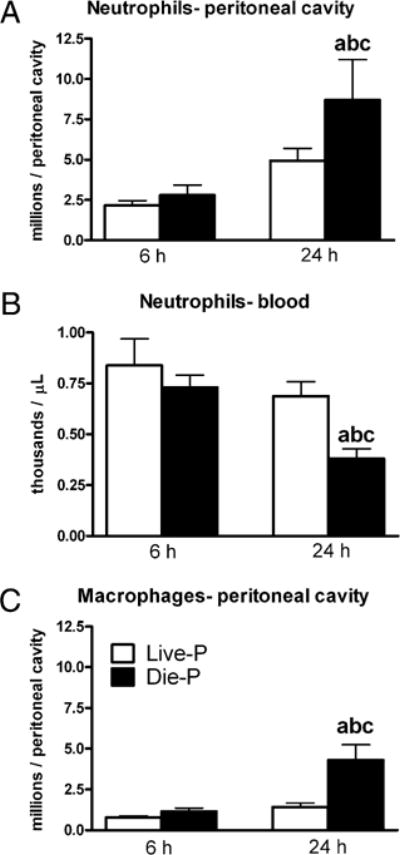
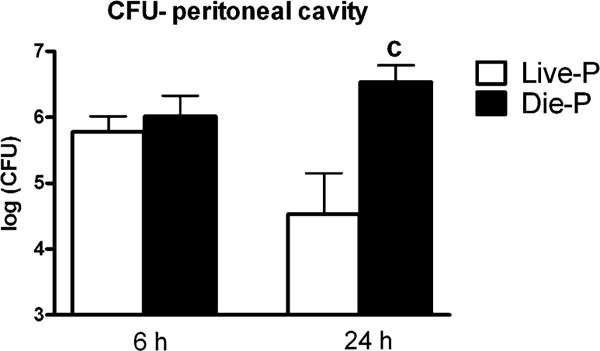
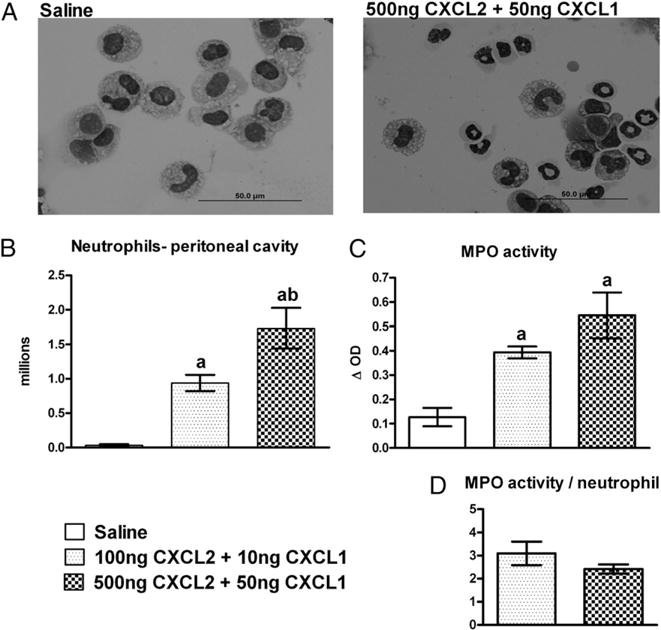
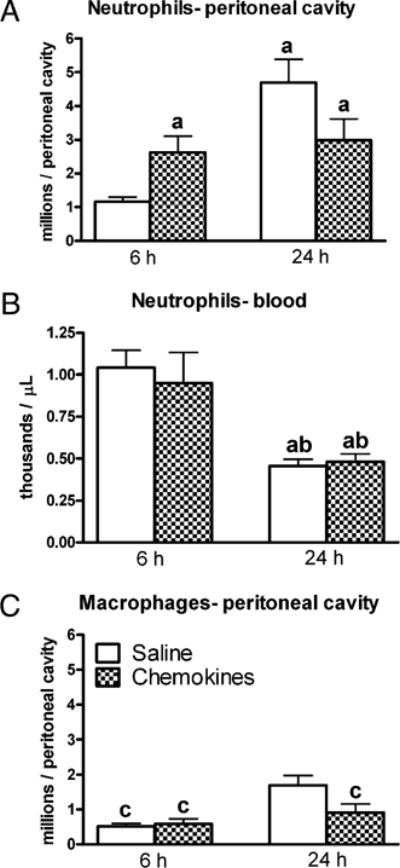
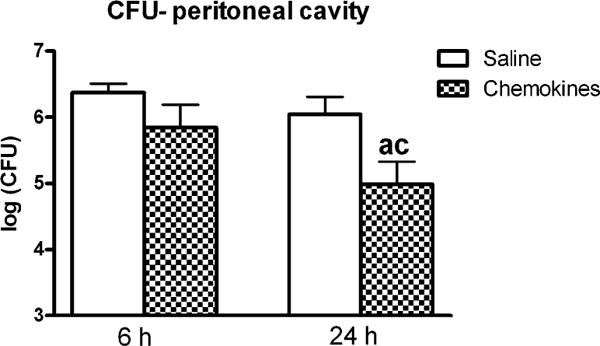
Neutrophils are critical for the rapid eradication of bacterial pathogens, but they also contribute to the development of multiple organ failure in sepsis. We hypothesized that increasing early recruitment of neutrophils to the focus of infection will increase bacterial clearance and improve survival. Sepsis was induced in mice, using cecal ligation and puncture (CLP); blood samples were collected at 6 and 24 h; and survival was followed for 28 d. In separate experiments, peritoneal bacteria and inflammatory cells were measured. Septic mice predicted to die based on IL-6 levels (Die-P) had higher concentrations of CXCL1 and CXCL2 in the peritoneum and plasma compared with those predicted to live (Live-P). At 6 h, Live-P and Die-P had equivalent numbers of peritoneal neutrophils and bacteria. In Die-P mice the number of peritoneal bacteria increased between 6 and 24 h post-CLP, whereas in Live-P it decreased. The i.p. injection of CXCL1 and CXCL2 in naive mice resulted in local neutrophil recruitment. When given immediately after CLP, CXC chemokines increased peritoneal neutrophil recruitment at 6 h after CLP. This early increase in neutrophils induced by exogenous chemokines resulted in significantly fewer peritoneal bacteria by 24 h [CFU (log) = 6.04 versus 4.99 for vehicle versus chemokine treatment; p < 0.05]. Chemokine treatment significantly improved survival at both 5 d (40 versus 72%) and 28 d (27 versus 52%; p < 0.02 vehicle versus chemokines). These data demonstrate that early, local treatment with CXC chemokines enhances neutrophil recruitment and clearance of bacteria as well as improves survival in the CLP model of sepsis.
中性粒细胞对于迅速消除细菌病原体至关重要,但它们也会导致脓毒症多器官衰竭的发展。我们假设,增加中性粒细胞向感染灶的早期募集将增加细菌清除率并提高存活率。使用盲肠结扎和穿孔术(CLP)在小鼠中诱导败血症;在 6 小时和 24 小时采集血液样本;并随访 28 天。在单独的实验中,测量了腹膜内细菌和炎症细胞。根据白细胞介素 6 水平(死亡预测)预测死亡的败血症小鼠腹膜中和血浆中的 CXCL1 和 CXCL2 浓度较高,与预测存活的小鼠(存活预测)相比。在 6 小时时,存活预测和死亡预测的腹膜中性粒细胞和细菌数量相等。在死亡预测小鼠中,腹膜内细菌数量在 CLP 后 6 至 24 小时之间增加,而在存活预测中则减少。在未感染的小鼠中,腹腔内注射 CXCL1 和 CXCL2 会导致局部中性粒细胞募集。在 CLP 后立即给予时,CXC 趋化因子会增加 CLP 后 6 小时的腹膜中性粒细胞募集。这种由外源性趋化因子诱导的早期中性粒细胞增加导致 24 小时时腹膜内细菌数量明显减少[CFU(对数)= 6.04 与载体相比为 4.99 与趋化因子治疗;p <0.05]。趋化因子治疗在第 5 天(40 与 72%;p <0.02 与载体相比)和第 28 天(27 与 52%;p <0.02 与载体相比)显著提高了存活率。这些数据表明,早期局部使用 CXC 趋化因子可增强中性粒细胞募集和清除细菌,并改善 CLP 模型中败血症的存活率。