Oncohematology Laboratory, Department of Pediatrics, University of Padova, Padova, Italy.
PLoS One. 2010 Oct 21;5(10):e13552. doi: 10.1371/journal.pone.0013552.
In spite of leukemia therapy improvements obtained over the last decades, therapy is not yet effective in all cases. Current approaches in Acute Lymphoblastic Leukemia (ALL) research focus on identifying new molecular targets to improve outcome for patients with a dismal prognosis. In this light phosphoproteomics seems to hold great promise for the identification of proteins suitable for targeted therapy.
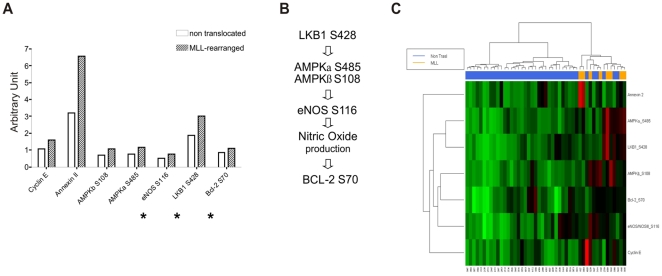
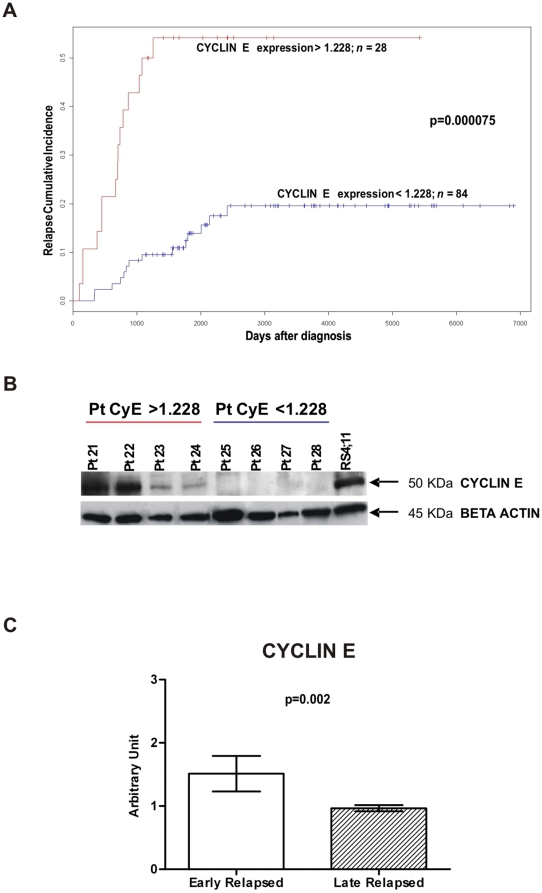
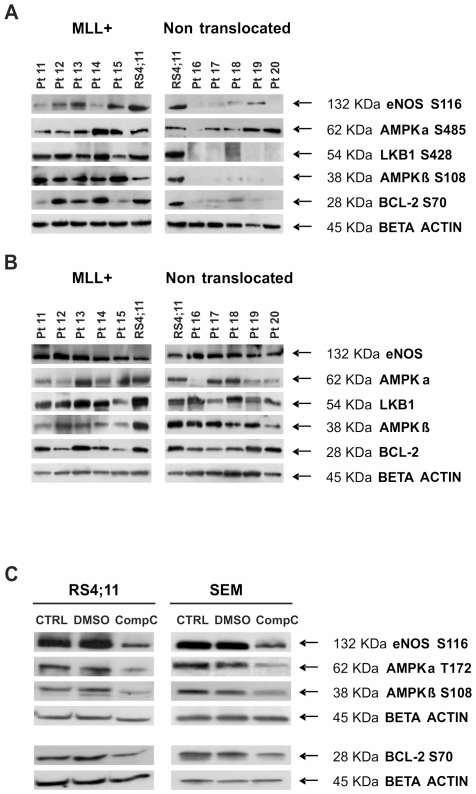
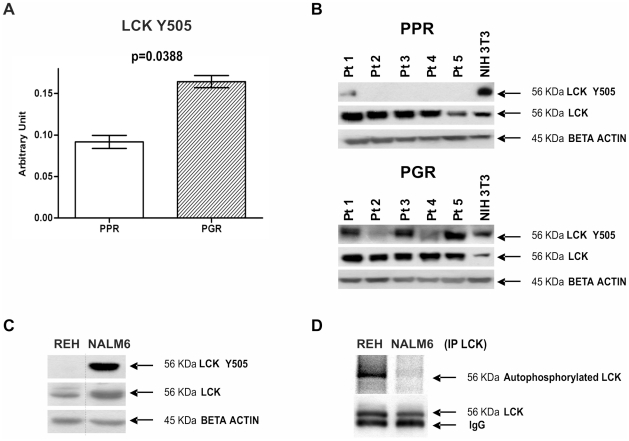
METHODOLOGY/PRINCIPAL FINDINGS: We employed Reverse Phase Protein Microarrays to identify aberrantly activated proteins in 118 pediatric B-cell precursor (BCP)-ALL patients. Signal transduction pathways were assayed for activation/expression status of 92 key signalling proteins. We observed an increased activation/expression of several pathways involved in cell proliferation in poor clinical prognosis patients. MLL-rearranged tumours revealed BCL-2 hyperphosphorylation through AMPK activation, which indicates that AMPK could provide a functional role in inhibiting apoptosis in MLL-rearranged patients, and could be considered as a new potential therapeutic target. Second, in patients with poor clinical response to prednisone we observed the up-modulation of LCK activity with respect to patients with good response. This tyrosine-kinase can be down-modulated with clinically used inhibitors, thus modulating LCK activity could be considered for further studies as a new additional therapy for prednisone-resistant patients. Further we also found an association between high levels of CYCLIN E and relapse incidence. Moreover, CYCLIN E is more expressed in early relapsed patients, who usually show an unfavourable prognosis.
CONCLUSIONS/SIGNIFICANCE: We conclude that functional protein pathway activation mapping revealed specific deranged signalling networks in BCP-ALL that could be potentially modulated to produce a better clinical outcome for patients resistant to standard-of-care therapies.
尽管过去几十年中白血病治疗取得了进展,但并非所有病例的治疗都有效。目前急性淋巴细胞白血病(ALL)研究的方法侧重于确定新的分子靶标,以改善预后不良患者的治疗效果。在这方面,磷酸化蛋白质组学似乎为鉴定适合靶向治疗的蛋白质提供了很大的希望。
方法/主要发现:我们使用反相蛋白微阵列鉴定了 118 例儿科 B 细胞前体(BCP)-ALL 患者中异常激活的蛋白质。测定了 92 种关键信号蛋白的信号转导途径的激活/表达状态。我们观察到,在临床预后不良的患者中,参与细胞增殖的几条信号通路的激活/表达增加。MLL 重排肿瘤通过 AMPK 激活显示出 BCL-2 的过度磷酸化,这表明 AMPK 可以在 MLL 重排患者中抑制细胞凋亡,从而发挥功能作用,并且可以被认为是一个新的潜在治疗靶点。其次,在对泼尼松反应不良的患者中,与对泼尼松反应良好的患者相比,我们观察到 LCK 活性的上调。这种酪氨酸激酶可以用临床使用的抑制剂下调,因此,调节 LCK 活性可以被认为是对泼尼松耐药患者的进一步研究的新的附加治疗方法。此外,我们还发现高水平的细胞周期蛋白 E 与复发率之间存在关联。此外,细胞周期蛋白 E 在早期复发患者中表达更高,这些患者通常预后不良。
我们的结论是,功能蛋白途径激活图谱揭示了 BCP-ALL 中特定的失调信号网络,这些网络可能可以被调节,从而为对标准治疗耐药的患者提供更好的临床结果。