Program in Biomedical Informatics, Stanford University School of Medicine, Stanford, CA 94305, USA.
BMC Bioinformatics. 2010 Oct 28;11 Suppl 9(Suppl 9):S4. doi: 10.1186/1471-2105-11-S9-S4.
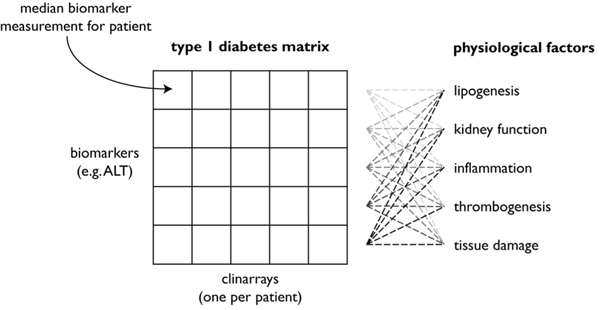
Diagnosis and treatment of patients in the clinical setting is often driven by known symptomatic factors that distinguish one particular condition from another. Treatment based on noticeable symptoms, however, is limited to the types of clinical biomarkers collected, and is prone to overlooking dysfunctions in physiological factors not easily evident to medical practitioners. We used a vector-based representation of patient clinical biomarkers, or clinarrays, to search for latent physiological factors that underlie human diseases directly from clinical laboratory data. Knowledge of these factors could be used to improve assessment of disease severity and help to refine strategies for diagnosis and monitoring disease progression.
Applying Independent Component Analysis on clinarrays built from patient laboratory measurements revealed both known and novel concomitant physiological factors for asthma, types 1 and 2 diabetes, cystic fibrosis, and Duchenne muscular dystrophy. Serum sodium was found to be the most significant factor for both type 1 and type 2 diabetes, and was also significant in asthma. TSH3, a measure of thyroid function, and blood urea nitrogen, indicative of kidney function, were factors unique to type 1 diabetes respective to type 2 diabetes. Platelet count was significant across all the diseases analyzed.
The results demonstrate that large-scale analyses of clinical biomarkers using unsupervised methods can offer novel insights into the pathophysiological basis of human disease, and suggest novel clinical utility of established laboratory measurements.
临床环境中患者的诊断和治疗通常由可区分特定病症的已知症状因素驱动。然而,基于明显症状的治疗仅限于所收集的临床生物标志物类型,并且容易忽略医学从业者不易察觉的生理因素功能障碍。我们使用基于向量的患者临床生物标志物表示形式(即 clinarrays),直接从临床实验室数据中搜索潜在的生理因素,这些因素是导致人类疾病的基础。了解这些因素可以帮助提高对疾病严重程度的评估,并有助于完善诊断和监测疾病进展的策略。
应用独立成分分析(ICA)对从患者实验室测量值构建的 clinarrays 进行分析,揭示了哮喘、1 型和 2 型糖尿病、囊性纤维化和杜氏肌营养不良症的已知和新的伴随生理因素。血清钠被发现是 1 型和 2 型糖尿病的最重要因素,在哮喘中也具有重要意义。TSH3(甲状腺功能的衡量指标)和血尿素氮(指示肾功能)是 1 型糖尿病特有的因素,与 2 型糖尿病不同。血小板计数在所有分析的疾病中均具有显著意义。
研究结果表明,使用无监督方法对临床生物标志物进行大规模分析,可以为人类疾病的病理生理基础提供新的见解,并提示现有实验室测量具有新的临床应用价值。