Department of Genetics, University of Leicester, Leicester LE1 7RH, United Kingdom.
J Biol Chem. 2011 Jan 7;286(1):410-9. doi: 10.1074/jbc.M110.101527. Epub 2010 Nov 2.
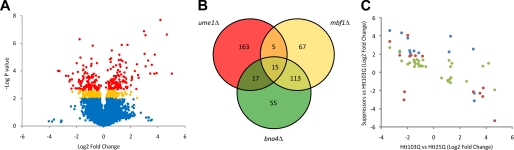
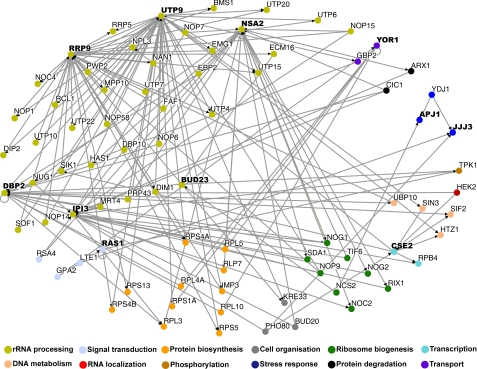
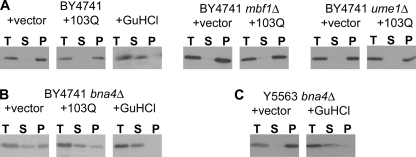
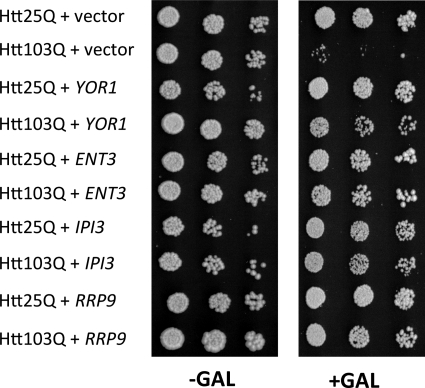
Huntington disease (HD) is a neurodegenerative disorder caused by the expansion of a polyglutamine tract in the huntingtin (htt) protein. To uncover candidate therapeutic targets and networks involved in pathogenesis, we integrated gene expression profiling and functional genetic screening to identify genes critical for mutant htt toxicity in yeast. Using mRNA profiling, we have identified genes differentially expressed in wild-type yeast in response to mutant htt toxicity as well as in three toxicity suppressor strains: bna4Δ, mbf1Δ, and ume1Δ. BNA4 encodes the yeast homolog of kynurenine 3-monooxygenase, a promising drug target for HD. Intriguingly, despite playing diverse cellular roles, these three suppressors share common differentially expressed genes involved in stress response, translation elongation, and mitochondrial transport. We then systematically tested the ability of the differentially expressed genes to suppress mutant htt toxicity when overexpressed and have thereby identified 12 novel suppressors, including genes that play a role in stress response, Golgi to endosome transport, and rRNA processing. Integrating the mRNA profiling data and the genetic screening data, we have generated a robust network that shows enrichment in genes involved in rRNA processing and ribosome biogenesis. Strikingly, these observations implicate dysfunction of translation in the pathology of HD. Recent work has shown that regulation of translation is critical for life span extension in Drosophila and that manipulation of this process is protective in Parkinson disease models. In total, these observations suggest that pharmacological manipulation of translation may have therapeutic value in HD.
亨廷顿病(HD)是一种神经退行性疾病,由亨廷顿蛋白(htt)中多聚谷氨酰胺链的扩展引起。为了揭示涉及发病机制的候选治疗靶点和网络,我们整合了基因表达谱和功能遗传筛选,以鉴定在酵母中对突变 htt 毒性至关重要的基因。通过 mRNA 谱分析,我们已经确定了在野生型酵母中响应突变 htt 毒性以及在三种毒性抑制菌株 bna4Δ、mbf1Δ 和 ume1Δ 中差异表达的基因。BNA4 编码酵母色氨酸 3-单加氧酶的同源物,这是 HD 的一个有前途的药物靶点。有趣的是,尽管这些抑制子发挥着不同的细胞作用,但它们具有共同的差异表达基因,这些基因涉及应激反应、翻译延伸和线粒体运输。然后,我们系统地测试了差异表达基因在过表达时抑制突变 htt 毒性的能力,从而鉴定出 12 个新的抑制子,包括参与应激反应、高尔基体到内体运输和 rRNA 加工的基因。整合 mRNA 谱分析数据和遗传筛选数据,我们生成了一个稳健的网络,该网络显示在参与 rRNA 加工和核糖体生物发生的基因中富集。引人注目的是,这些观察结果表明翻译功能障碍与 HD 的病理学有关。最近的工作表明,翻译的调节对果蝇寿命的延长至关重要,并且该过程的操纵在帕金森病模型中具有保护作用。总的来说,这些观察结果表明,翻译的药理学操纵在 HD 中可能具有治疗价值。