Department of Genetics and Biochemistry, Clemson University, Clemson, SC 29634, USA.
BMC Genomics. 2010 Nov 2;11 Suppl 2(Suppl 2):S15. doi: 10.1186/1471-2164-11-S2-S15.
Microarray gene expression data are accumulating in public databases. The expression profiles contain valuable information for understanding human gene expression patterns. However, the effective use of public microarray data requires integrating the expression profiles from heterogeneous sources.
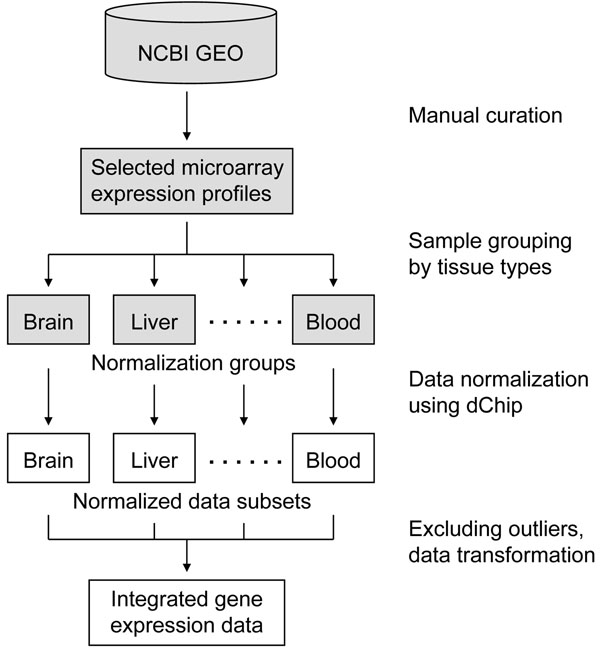
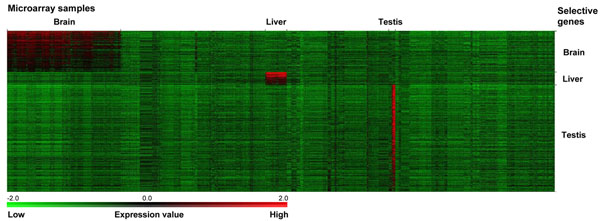
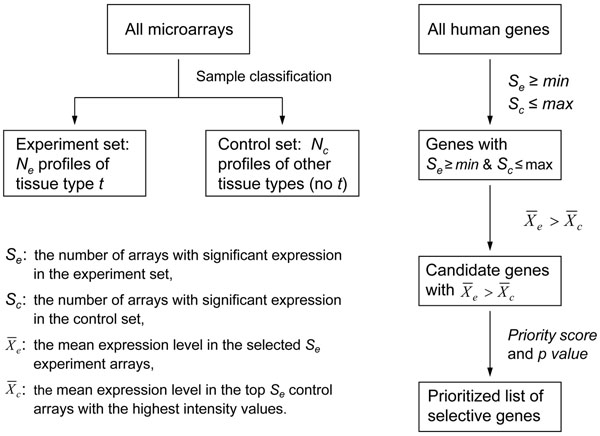
In this study, we have compiled a compendium of microarray expression profiles of various human tissue samples. The microarray raw data generated in different research laboratories have been obtained and combined into a single dataset after data normalization and transformation. To demonstrate the usefulness of the integrated microarray data for studying human gene expression patterns, we have analyzed the dataset to identify potential tissue-selective genes. A new method has been proposed for genome-wide identification of tissue-selective gene targets using both microarray intensity values and detection calls. The candidate genes for brain, liver and testis-selective expression have been examined, and the results suggest that our approach can select some interesting gene targets for further experimental studies.
A computational approach has been developed in this study for combining microarray expression profiles from heterogeneous sources. The integrated microarray data can be used to investigate tissue-selective expression patterns of human genes.
微阵列基因表达数据正在公共数据库中积累。这些表达谱包含了理解人类基因表达模式的有价值的信息。然而,要有效利用公共微阵列数据,需要整合来自不同来源的表达谱。
在这项研究中,我们编制了一份各种人类组织样本的微阵列表达谱摘要。在数据归一化和转换后,从不同研究实验室生成的微阵列原始数据被获取并组合成一个单一的数据集。为了展示整合微阵列数据对于研究人类基因表达模式的有用性,我们已经分析了数据集以识别潜在的组织特异性基因。提出了一种新的方法,用于使用微阵列强度值和检测调用来进行全基因组识别组织特异性基因靶标。已经检查了脑、肝和睾丸选择性表达的候选基因,结果表明我们的方法可以选择一些有趣的基因靶标进行进一步的实验研究。
在这项研究中,开发了一种用于整合来自不同来源的微阵列表达谱的计算方法。整合的微阵列数据可用于研究人类基因的组织特异性表达模式。