Brain Trauma Research Center, Department of Neurosurgery, University of Pittsburgh, 3434 Fifth Ave, Suite 201, Pittsburgh, PA 15260, USA.
Brain Res. 2011 Jan 19;1369:208-15. doi: 10.1016/j.brainres.2010.10.096. Epub 2010 Nov 1.
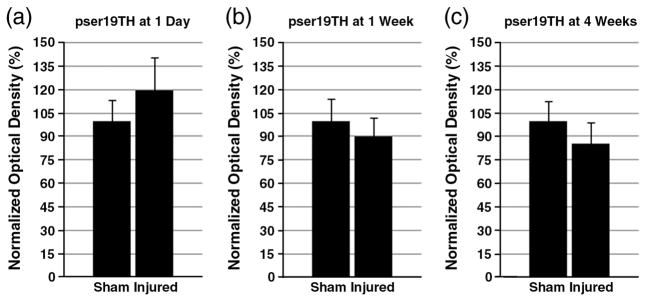
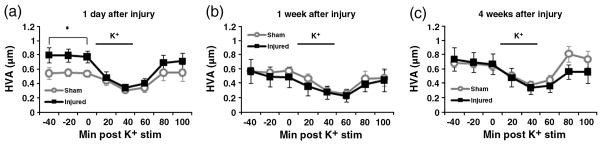
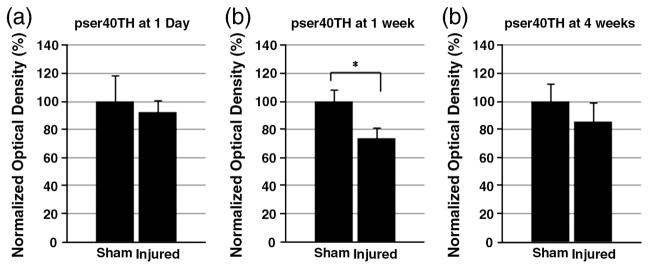
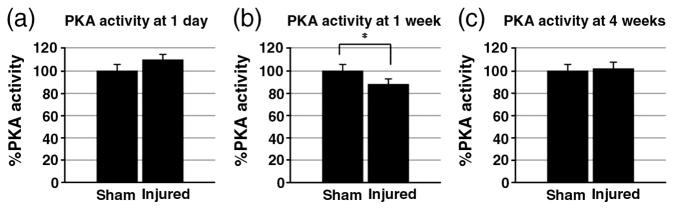
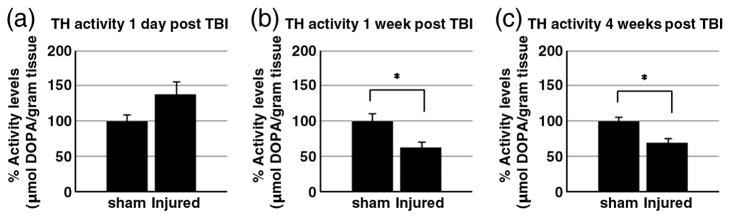
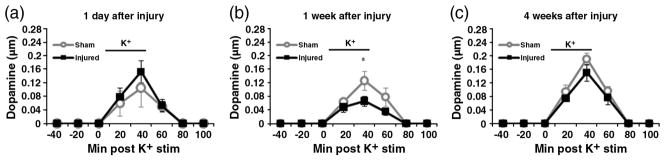
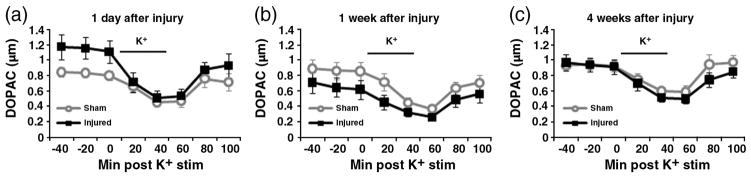
There is increasing evidence that traumatic brain injury (TBI) induces hypofunction of the striatal dopaminergic system, the mechanisms of which are unknown. In this study, we analyzed the activity of striatal tyrosine hydroxylase (TH) in rats at 1 day, 1 week, and 4 weeks after TBI using the controlled cortical impact model. There were no changes in the level of TH phosphorylated at serine 40 site (pser40TH) at 1 day or 4 weeks. At 1 week, injured animals showed decreased pser40TH to 73.9±7.3% (p≤0.05) of sham injured rats. The in vivo TH activity assay showed no significant difference between injured and sham rats at 1 day. However, there was a decreased activity in injured rats to 62.1±8.2% (p≤0.05) and 68.8±6.2% (p≤0.05) of sham injured rats at 1 and 4 weeks, respectively. Also, the activity of protein kinase A, which activates TH, decreased at 1 week (injured: 87.8±2.8%, sham: 100.0±4.2%, p≤0.05). To study the release activity of dopamine after injury, potassium (80 mM)-evoked dopamine release was measured by microdialysis in awake, freely moving rats. Dialysates were collected and analyzed by high-performance liquid chromatography. There were no significant differences in dopamine release at 1 day and 4 weeks between sham and injured groups. At 1 week, there was a significant decrease (injured: 0.067±0.015 μM, sham: 0.127±0.027 μM, p≤0.05). These results suggest that TBI-induced dopamine neurotransmission deficits are, at least in part, attributable to deficits in TH activity.
越来越多的证据表明,创伤性脑损伤(TBI)会导致纹状体多巴胺能系统功能低下,但其机制尚不清楚。在这项研究中,我们使用皮质撞击模型分析了 TBI 后 1 天、1 周和 4 周大鼠纹状体酪氨酸羟化酶(TH)的活性。1 天或 4 周时,丝氨酸 40 位磷酸化 TH(pser40TH)的水平没有变化。在 1 周时,受伤动物的 pser40TH 减少到 sham 受伤大鼠的 73.9±7.3%(p≤0.05)。1 天时,体内 TH 活性测定显示受伤和 sham 大鼠之间没有显著差异。然而,受伤大鼠的活性分别降至 sham 受伤大鼠的 62.1±8.2%(p≤0.05)和 68.8±6.2%(p≤0.05)。此外,激活 TH 的蛋白激酶 A 的活性在 1 周时降低(受伤:87.8±2.8%, sham:100.0±4.2%,p≤0.05)。为了研究损伤后多巴胺的释放活性,通过微透析在清醒、自由活动的大鼠中测量了钾(80 mM)诱发的多巴胺释放。收集透析液并通过高效液相色谱进行分析。在 sham 和受伤组之间,1 天和 4 周时多巴胺释放没有显著差异。在 1 周时,多巴胺释放显著减少(受伤:0.067±0.015 μM, sham:0.127±0.027 μM,p≤0.05)。这些结果表明,TBI 诱导的多巴胺神经传递缺陷至少部分归因于 TH 活性的缺陷。