Department of Physiology and Biophysics, Université de Sherbrooke, Sherbrooke, Quebec, Canada.
PLoS One. 2010 Oct 29;5(10):e13774. doi: 10.1371/journal.pone.0013774.
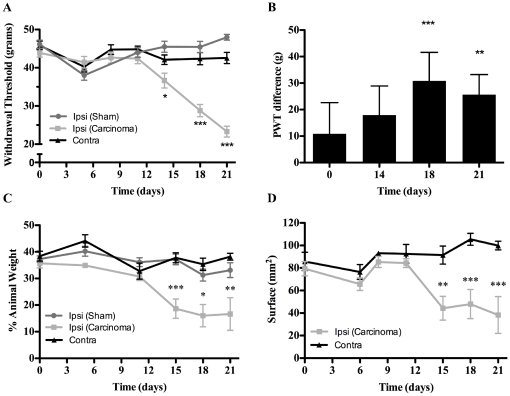
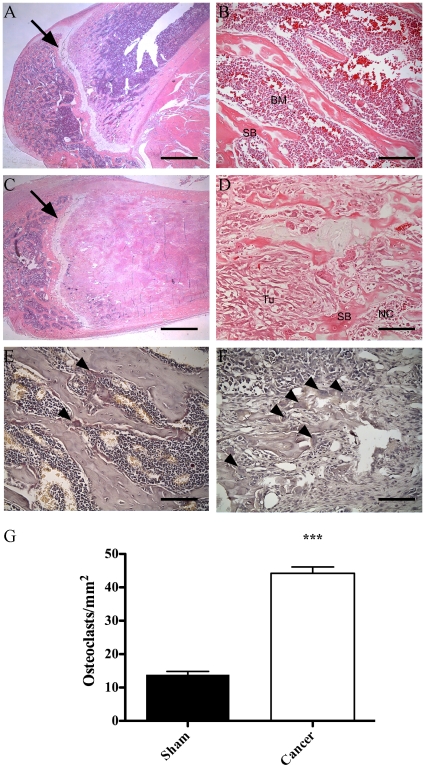
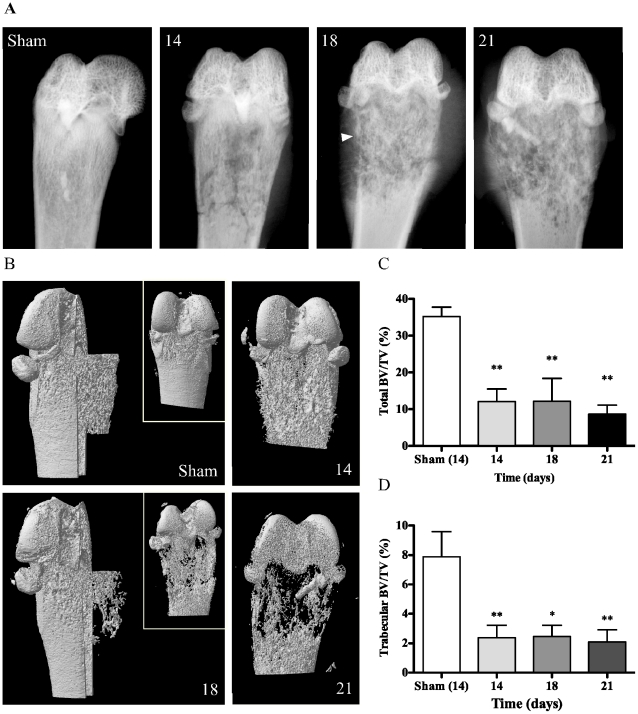
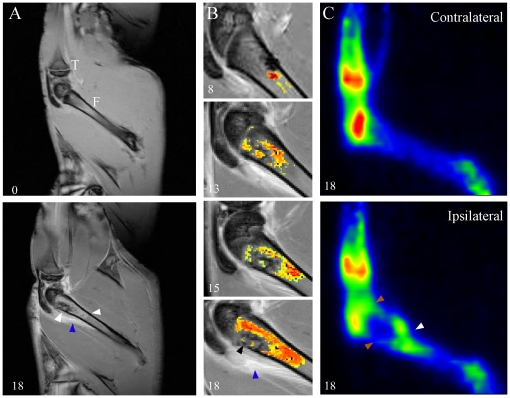
Pre-clinical bone cancer pain models mimicking the human condition are required to respond to clinical realities. Breast or prostate cancer patients coping with bone metastases experience intractable pain, which affects their quality of life. Advanced monitoring is thus required to clarify bone cancer pain mechanisms and refine treatments. In our model of rat femoral mammary carcinoma MRMT-1 cell implantation, pain onset and tumor growth were monitored for 21 days. The surgical procedure performed without arthrotomy allowed recording of incidental pain in free-moving rats. Along with the gradual development of mechanical allodynia and hyperalgesia, behavioral signs of ambulatory pain were detected at day 14 by using a dynamic weight-bearing apparatus. Osteopenia was revealed from day 14 concomitantly with disorganization of the trabecular architecture (µCT). Bone metastases were visualized as early as day 8 by MRI (T(1)-Gd-DTPA) before pain detection. PET (Na(18)F) co-registration revealed intra-osseous activity, as determined by anatomical superimposition over MRI in accordance with osteoclastic hyperactivity (TRAP staining). Pain and bone destruction were aggravated with time. Bone remodeling was accompanied by c-Fos (spinal) and ATF3 (DRG) neuronal activation, sustained by astrocyte (GFAP) and microglia (Iba1) reactivity in lumbar spinal cord. Our animal model demonstrates the importance of simultaneously recording pain and tumor progression and will allow us to better characterize therapeutic strategies in the future.
需要模拟人类状况的临床前骨癌痛模型来应对临床实际情况。患有骨转移的乳腺癌或前列腺癌患者会经历难以忍受的疼痛,这会影响他们的生活质量。因此,需要进行高级监测来阐明骨癌痛的机制并改进治疗方法。在我们的大鼠股骨乳腺癌 MRMT-1 细胞植入模型中,监测了疼痛发作和肿瘤生长 21 天。在不进行关节切开术的情况下进行的手术程序允许在自由活动的大鼠中记录偶发性疼痛。随着机械性痛觉过敏和痛觉过敏的逐渐发展,在第 14 天通过动态负重装置检测到了步行疼痛的行为迹象。从第 14 天开始,骨质疏松症与小梁结构的紊乱(µCT)同时发生。通过 MRI(T1-Gd-DTPA)早在第 8 天就可以观察到骨转移,而在疼痛检测之前。PET(Na18F)配准显示了骨内活性,这是通过 MRI 上的解剖叠加与破骨细胞活性(TRAP 染色)相一致来确定的。随着时间的推移,疼痛和骨破坏加剧。骨重塑伴随着脊髓中的 c-Fos(脊髓)和 ATF3(DRG)神经元激活,由腰椎脊髓中的星形胶质细胞(GFAP)和小胶质细胞(Iba1)反应维持。我们的动物模型表明了同时记录疼痛和肿瘤进展的重要性,并将使我们能够在未来更好地描述治疗策略。