Department of Society, Harvard School of Public Health, Boston, Massachusetts, United States of America.
PLoS One. 2010 Oct 27;5(10):e13656. doi: 10.1371/journal.pone.0013656.
Shorter stature is associated with greater all cause and heart disease mortality, but taller stature with increased risk of cancer mortality. Though childhood environment is important in determining height, limited data address how maternal depression affects linear growth in children. We examined the relationships between antenatal and postpartum depressive symptoms and child height and linear growth from birth to age 3 years in a U.S. sample.
Subjects were 872 mother-child pairs in Project Viva, a prospective pre-birth cohort study. The study population is relatively advantaged with high levels of income and education and low risk of food insecurity. We assessed maternal depression at mid-pregnancy (mean 28 weeks' gestation) and 6 months postpartum with the Edinburgh Postnatal Depression Scale (score > = 13 on 0-30 scale indicating probable depression). Child outcomes at age 3 were height-for-age z-score (HAZ) and leg length. HAZ was also available at birth and ages 6 months, 1, 2, and 3 years.
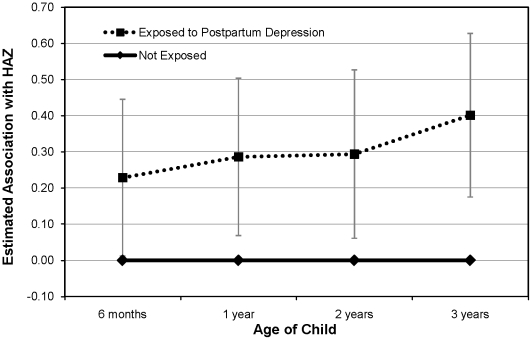
Seventy (8.0%) women experienced antenatal depression and 64 (7.3%) experienced postpartum depression. The mean (SD) height for children age 3 was 97.2 cm (4.2), with leg length of 41.6 cm (2.6). In multivariable linear regression models, exposure to postpartum depression was associated with greater HAZ (0.37 [95% confidence interval: 0.16, 0.58]) and longer leg length (0.88 cm [0.35, 1.41]). The relationship between postpartum depression and greater HAZ was evident starting at 6 months and continued to age 3. We found minimal relationships between antenatal depression and child height outcomes.
Our findings do not support the hypothesis that maternal depression is associated with reduced height in children in this relatively advantaged sample in a high-income country.
身材较矮与全因死亡率和心脏病死亡率增加相关,但身材较高与癌症死亡率增加相关。虽然儿童时期的环境对身高的决定很重要,但关于母亲抑郁如何影响儿童的线性生长,数据有限。我们在美国样本中检查了产前和产后抑郁症状与儿童身高和从出生到 3 岁期间线性生长之间的关系。
研究对象为 Project Viva 中的 872 对母婴对,这是一项前瞻性的产前队列研究。该研究人群相对优越,收入和教育水平高,食物不安全风险低。我们使用 Edinburgh 产后抑郁量表(0-30 分制上得分≥13 表示可能有抑郁)评估了母亲在妊娠中期(平均妊娠 28 周)和产后 6 个月时的抑郁情况。3 岁时的儿童结局为身高年龄 z 评分(HAZ)和腿长。HAZ 也可在出生和 6 个月、1 岁、2 岁和 3 岁时获得。
70 名(8.0%)女性经历了产前抑郁,64 名(7.3%)经历了产后抑郁。3 岁儿童的平均(SD)身高为 97.2cm(4.2),腿长为 41.6cm(2.6)。在多变量线性回归模型中,产后抑郁暴露与更大的 HAZ(0.37 [95%置信区间:0.16,0.58])和更长的腿长(0.88cm [0.35,1.41])相关。产后抑郁与更大 HAZ 之间的关系从 6 个月开始显现,并持续到 3 岁。我们发现产前抑郁与儿童身高结局之间的关系很小。
在这个高收入国家相对优越的样本中,我们的研究结果不支持母亲抑郁与儿童身高降低相关的假设。