Center for Dementia Research, Nathan Kline Institute, Orangeburg, New York 10962, USA.
Mol Brain. 2010 Nov 8;3:34. doi: 10.1186/1756-6606-3-34.
It is hypothesized that complex interactions between multiple environmental factors and genetic factors are implicated in sporadic Alzheimer's disease (AD); however, the underlying mechanisms are poorly understood. Importantly, recent evidence reveals that expression and activity levels of the β-site APP cleaving enzyme 1 (BACE1), which initiates amyloid-β (Aβ) production, are elevated in AD brains. In this study, we investigated a molecular mechanism by which sex and stress interactions may accelerate β-amyloidogenesis and contribute to sporadic AD.
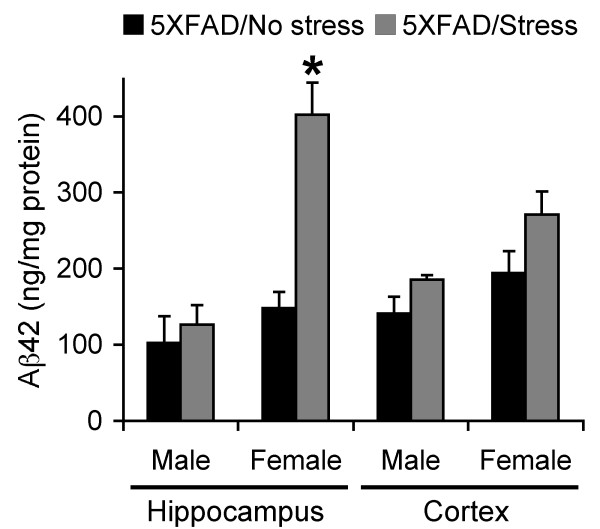
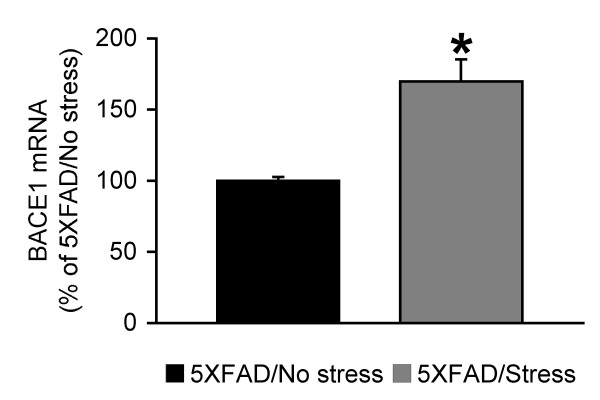
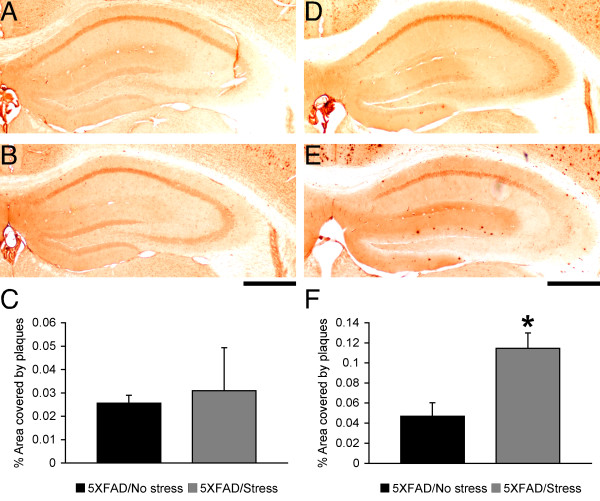
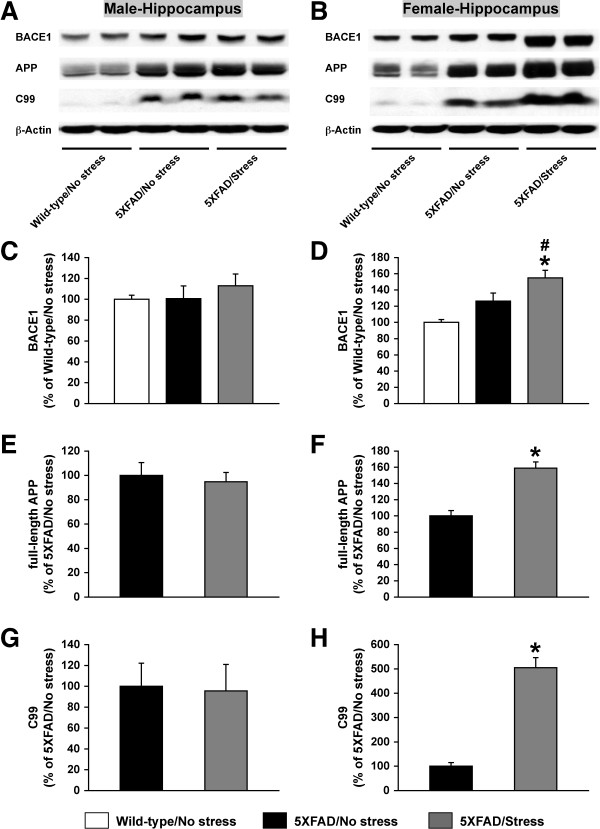
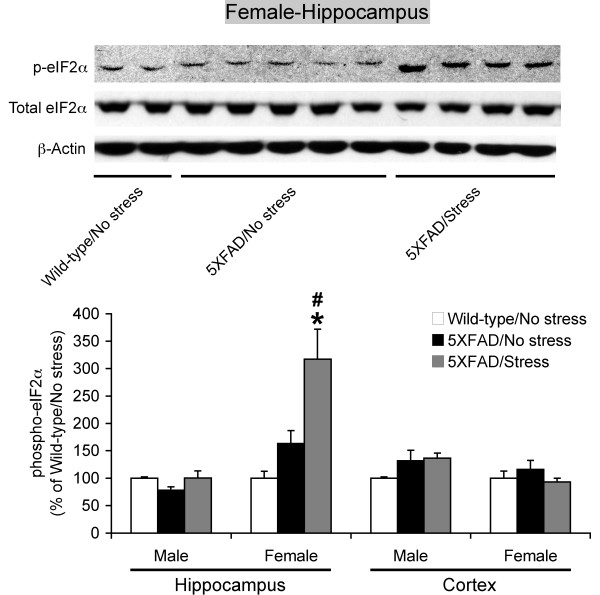
We applied 5-day restraint stress (6 h/day) to the male and female 5XFAD transgenic mouse model of AD at the pre-pathological stage of disease, which showed little amyloid deposition under non-stressed control conditions. Exposure to the relatively brief behavioral stress increased levels of neurotoxic Aβ42 peptides, the β-secretase-cleaved C-terminal fragment (C99) and plaque burden in the hippocampus of female 5XFAD mice but not in that of male 5XFAD mice. In contrast, significant changes in the parameters of β-amyloidosis were not observed in the cerebral cortex of stressed male or female 5XFAD mice. We found that this sex- and brain region-specific acceleration of β-amyloidosis was accounted for by elevations in BACE1 and APP levels in response to adverse stress. Furthermore, not only BACE1 mRNA but also phosphorylation of the translation initiation factor eIF2α (a proposed mediator of the post-transcriptional upregulation of BACE1) was elevated in the hippocampus of stressed female 5XFAD mice.
Our results suggest that the higher prevalence of sporadic AD in women may be attributable to the vulnerability of female brains (especially, the hippocampus) to stressful events, which alter APP processing to favor the β-amyloidogenesis through the transcriptional and translational upregulation of BACE1 combined with elevations in its substrate APP.
据推测,多种环境因素和遗传因素之间的复杂相互作用与散发性阿尔茨海默病(AD)有关;然而,其潜在机制尚不清楚。重要的是,最近的证据表明,β-位点 APP 切割酶 1(BACE1)的表达和活性水平在 AD 脑中升高,BACE1 启动淀粉样蛋白-β(Aβ)的产生。在这项研究中,我们研究了性别和应激相互作用可能加速β-淀粉样蛋白形成并导致散发性 AD 的分子机制。
我们在疾病的病理前阶段,对雄性和雌性 5XFAD 转基因 AD 小鼠模型应用了为期 5 天的束缚应激(每天 6 小时),在未受应激的对照条件下,模型显示出很少的淀粉样蛋白沉积。暴露于相对短暂的行为应激增加了雌性 5XFAD 小鼠海马体中神经毒性 Aβ42 肽、β-分泌酶切割的 C 端片段(C99)和斑块负担的水平,但对雄性 5XFAD 小鼠没有影响。相比之下,应激对雄性或雌性 5XFAD 小鼠大脑皮层中β-淀粉样蛋白形成的参数没有明显变化。我们发现,这种性别和大脑区域特异性的β-淀粉样蛋白形成加速是由于对不利应激的 BACE1 和 APP 水平升高引起的。此外,应激后雌性 5XFAD 小鼠海马体中的不仅 BACE1mRNA,而且翻译起始因子 eIF2α 的磷酸化(一种 BACE1 转录后上调的拟议介质)也升高。
我们的结果表明,女性中散发性 AD 的更高患病率可能归因于女性大脑(特别是海马体)对应激事件的脆弱性,这些应激事件改变了 APP 加工,通过 BACE1 的转录和翻译上调以及其底物 APP 的升高来促进β-淀粉样蛋白形成。