Wasilenko W J, Nori M, Testerman N, Weber M J
Department of Microbiology and Cancer Center, University of Virginia Health Sciences Center, Charlottesville 22908.
Mol Cell Biol. 1990 Mar;10(3):1254-8. doi: 10.1128/mcb.10.3.1254-1258.1990.
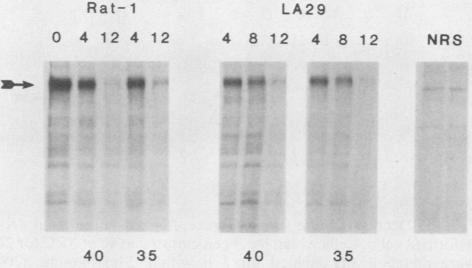
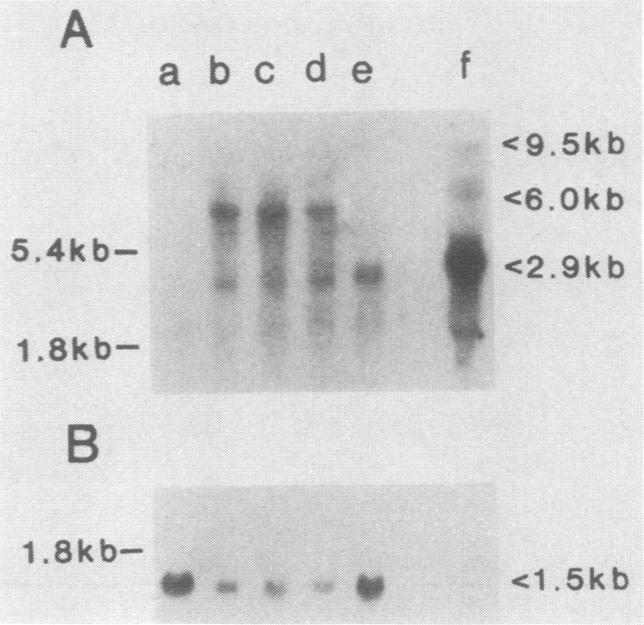
We have previously shown that an intracellular mechanism down regulates epidermal growth factor (EGF) receptor levels in rodent fibroblasts transformed by the src oncogene (W. J. Wasilenko, L. K. Shawver, and M. J. Weber, J. Cell. Physiol. 131:450-457, 1987). We now report that this down regulation is due to an inhibition of EGF receptor biosynthesis. With Rat-1 (R1) cells infected with a temperature-sensitive src mutant, we found that 125I-labeled EGF binding to cells began to decrease soon after the activation of pp60v-src by shift down to the permissive temperature for transformation. This effect of src on EGF receptors was reversible. Pulse-chase studies with [35S]methionine-labeled cells revealed that the tyrosine protein kinase activity of pp60v-src had little if any effect on EGF receptor degradation rate. By contrast, the expression of pp60v-src caused a large reduction in the apparent rate of EGF receptor biosynthesis. Northern (RNA) blot analysis demonstrated that pp60v-src also caused marked reductions in the steady-state level of EGF receptor mRNA. These data indicate that one way the expression of the src oncogene can affect the machinery of growth control is by affecting the expression of specific genes for growth factor receptors.
我们先前已经表明,在由src癌基因转化的啮齿动物成纤维细胞中,一种细胞内机制会下调表皮生长因子(EGF)受体水平(W. J. 瓦西连科、L. K. 肖弗和M. J. 韦伯,《细胞生理学杂志》131:450 - 457,1987年)。我们现在报告,这种下调是由于EGF受体生物合成受到抑制。在用温度敏感型src突变体感染的大鼠-1(R1)细胞中,我们发现,将温度下调至允许转化的温度从而激活pp60v-src后不久,125I标记的EGF与细胞的结合开始减少。src对EGF受体的这种作用是可逆的。用[35S]甲硫氨酸标记细胞进行脉冲追踪研究表明,pp60v-src的酪氨酸蛋白激酶活性对EGF受体降解速率几乎没有影响。相比之下,pp60v-src的表达导致EGF受体生物合成的表观速率大幅降低。Northern(RNA)印迹分析表明,pp60v-src还导致EGF受体mRNA的稳态水平显著降低。这些数据表明,src癌基因表达影响生长控制机制的一种方式是通过影响生长因子受体特定基因的表达。