Division of Molecular Pharmacology and Neuroscience, Nagasaki University Graduate School of Biomedical Sciences, 1-14 Bunkyo-machi, Nagasaki 852-8521, Japan.
Mol Pain. 2010 Nov 9;6:78. doi: 10.1186/1744-8069-6-78.
Although neuropathic pain is frequently observed in demyelinating diseases such as Guillain-Barré syndrome and multiple sclerosis, the molecular basis for the relationship between demyelination and neuropathic pain behaviors is poorly understood. Previously, we found that lysophosphatidic acid receptor (LPA1) signaling initiates sciatic nerve injury-induced neuropathic pain and demyelination.
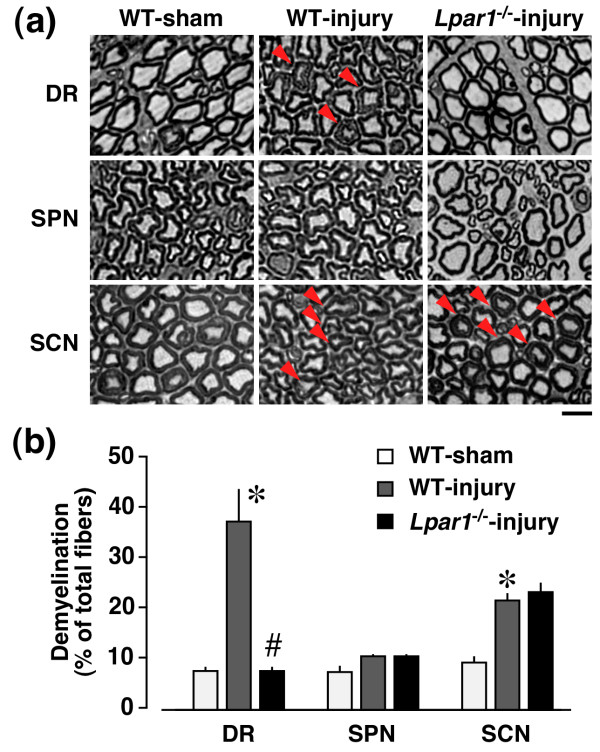
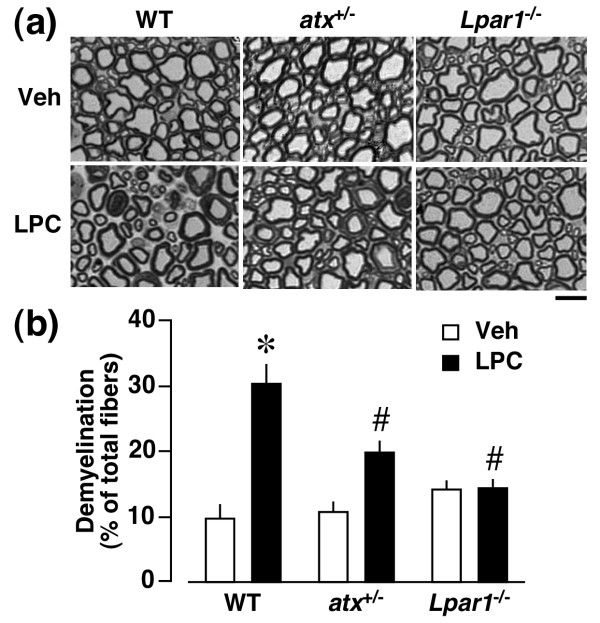
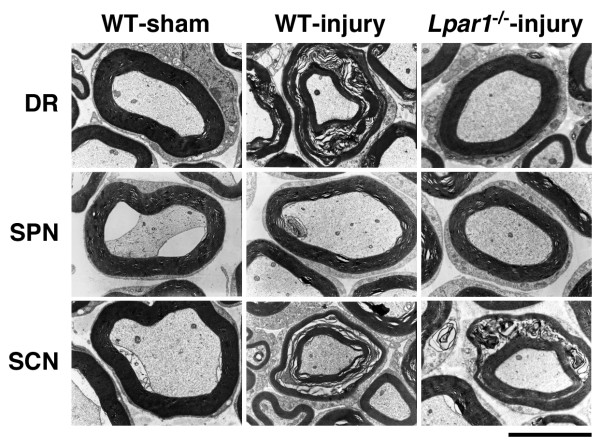
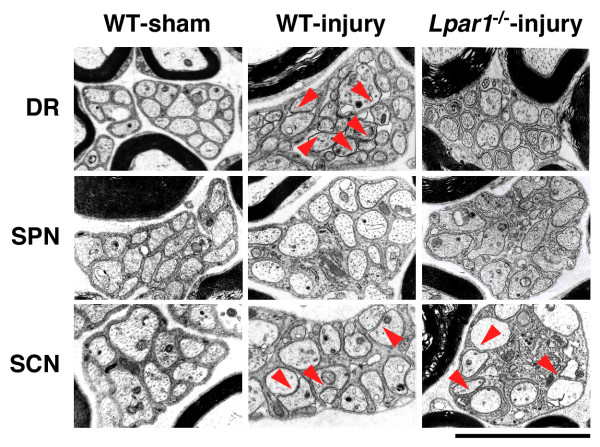
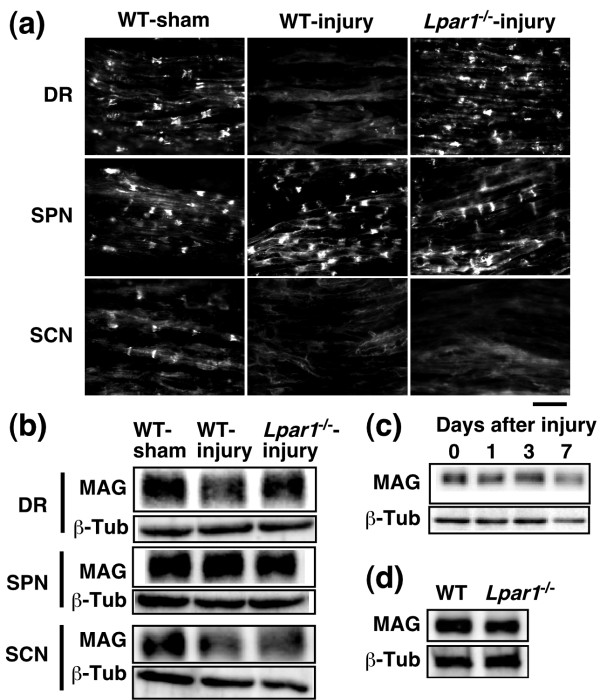
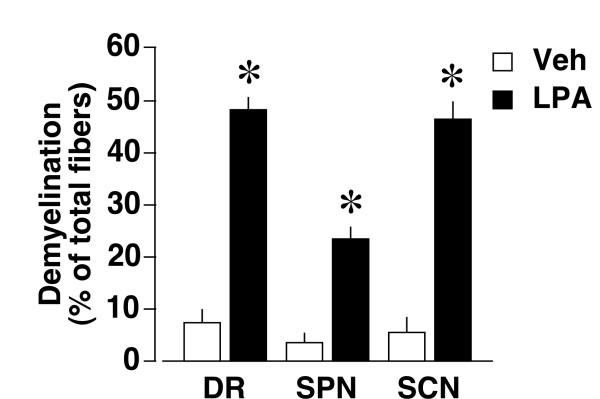
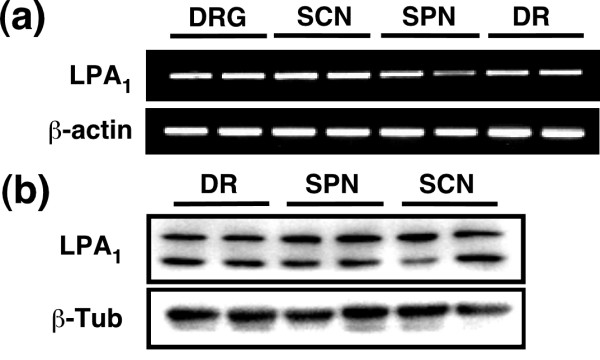
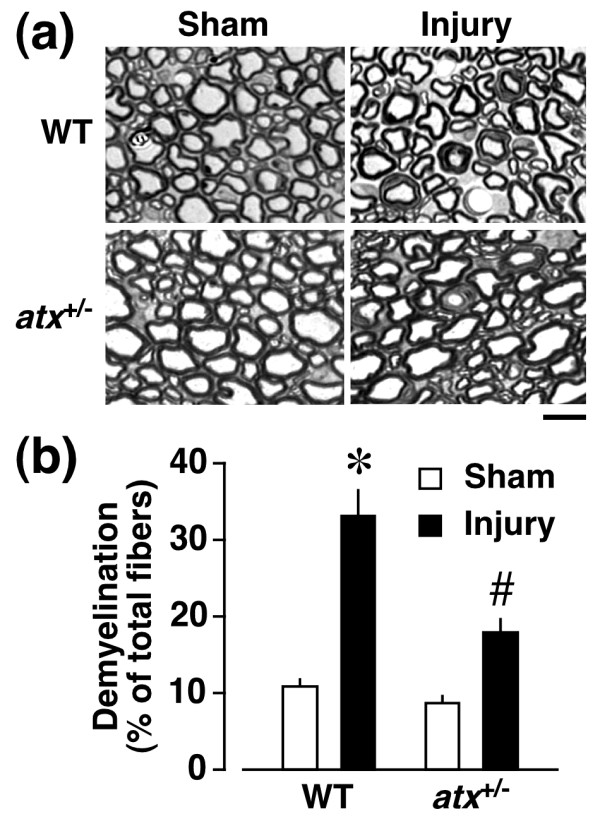
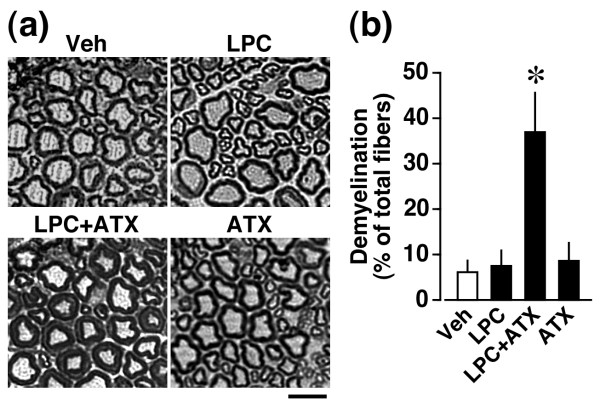
In the present study, we have demonstrated that sciatic nerve injury induces marked demyelination accompanied by myelin-associated glycoprotein (MAG) down-regulation and damage of Schwann cell partitioning of C-fiber-containing Remak bundles in the sciatic nerve and dorsal root, but not in the spinal nerve. Demyelination, MAG down-regulation and Remak bundle damage in the dorsal root were abolished in LPA1 receptor-deficient (Lpar1-/-) mice, but these alterations were not observed in sciatic nerve. However, LPA-induced demyelination in ex vivo experiments was observed in the sciatic nerve, spinal nerve and dorsal root, all which express LPA1 transcript and protein. Nerve injury-induced dorsal root demyelination was markedly attenuated in mice heterozygous for autotaxin (atx+/-), which converts lysophosphatidylcholine (LPC) to LPA. Although the addition of LPC to ex vivo cultures of dorsal root fibers in the presence of recombinant ATX caused potent demyelination, it had no significant effect in the absence of ATX. On the other hand, intrathecal injection of LPC caused potent dorsal root demyelination, which was markedly attenuated or abolished in atx+/- or Lpar1-/- mice.
These results suggest that LPA, which is converted from LPC by ATX, activates LPA1 receptors and induces dorsal root demyelination following nerve injury, which causes neuropathic pain.
尽管神经病理性疼痛在脱髓鞘疾病中很常见,如吉兰-巴雷综合征和多发性硬化症,但脱髓鞘与神经病理性疼痛行为之间的关系的分子基础仍知之甚少。此前,我们发现溶血磷脂酸受体(LPA1)信号启动坐骨神经损伤诱导的神经病理性疼痛和脱髓鞘。
在本研究中,我们已经证明坐骨神经损伤会导致明显的脱髓鞘,伴随着髓鞘相关糖蛋白(MAG)下调以及坐骨神经和背根中 C 纤维所含 Remak 束的雪旺细胞分区损伤,但在脊髓神经中则不会。LPA1 受体缺陷(Lpar1-/-)小鼠中,背根中的脱髓鞘、MAG 下调和 Remak 束损伤被消除,但坐骨神经中则没有观察到这些改变。然而,在离体实验中观察到 LPA 诱导的坐骨神经、脊髓神经和背根脱髓鞘,这些部位均表达 LPA1 转录本和蛋白。神经损伤诱导的背根脱髓鞘在自动蛋白水解酶(atx+/-)杂合子小鼠中明显减弱,该酶将溶血磷脂酰胆碱(LPC)转化为 LPA。尽管在存在重组 ATX 的情况下,将 LPC 添加到背根纤维的离体培养物中会导致强烈的脱髓鞘,但在没有 ATX 的情况下则没有明显影响。另一方面,鞘内注射 LPC 会导致强烈的背根脱髓鞘,而在 atx+/-或 Lpar1-/-小鼠中则明显减弱或消除。
这些结果表明,ATX 将 LPC 转化为 LPA,LPA 激活 LPA1 受体,并在神经损伤后引起背根脱髓鞘,从而导致神经病理性疼痛。