Service ICAR, Department of Nephrology, Pitié-Salpêtrière Hospital, 47-83 Boulevard de l'Hôpital, Paris 75013, France.
Br J Cancer. 2010 Dec 7;103(12):1815-21. doi: 10.1038/sj.bjc.6605979. Epub 2010 Nov 9.
half of anticancer drugs are predominantly excreted in urine. Dosage adjustment in renal insufficiency (RI) is, therefore, a crucial issue. Moreover, patients with abnormal renal function are at high risk for drug-induced nephrotoxicity. The Belgian Renal Insufficiency and Anticancer Medications (BIRMA) study investigated the prevalence of RI in cancer patients, and the profile/dosing of anticancer drugs prescribed.
primary end point: to estimate the prevalence of abnormal glomerular filtration rate (GFR; estimated with the abbreviated Modification of Diet in Renal Disease formula) and RI in cancer patient. Secondary end point: to describe the profile of anticancer drugs prescribed (dose reduction/nephrotoxicity). Data were collected for patients presenting at one of the seven Belgian BIRMA centres in March 2006.
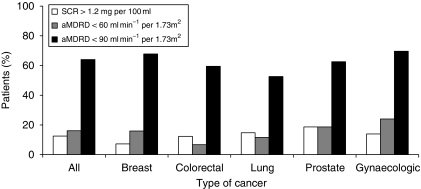
a total of 1218 patients were included. The prevalence of elevated SCR (> or =1.2 mg per 100 ml) was 14.9%, but 64.0% had a GFR<90 ml min(-1) per 1.73 m(2). In all, 78.6% of treated patients (n=1087) were receiving at least one drug needing dosage adjustment and 78.1% received at least one nephrotoxic drug. In all, 56.5% of RI patients receiving chemotherapy requiring dose reduction in case of RI did not receive dose adjustment.
the RI is highly frequent in cancer patients. In all, 80% of the patients receive potentially nephrotoxic drugs and/or for which dosage must be adjusted in RI. Oncologists should check the appropriate dose of chemotherapeutic drugs in relation to renal function before prescribing.
半数的抗癌药物主要通过尿液排泄。因此,肾功能不全(RI)患者的剂量调整是一个关键问题。此外,肾功能异常的患者有发生药物性肾毒性的高风险。比利时肾功能不全和抗癌药物(BIRMA)研究调查了癌症患者中 RI 的流行情况,以及开具的抗癌药物的种类/剂量。
主要终点:估计癌症患者异常肾小球滤过率(GFR;用简化肾脏病饮食修正公式估算)和 RI 的流行情况。次要终点:描述开具的抗癌药物的种类(剂量减少/肾毒性)。数据收集于 2006 年 3 月在比利时的七个 BIRMA 中心之一就诊的患者。
共纳入 1218 例患者。SCR 升高(>或=1.2 mg/100 ml)的患病率为 14.9%,但有 64.0%的患者 GFR<90 ml/min/1.73 m2。所有接受治疗的患者中(n=1087),有 78.6%至少使用一种需要剂量调整的药物,有 78.1%使用至少一种肾毒性药物。所有 RI 患者中,56.5%接受化疗的 RI 患者需要剂量减少,但未接受剂量调整。
癌症患者 RI 的发病率很高。所有患者中,80%的患者使用潜在肾毒性药物和/或需要在 RI 时调整剂量。肿瘤学家在开化疗药物之前,应根据肾功能检查合适的剂量。