• 文献检索
  • 文档翻译
  • 深度研究
  • 学术资讯
  • Suppr Zotero 插件Zotero 插件
  • 邀请有礼
  • 套餐&价格
  • 历史记录
应用&插件
Suppr Zotero 插件Zotero 插件浏览器插件Mac 客户端Windows 客户端微信小程序
定价
高级版会员购买积分包购买API积分包
服务
文献检索文档翻译深度研究API 文档MCP 服务
关于我们
关于 Suppr公司介绍联系我们用户协议隐私条款
关注我们

Suppr 超能文献

核心技术专利:CN118964589B侵权必究
粤ICP备2023148730 号-1Suppr @ 2026

文献检索

告别复杂PubMed语法,用中文像聊天一样搜索,搜遍4000万医学文献。AI智能推荐,让科研检索更轻松。

立即免费搜索

文件翻译

保留排版,准确专业,支持PDF/Word/PPT等文件格式,支持 12+语言互译。

免费翻译文档

深度研究

AI帮你快速写综述,25分钟生成高质量综述,智能提取关键信息,辅助科研写作。

立即免费体验

G 蛋白调节因子 EGL-10 和 EAT-16、Giα GOA-1 和 G(q)α EGL-30 调节线虫 ASH 多模态伤害感受神经元对驱虫剂的反应。

The G protein regulators EGL-10 and EAT-16, the Giα GOA-1 and the G(q)α EGL-30 modulate the response of the C. elegans ASH polymodal nociceptive sensory neurons to repellents.

机构信息

Istituto di Genetica e Biofisica A, IGB, CNR, Consiglio Nazionale delle Ricerche, Napoli, Italy.

出版信息

BMC Biol. 2010 Nov 11;8:138. doi: 10.1186/1741-7007-8-138.

DOI:10.1186/1741-7007-8-138
PMID:21070627
原文链接:https://pmc.ncbi.nlm.nih.gov/articles/PMC2996360/
Abstract

BACKGROUND

Polymodal, nociceptive sensory neurons are key cellular elements of the way animals sense aversive and painful stimuli. In Caenorhabditis elegans, the polymodal nociceptive ASH sensory neurons detect aversive stimuli and release glutamate to generate avoidance responses. They are thus useful models for the nociceptive neurons of mammals. While several molecules affecting signal generation and transduction in ASH have been identified, less is known about transmission of the signal from ASH to downstream neurons and about the molecules involved in its modulation.

RESULTS

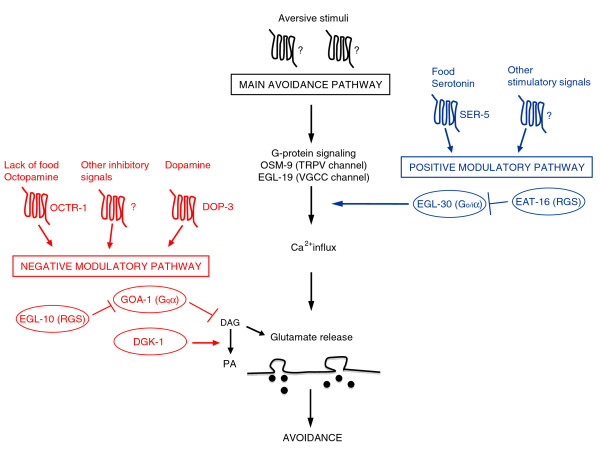
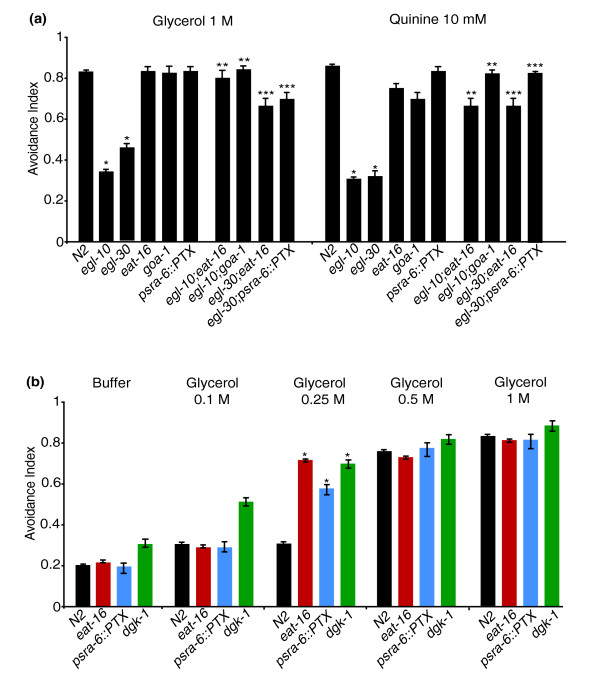
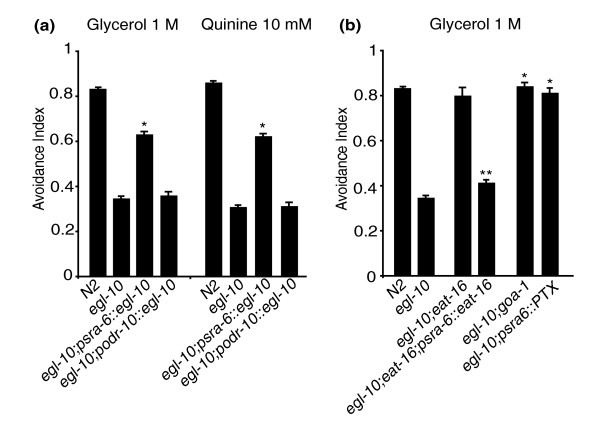
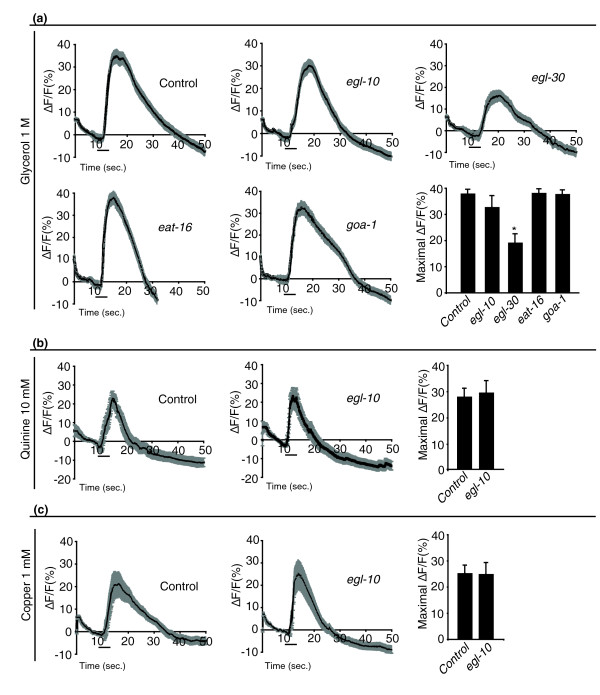
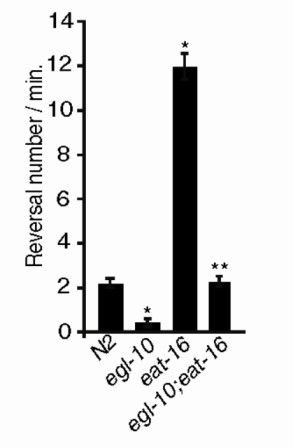
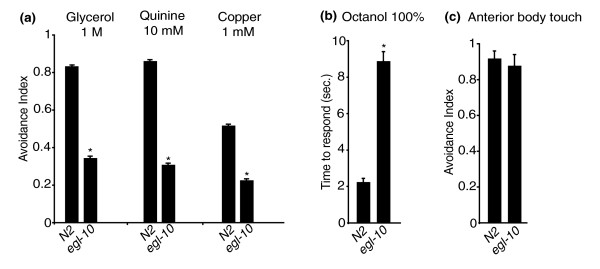
We discovered that the regulator of G protein signalling (RGS) protein, EGL-10, is required for appropriate avoidance responses to noxious stimuli sensed by ASH. As it does for other behaviours in which it is also involved, egl-10 interacts genetically with the G(o)/(i)α protein GOA-1, the G(q)α protein EGL-30 and the RGS EAT-16. Genetic, behavioural and Ca²(+) imaging analyses of ASH neurons in live animals demonstrate that, within ASH, EGL-10 and GOA-1 act downstream of stimulus-evoked signal transduction and of the main transduction channel OSM-9. EGL-30 instead appears to act upstream by regulating Ca²(+) transients in response to aversive stimuli. Analysis of the delay in the avoidance response, of the frequency of spontaneous inversions and of the genetic interaction with the diacylglycerol kinase gene, dgk-1, indicate that EGL-10 and GOA-1 do not affect signal transduction and neuronal depolarization in response to aversive stimuli but act in ASH to modulate downstream transmission of the signal.

CONCLUSIONS

The ASH polymodal nociceptive sensory neurons can be modulated not only in their capacity to detect stimuli but also in the efficiency with which they respond to them. The Gα and RGS molecules studied in this work are conserved in evolution and, for each of them, mammalian orthologs can be identified. The discovery of their role in the modulation of signal transduction and signal transmission of nociceptors may help us to understand how pain is generated and how its control can go astray (such as chronic pain) and may suggest new pain control therapies.

摘要

背景

多模式伤害感受神经元是动物感知厌恶和疼痛刺激的关键细胞元件。在秀丽隐杆线虫中,多模式伤害感受 ASH 感觉神经元检测到厌恶刺激,并释放谷氨酸以产生回避反应。因此,它们是哺乳动物伤害感受神经元的有用模型。虽然已经确定了几种影响 ASH 中信号产生和转导的分子,但对于信号从 ASH 传递到下游神经元以及参与其调节的分子知之甚少。

结果

我们发现,G 蛋白信号调节因子(RGS)蛋白 EGL-10 对于 ASH 感知到的有害刺激的适当回避反应是必需的。与它参与的其他行为一样,egl-10 在遗传上与 G(o)/(i)α 蛋白 GOA-1、G(q)α 蛋白 EGL-30 和 RGS EAT-16 相互作用。对活体动物中 ASH 神经元的遗传、行为和 Ca²(+)成像分析表明,在 ASH 中,EGL-10 和 GOA-1 作用于刺激引发的信号转导下游和主要转导通道 OSM-9 之后。相反,EGL-30 似乎通过调节对厌恶刺激的 Ca²(+)瞬变来发挥上游作用。对回避反应的延迟、自发反转的频率以及与二酰基甘油激酶基因 dgk-1 的遗传相互作用的分析表明,EGL-10 和 GOA-1 不影响对厌恶刺激的信号转导和神经元去极化,但在 ASH 中作用于信号的下游传递。

结论

多模式伤害感受 ASH 感觉神经元不仅可以调节其检测刺激的能力,还可以调节其对刺激的反应效率。在这项工作中研究的 Gα 和 RGS 分子在进化中是保守的,并且可以鉴定出它们各自的哺乳动物同源物。发现它们在伤害感受器信号转导和信号传递的调节中的作用可能有助于我们了解疼痛是如何产生的,以及其控制如何出错(如慢性疼痛),并可能为新的疼痛控制疗法提供启示。
https://cdn.ncbi.nlm.nih.gov/pmc/blobs/043d/2996360/094278437f80/1741-7007-8-138-6.jpg
https://cdn.ncbi.nlm.nih.gov/pmc/blobs/043d/2996360/af53f416db88/1741-7007-8-138-1.jpg
https://cdn.ncbi.nlm.nih.gov/pmc/blobs/043d/2996360/719dc5fdb257/1741-7007-8-138-2.jpg
https://cdn.ncbi.nlm.nih.gov/pmc/blobs/043d/2996360/658a079f1d1e/1741-7007-8-138-3.jpg
https://cdn.ncbi.nlm.nih.gov/pmc/blobs/043d/2996360/53d23630981f/1741-7007-8-138-4.jpg
https://cdn.ncbi.nlm.nih.gov/pmc/blobs/043d/2996360/a9e3bf2e5936/1741-7007-8-138-5.jpg
https://cdn.ncbi.nlm.nih.gov/pmc/blobs/043d/2996360/094278437f80/1741-7007-8-138-6.jpg
https://cdn.ncbi.nlm.nih.gov/pmc/blobs/043d/2996360/af53f416db88/1741-7007-8-138-1.jpg
https://cdn.ncbi.nlm.nih.gov/pmc/blobs/043d/2996360/719dc5fdb257/1741-7007-8-138-2.jpg
https://cdn.ncbi.nlm.nih.gov/pmc/blobs/043d/2996360/658a079f1d1e/1741-7007-8-138-3.jpg
https://cdn.ncbi.nlm.nih.gov/pmc/blobs/043d/2996360/53d23630981f/1741-7007-8-138-4.jpg
https://cdn.ncbi.nlm.nih.gov/pmc/blobs/043d/2996360/a9e3bf2e5936/1741-7007-8-138-5.jpg
https://cdn.ncbi.nlm.nih.gov/pmc/blobs/043d/2996360/094278437f80/1741-7007-8-138-6.jpg

相似文献

1
The G protein regulators EGL-10 and EAT-16, the Giα GOA-1 and the G(q)α EGL-30 modulate the response of the C. elegans ASH polymodal nociceptive sensory neurons to repellents.G 蛋白调节因子 EGL-10 和 EAT-16、Giα GOA-1 和 G(q)α EGL-30 调节线虫 ASH 多模态伤害感受神经元对驱虫剂的反应。
BMC Biol. 2010 Nov 11;8:138. doi: 10.1186/1741-7007-8-138.
2
Two RGS proteins that inhibit Galpha(o) and Galpha(q) signaling in C. elegans neurons require a Gbeta(5)-like subunit for function.在秀丽隐杆线虫神经元中抑制Gα(o)和Gα(q)信号传导的两种RGS蛋白发挥功能需要一个类Gβ(5)亚基。
Curr Biol. 2001 Feb 20;11(4):222-31. doi: 10.1016/s0960-9822(01)00071-9.
3
eat-11 encodes GPB-2, a Gbeta(5) ortholog that interacts with G(o)alpha and G(q)alpha to regulate C. elegans behavior.eat-11编码GPB-2,一种与G(o)α和G(q)α相互作用以调节线虫行为的Gβ(5)直系同源物。
Curr Biol. 2001 Feb 20;11(4):288-93. doi: 10.1016/s0960-9822(01)00074-4.
4
RSBP-1 is a membrane-targeting subunit required by the Galpha(q)-specific but not the Galpha(o)-specific R7 regulator of G protein signaling in Caenorhabditis elegans.RSBP-1 是一种膜靶向亚基,在秀丽隐杆线虫中,它是 Galpha(q)-特异性但不是 Galpha(o)-特异性 R7 G 蛋白信号转导调节因子所必需的。
Mol Biol Cell. 2010 Jan 15;21(2):232-43. doi: 10.1091/mbc.e09-07-0642. Epub 2009 Nov 18.
5
The monoaminergic modulation of sensory-mediated aversive responses in Caenorhabditis elegans requires glutamatergic/peptidergic cotransmission.单胺能调制秀丽隐杆线虫感觉介导的厌恶反应需要谷氨酸能/肽能共传递。
J Neurosci. 2010 Jun 9;30(23):7889-99. doi: 10.1523/JNEUROSCI.0497-10.2010.
6
The C. elegans cGMP-dependent protein kinase EGL-4 regulates nociceptive behavioral sensitivity.秀丽隐杆线虫中的 cGMP 依赖性蛋白激酶 EGL-4 调节伤害感受行为敏感性。
PLoS Genet. 2013;9(7):e1003619. doi: 10.1371/journal.pgen.1003619. Epub 2013 Jul 11.
7
The G-protein beta-subunit GPB-2 in Caenorhabditis elegans regulates the G(o)alpha-G(q)alpha signaling network through interactions with the regulator of G-protein signaling proteins EGL-10 and EAT-16.秀丽隐杆线虫中的G蛋白β亚基GPB-2通过与G蛋白信号调节蛋白EGL-10和EAT-16相互作用来调节G(o)α-G(q)α信号网络。
Genetics. 2001 May;158(1):221-35. doi: 10.1093/genetics/158.1.221.
8
Heterotrimeric G proteins in C. elegans.秀丽隐杆线虫中的异源三聚体G蛋白。
WormBook. 2006 Oct 13:1-25. doi: 10.1895/wormbook.1.75.1.
9
An N-terminal region of Caenorhabditis elegans RGS proteins EGL-10 and EAT-16 directs inhibition of G(alpha)o versus G(alpha)q signaling.秀丽隐杆线虫RGS蛋白EGL-10和EAT-16的N端区域可抑制G(α)o与G(α)q信号传导。
J Biol Chem. 2002 Dec 6;277(49):47004-13. doi: 10.1074/jbc.M208186200. Epub 2002 Sep 26.
10
Goalpha regulates olfactory adaptation by antagonizing Gqalpha-DAG signaling in Caenorhabditis elegans.Goα通过拮抗秀丽隐杆线虫中的Gqα-二酰甘油信号传导来调节嗅觉适应。
Proc Natl Acad Sci U S A. 2006 Jan 24;103(4):1112-7. doi: 10.1073/pnas.0506954103. Epub 2006 Jan 17.

引用本文的文献

1
G protein-coupled receptor-based thermosensation determines temperature acclimatization of Caenorhabditis elegans.基于 G 蛋白偶联受体的热感觉决定了秀丽隐杆线虫的温度适应。
Nat Commun. 2024 Feb 23;15(1):1660. doi: 10.1038/s41467-024-46042-z.
2
Chemosensory signal transduction in Caenorhabditis elegans.秀丽隐杆线虫的化学感觉信号转导。
Genetics. 2021 Mar 31;217(3). doi: 10.1093/genetics/iyab004.
3
Dysregulation of Neuronal Gαo Signaling by Graphene Oxide in Nematode Caenorhabditis elegans.氧化石墨烯通过线虫秀丽隐杆线虫中神经元 Ga 信号的失调。

本文引用的文献

1
The monoaminergic modulation of sensory-mediated aversive responses in Caenorhabditis elegans requires glutamatergic/peptidergic cotransmission.单胺能调制秀丽隐杆线虫感觉介导的厌恶反应需要谷氨酸能/肽能共传递。
J Neurosci. 2010 Jun 9;30(23):7889-99. doi: 10.1523/JNEUROSCI.0497-10.2010.
2
The C. elegans D2-like dopamine receptor DOP-3 decreases behavioral sensitivity to the olfactory stimulus 1-octanol.秀丽隐杆线虫 D2 样多巴胺受体 DOP-3 降低了对嗅觉刺激 1-辛醇的行为敏感性。
PLoS One. 2010 Mar 2;5(3):e9487. doi: 10.1371/journal.pone.0009487.
3
Three distinct amine receptors operating at different levels within the locomotory circuit are each essential for the serotonergic modulation of chemosensation in Caenorhabditis elegans.
Sci Rep. 2019 Apr 15;9(1):6026. doi: 10.1038/s41598-019-42603-1.
4
A mathematical and computational model of the calcium dynamics in Caenorhabditis elegans ASH sensory neuron.秀丽隐杆线虫 ASH 感觉神经元钙离子动力学的数学和计算模型。
PLoS One. 2018 Jul 26;13(7):e0201302. doi: 10.1371/journal.pone.0201302. eCollection 2018.
5
The NCA-1 and NCA-2 Ion Channels Function Downstream of G and Rho To Regulate Locomotion in .NCA-1和NCA-2离子通道在G蛋白和Rho蛋白下游发挥作用,以调节[具体生物名称]中的运动。 (原文中“in”后面缺少具体生物名称)
Genetics. 2017 May;206(1):265-282. doi: 10.1534/genetics.116.198820. Epub 2017 Mar 21.
6
A Generative Statistical Algorithm for Automatic Detection of Complex Postures.一种用于自动检测复杂姿势的生成式统计算法。
PLoS Comput Biol. 2015 Oct 6;11(10):e1004517. doi: 10.1371/journal.pcbi.1004517. eCollection 2015 Oct.
7
Dopamine receptors antagonistically regulate behavioral choice between conflicting alternatives in C. elegans.多巴胺受体对秀丽隐杆线虫在相互冲突的选择之间的行为选择起拮抗调节作用。
PLoS One. 2014 Dec 23;9(12):e115985. doi: 10.1371/journal.pone.0115985. eCollection 2014.
8
Serotonin differentially modulates Ca2+ transients and depolarization in a C. elegans nociceptor.血清素以不同方式调节秀丽隐杆线虫伤害感受器中的钙离子瞬变和去极化。
J Neurophysiol. 2015 Feb 15;113(4):1041-50. doi: 10.1152/jn.00665.2014. Epub 2014 Nov 19.
9
A G-protein α subunit, GOA-1, plays a role in C. elegans avoidance behavior of strongly alkaline pH.一种G蛋白α亚基GOA-1在秀丽隐杆线虫对强碱性pH的回避行为中发挥作用。
Commun Integr Biol. 2013 Nov 1;6(6):e26668. doi: 10.4161/cib.26668. Epub 2013 Oct 8.
10
Parasite neuropeptide biology: Seeding rational drug target selection?寄生虫神经肽生物学:为合理选择药物靶点奠定基础?
Int J Parasitol Drugs Drug Resist. 2011 Nov 15;2:76-91. doi: 10.1016/j.ijpddr.2011.10.004. eCollection 2012 Dec.
三种不同的胺类受体在线虫运动回路的不同水平发挥作用,它们对于秀丽隐杆线虫化学感受的血清素能调节均至关重要。
J Neurosci. 2009 Feb 4;29(5):1446-56. doi: 10.1523/JNEUROSCI.4585-08.2009.
4
Regulation of serotonin biosynthesis by the G proteins Galphao and Galphaq controls serotonin signaling in Caenorhabditis elegans.G蛋白Galphao和Galphaq对血清素生物合成的调节控制着秀丽隐杆线虫中的血清素信号传导。
Genetics. 2008 Jan;178(1):157-69. doi: 10.1534/genetics.107.079780.
5
Tyramine and octopamine independently inhibit serotonin-stimulated aversive behaviors in Caenorhabditis elegans through two novel amine receptors.酪胺和章鱼胺通过两种新型胺受体独立抑制秀丽隐杆线虫中5-羟色胺刺激的厌恶行为。
J Neurosci. 2007 Dec 5;27(49):13402-12. doi: 10.1523/JNEUROSCI.3495-07.2007.
6
Chemosensation in C. elegans.秀丽隐杆线虫中的化学感受
WormBook. 2006 Oct 25:1-29. doi: 10.1895/wormbook.1.123.1.
7
CDK-5 regulates the abundance of GLR-1 glutamate receptors in the ventral cord of Caenorhabditis elegans.细胞周期蛋白依赖性激酶5(CDK-5)调节秀丽隐杆线虫腹神经索中GLR-1谷氨酸受体的丰度。
Mol Biol Cell. 2007 Oct;18(10):3883-93. doi: 10.1091/mbc.e06-09-0818. Epub 2007 Aug 1.
8
C. elegans G protein regulator RGS-3 controls sensitivity to sensory stimuli.秀丽隐杆线虫G蛋白调节剂RGS-3控制对感觉刺激的敏感性。
Neuron. 2007 Jan 4;53(1):39-52. doi: 10.1016/j.neuron.2006.11.015.
9
Chemical sensitivity in Caenorhabditis elegans.秀丽隐杆线虫的化学敏感性。
Cell Mol Life Sci. 2006 Jul;63(13):1510-22. doi: 10.1007/s00018-006-6114-7.
10
KEL-8 is a substrate receptor for CUL3-dependent ubiquitin ligase that regulates synaptic glutamate receptor turnover.KEL-8是一种CUL3依赖性泛素连接酶的底物受体,可调节突触谷氨酸受体的周转。
Mol Biol Cell. 2006 Mar;17(3):1250-60. doi: 10.1091/mbc.e05-08-0794. Epub 2006 Jan 4.