Department of Cardiology, National Cardiovascular Center, Osaka, Japan.
Cardiovasc Diabetol. 2010 Nov 11;9:75. doi: 10.1186/1475-2840-9-75.
Diabetes mellitus (DM) and impaired glucose tolerance (IGT) are risk factors for acute myocardial infarction (AMI). However, it is unknown whether hyperglycemic state is associated with increased major adverse cardiovascular events (MACE) after AMI. In this study, we evaluated the relationship between glucometabolic status and MACE in patients after AMI, and determined the critical level of 2 h post-load plasma glucose that may be used to predict MACE.
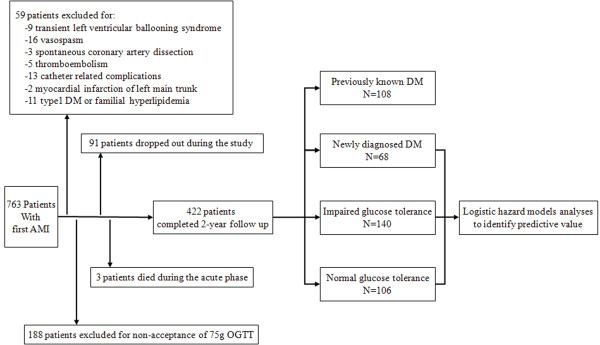
AMI patients (n = 422) were divided into 4 groups as follows: normal glucose tolerance (NGT) group, IGT group, newly diagnosed DM (NDM) group, and previously known DM (PDM) group. MACE of the 4 groups were compared for 2 years from AMI onset.
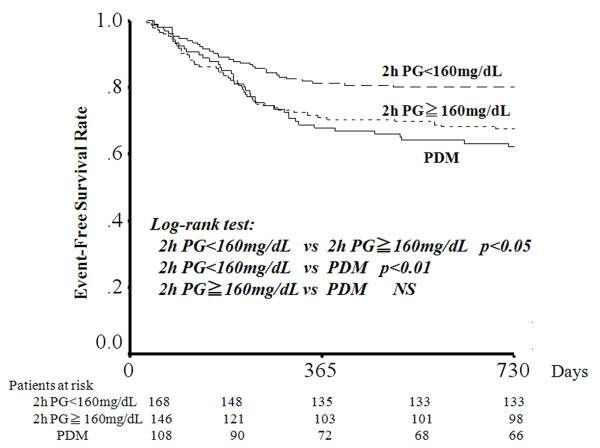
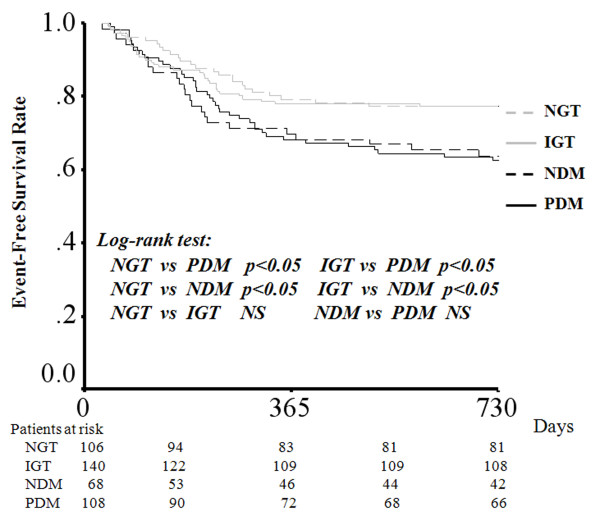
The NDM group had a significantly higher event rate than the IGT and NGT groups and had a similar event rate curve to PDM group. The logistic models analyses revealed that 2 h post-load plasma glucose values of ≥160 mg/dL was the only independent predictor of long-term MACE after AMI (p = 0.028, OR: 1.85, 95% CI: 1.07-3.21). The 2-year cardiac event rate of patients with a 2 h post-load hyperglycemia of ≥160 mg/dL was significantly higher than that of patients with 2 h post-load glucose of <160 mg/dL (32.2% vs. 19.8%, p < 0.05) and was similar to that of PDM group (37.4%, p = 0.513).
NDM increases the risk of MACE after AMI as does PDM. Particularly, post-AMI patients with a 2 h post-load hyperglycemia ≥160 mg/dL may need adjunctive therapy after AMI.
糖尿病(DM)和葡萄糖耐量受损(IGT)是急性心肌梗死(AMI)的危险因素。然而,高血糖状态是否与 AMI 后主要不良心血管事件(MACE)的增加有关尚不清楚。在这项研究中,我们评估了 AMI 后患者的糖代谢状态与 MACE 的关系,并确定了可能用于预测 MACE 的 2 小时负荷后血浆葡萄糖临界水平。
将 422 例 AMI 患者分为 4 组:正常糖耐量(NGT)组、IGT 组、新诊断的 DM(NDM)组和已知的 DM(PDM)组。比较 4 组患者从 AMI 发病后 2 年的 MACE。
NDM 组的事件发生率明显高于 IGT 和 NGT 组,与 PDM 组的事件发生率曲线相似。Logistic 模型分析显示,负荷后 2 小时血糖值≥160mg/dL 是 AMI 后长期 MACE 的唯一独立预测因素(p=0.028,OR:1.85,95%CI:1.07-3.21)。负荷后 2 小时血糖≥160mg/dL 的患者 2 年心脏事件发生率明显高于负荷后 2 小时血糖<160mg/dL 的患者(32.2%比 19.8%,p<0.05),与 PDM 组相似(37.4%,p=0.513)。
NDM 增加 AMI 后 MACE 的风险,与 PDM 相似。特别是 AMI 后负荷后 2 小时血糖≥160mg/dL 的患者,AMI 后可能需要辅助治疗。