Structural Genomics Consortium, University of Toronto, Toronto, Ontario, Canada.
PLoS One. 2010 Nov 2;5(11):e13559. doi: 10.1371/journal.pone.0013559.
Expansion of the CGG trinucleotide repeat in the 5'-untranslated region of the FMR1, fragile X mental retardation 1, gene results in suppression of protein expression for this gene and is the underlying cause of Fragile X syndrome. In unaffected individuals, the FMRP protein, together with two additional paralogues (Fragile X Mental Retardation Syndrome-related Protein 1 and 2), associates with mRNA to form a ribonucleoprotein complex in the nucleus that is transported to dendrites and spines of neuronal cells. It is thought that the fragile X family of proteins contributes to the regulation of protein synthesis at sites where mRNAs are locally translated in response to stimuli.
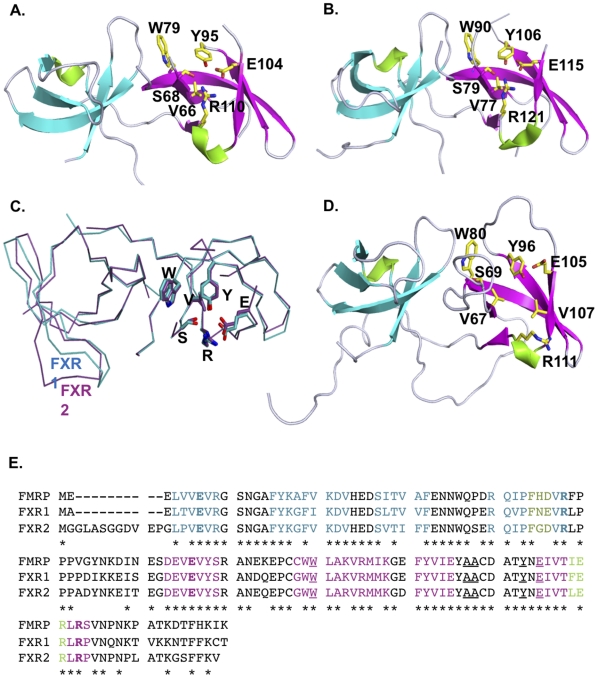
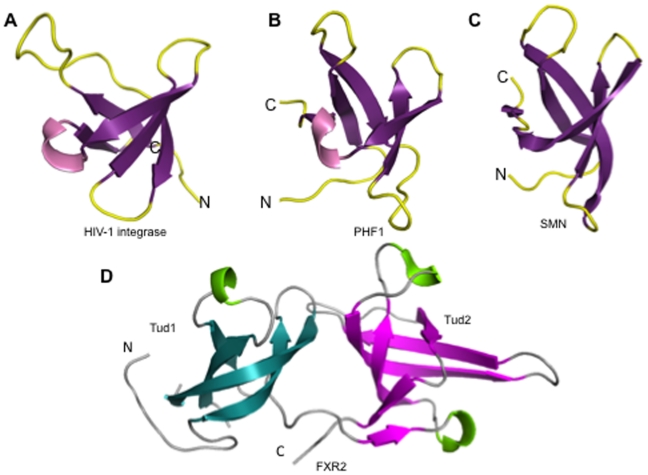
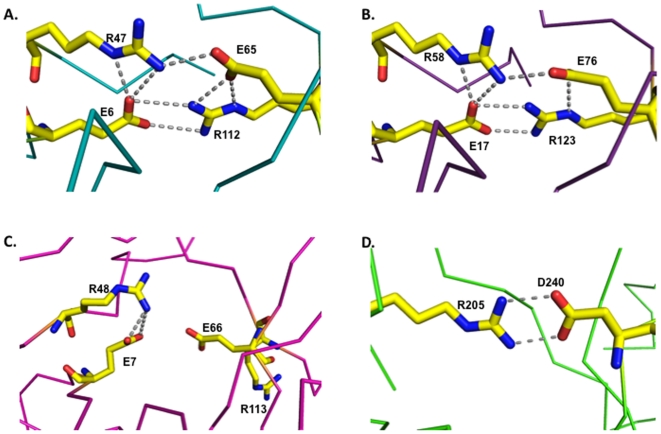
METHODOLOGY/PRINCIPAL FINDINGS: Here, we report the X-ray crystal structures of the non-canonical nuclear localization signals of the FXR1 and FXR2 autosomal paralogues of FMRP, which were determined at 2.50 and 1.92 Å, respectively. The nuclear localization signals of the FXR1 and FXR2 comprise tandem Tudor domain architectures, closely resembling that of UHRF1, which is proposed to bind methylated histone H3K9.
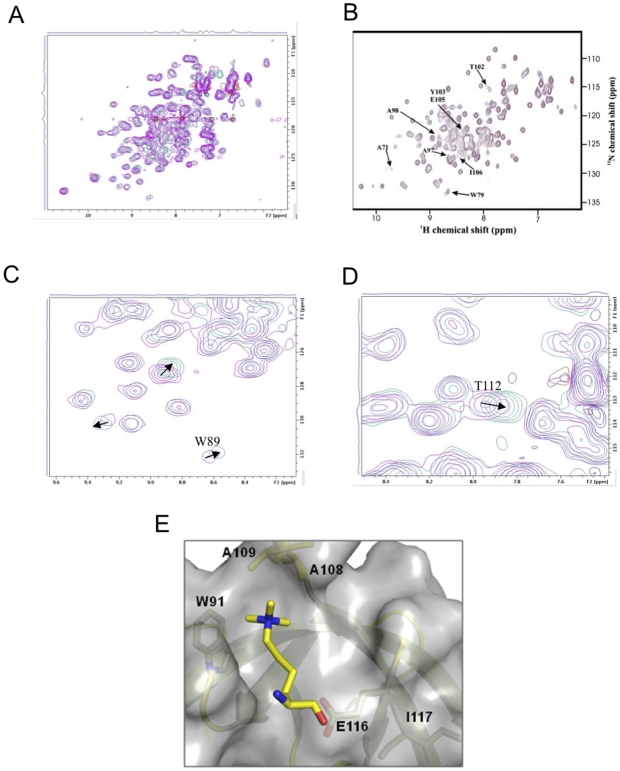
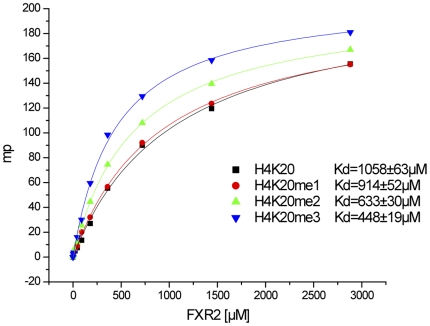
The FMRP, FXR1 and FXR2 proteins comprise a small family of highly conserved proteins that appear to be important in translational regulation, particularly in neuronal cells. The crystal structures of the N-terminal tandem Tudor domains of FXR1 and FXR2 revealed a conserved architecture with that of FMRP. Biochemical analysis of the tandem Tudor domains reveals their ability to preferentially recognize trimethylated peptides in a sequence-specific manner.
This article can also be viewed as an enhanced version in which the text of the article is integrated with interactive 3D representations and animated transitions. Please note that a web plugin is required to access this enhanced functionality. Instructions for the installation and use of the web plugin are available in Text S1.
脆性 X 智力低下 1 基因(FMR1)5'非翻译区的 CGG 三核苷酸重复扩展导致该基因的蛋白质表达受到抑制,是脆性 X 综合征的根本原因。在正常个体中,FMRP 蛋白与另外两个同源物(脆性 X 智力低下综合征相关蛋白 1 和 2)一起与 mRNA 结合,在核内形成核糖核蛋白复合物,然后转运到神经元细胞的树突和棘突。人们认为脆性 X 蛋白家族有助于调节蛋白质合成,这些蛋白质合成的位置是在对刺激作出反应时,mRNA 在局部被翻译的位置。
方法/主要发现:在这里,我们报告了 FMRP 的常染色体同源物 FXR1 和 FXR2 的非典型核定位信号的 X 射线晶体结构,分别在 2.50 和 1.92 Å 下确定。FXR1 和 FXR2 的核定位信号由串联 Tudor 结构域组成,与 UHRF1 非常相似,UHRF1 被认为可以结合甲基化的组蛋白 H3K9。
FMRP、FXR1 和 FXR2 蛋白构成了一个高度保守的小蛋白家族,它们似乎在翻译调节中非常重要,特别是在神经元细胞中。FXR1 和 FXR2 的 N 端串联 Tudor 结构域的晶体结构揭示了一个保守的结构,与 FMRP 相似。串联 Tudor 结构域的生化分析表明,它们能够以序列特异性的方式优先识别三甲基化肽。
本文也可以作为一个增强版本查看,其中文章的文本与交互式 3D 表示和动画过渡集成在一起。请注意,需要一个网络插件才能访问此增强功能。有关安装和使用网络插件的说明,请参见文本 S1。