Zhou Jia, Tao Peng, Fisher Jed F, Shi Qicun, Mobashery Shahriar, Schlegel H Bernhard
Department of Chemistry, Wayne State University, 5101 Cass Ave Detroit, Michigan 48202.
J Chem Theory Comput. 2010 Nov 9;6(11):3580-3587. doi: 10.1021/ct100382k.
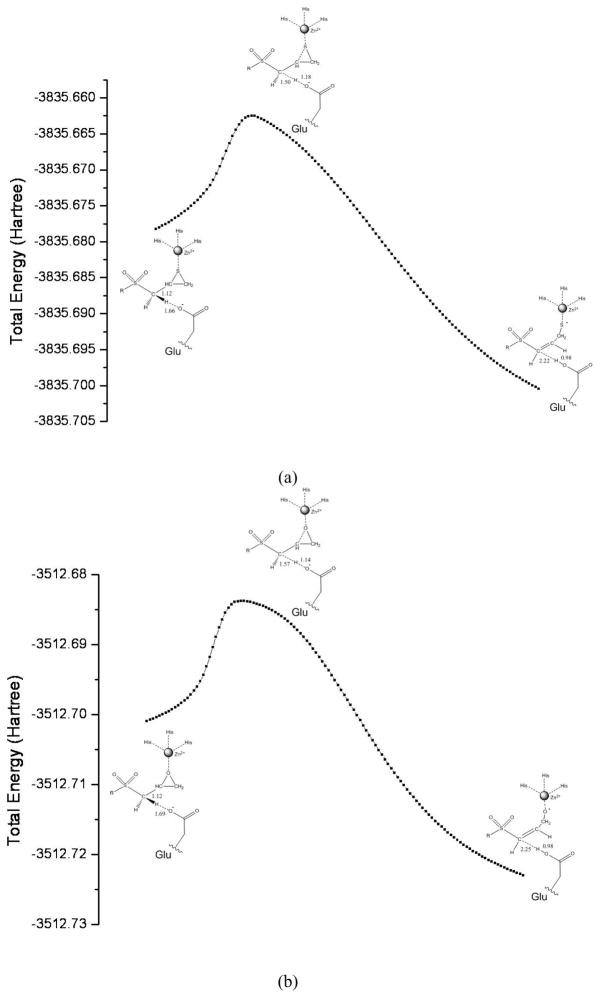
SB-3CT, (4-phenoxyphenylsulfonyl)methylthiirane, is a potent, mechanism-based inhibitor of the gelatinase sub-class of the matrix metalloproteinase (MMP) family of zinc proteases. The gelatinase MMPs are unusual in that there are several examples where both enantiomers of a racemic inhibitor have comparable inhibitory abilities. SB-3CT is one such example. Here, the inhibition mechanism of the MMP2 gelatinase by the (S)-SB-3CT enantiomer and its oxirane analogue is examined computationally, and compared to the mechanism of (R)-SB-3CT. Inhibition of MMP2 by (R)-SB-3CT was shown previously to involve enzyme-catalyzed C-H deprotonation adjacent to the sulfone, with concomitant opening by β-elimination of the sulfur of the three-membered thiirane ring. Similarly to the R enantiomer, (S)-SB-3CT was docked into the active site of MMP2, followed by molecular dynamics simulation to prepare the complex for combined quantum mechanics and molecular mechanics (QM/MM) calculations. QM/MM calculations with B3LYP/6-311+G(d,p) for the QM part (46 atoms) and the AMBER force field for the MM part were used to compare the reaction of (S)-SB-3CT and its oxirane analogue in the active site of MMP2 (9208 atoms). These calculations show that the barrier for the proton abstraction coupled ring opening reaction of (S)-SB-3CT in the MMP2 active site is 4.4 kcal/mol lower than its oxirane analogue, and the ring opening reaction energy of (S)-SB-3CT is only 1.6 kcal/mol less exothermic than its oxirane analogue. Calculations also show that the protonation of the ring-opened products by water is thermodynamically much more favorable for the alkoxide obtained from the oxirane, than for the thiolate obtained from the thiirane. In contrast to (R)-SB-3CT and the R-oxirane analogue, the double bonds of the ring-opened products of (S)-SB-3CT and its S-oxirane analogue have the cis-configuration. Vibrational frequency and intrinsic reaction path calculations on a reduced size QM/MM model (2747 atoms) provide additional insight into the mechanism. These calculations yield 5.9 and 6.7 for the deuterium kinetic isotope effect for C-H bond cleavage in the transition state for the R and S enantiomers of SB-3CT, in good agreement with the experimental results.
SB - 3CT,即(4 - 苯氧基苯基磺酰基)甲基硫杂环丙烷,是基质金属蛋白酶(MMP)家族锌蛋白酶中明胶酶亚类的一种强效、基于机制的抑制剂。明胶酶MMPs不同寻常之处在于,有几个外消旋抑制剂对映体的例子,其两种对映体都具有相当的抑制能力。SB - 3CT就是这样一个例子。在此,通过计算研究了(S)-SB - 3CT对映体及其环氧乙烷类似物对MMP2明胶酶的抑制机制,并与(R)-SB - 3CT的机制进行了比较。先前已表明(R)-SB - 3CT对MMP2的抑制涉及酶催化的砜相邻位置的C - H去质子化,同时通过β - 消除使三元硫杂环丙烷环的硫原子开环。与R对映体类似,将(S)-SB - 3CT对接至MMP2的活性位点,随后进行分子动力学模拟,为结合量子力学和分子力学(QM/MM)计算准备复合物。使用QM部分(46个原子)的B3LYP/6 - 311 + G(d,p)和MM部分的AMBER力场进行QM/MM计算,以比较(S)-SB - 3CT及其环氧乙烷类似物在MMP2活性位点(9208个原子)中的反应。这些计算表明,(S)-SB - 3CT在MMP2活性位点中质子夺取偶联开环反应的势垒比其环氧乙烷类似物低4.4千卡/摩尔,并且(S)-SB - 3CT的开环反应能量仅比其环氧乙烷类似物少放热1.6千卡/摩尔。计算还表明,水对开环产物的质子化在热力学上对由环氧乙烷得到的醇盐比对由硫杂环丙烷得到的硫醇盐更有利。与(R)-SB - 3CT和R - 环氧乙烷类似物相反,(S)-SB - 3CT及其S - 环氧乙烷类似物的开环产物的双键具有顺式构型。在简化尺寸的QM/MM模型(2747个原子)上进行的振动频率和本征反应路径计算为该机制提供了更多见解。这些计算得出SB - 3CT的R和S对映体在过渡态中C - H键断裂的氘动力学同位素效应分别为5.9和6.7,与实验结果良好吻合。