
日本经典型和轻型家族性腺瘤性息肉病患者中5种新的种系APC突变的鉴定及临床表型特征分析
Identification of 5 novel germline APC mutations and characterization of clinical phenotypes in Japanese patients with classical and attenuated familial adenomatous polyposis.
作者信息
Tao Hong, Shinmura Kazuya, Yamada Hidetaka, Maekawa Masato, Osawa Satoshi, Takayanagi Yasuhiro, Okamoto Kazuya, Terai Tomohiro, Mori Hiroki, Nakamura Toshio, Sugimura Haruhiko
机构信息
First Department of Pathology, Hamamatsu University School of Medicine, 1-20-1 Handayama, Higashi Ward, Hamamatsu, Shizuoka 431-3192, Japan.
出版信息
BMC Res Notes. 2010 Nov 16;3:305. doi: 10.1186/1756-0500-3-305.
BACKGROUND
Familial adenomatous polyposis (FAP) is an autosomal dominant hereditary disease characterized by multiple colorectal adenomatous polyps and frequent extracolonic manifestations. An attenuated form of FAP (AFAP) is diagnosed based on a milder colorectal phenotype, and the colorectal phenotype of (A)FAP has been linked to germline APC mutations. The relationships between the spectrum of mutations and extracolonic manifestations are quite well known, but they need to be further defined.
FINDINGS
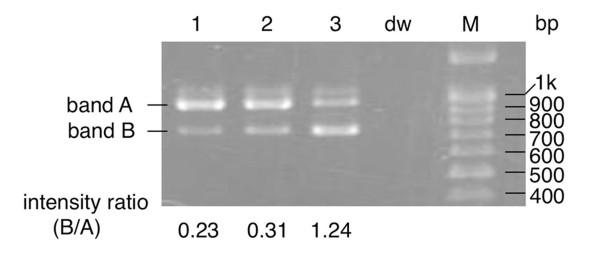
Nine germline APC mutations, but no large deletions, were identified in the APC locus of 8 (A)FAP patients, and 5 of the mutations, c.446A > T (p.Asp149Val), c.448A > T (p.Lys150X), c.454_457insAGAA (p.Glu152ArgfsX17), c.497insA (p.Thr166AsnfsX2), and c.1958G > C (p.Arg653Ser), were novel mutations. In one patient the p.Asp149Val mutation and p.Lys150X mutation were detected in the same APC allele. The c.1958G > C mutation was located in the last nucleotide of exon 14, and RT-PCR analysis revealed that the mutation resulted in abnormal splicing. The above findings meant that a nonsense mutation, a frameshift mutation, or an exonic mutation leading to abnormal splicing was found in every patient. The following phenotypes, especially extracolonic manifestations, were observed in our (A)FAP patients: (1) multiple gastroduodenal adenomas and early-onset gastric carcinoma in AFAP patients with an exon 4 mutation; (2) a desmoid tumor in two FAP patients with a germline APC mutation outside the region between codons 1403 and 1578, which was previously reported to be associated with the development of desmoid tumors in FAP patients; (3) multiple myeloma in an AFAP patient with an exon 4 mutation.
CONCLUSIONS
Nine germline APC mutations, 5 of them were novel, were identified in 8 Japanese (A)FAP patients, and some associations between germline APC mutations and extracolonic manifestations were demonstrated. These findings should contribute to establishing relationships between germline APC mutations and the extracolonic manifestations of (A)FAP patients in the future.
背景
家族性腺瘤性息肉病(FAP)是一种常染色体显性遗传病,其特征为多发性结直肠腺瘤性息肉以及常见的结肠外表现。一种症状较轻的FAP(AFAP)基于较轻的结直肠表型得以诊断,并且(A)FAP的结直肠表型与种系APC突变相关。突变谱与结肠外表现之间的关系已为人熟知,但仍需进一步明确。
研究结果
在8例(A)FAP患者的APC基因座中鉴定出9种种系APC突变,但未发现大片段缺失,其中5种突变,即c.446A>T(p.Asp149Val)、c.448A>T(p.Lys150X)、c.454_457insAGAA(p.Glu152ArgfsX17)、c.497insA(p.Thr166AsnfsX2)和c.1958G>C(p.Arg653Ser),为新发现的突变。在1例患者的同一个APC等位基因中检测到p.Asp149Val突变和p.Lys150X突变。c.1958G>C突变位于第14外显子的最后一个核苷酸处,逆转录聚合酶链反应(RT-PCR)分析显示该突变导致异常剪接。上述结果表明,在每位患者中均发现了无义突变、移码突变或导致异常剪接的外显子突变。在我们的(A)FAP患者中观察到以下表型,尤其是结肠外表现:(1)4号外显子突变的AFAP患者出现多发性胃十二指肠腺瘤和早发性胃癌;(2)2例种系APC突变位于密码子1403至1578之间区域之外的FAP患者发生硬纤维瘤,此前报道该区域与FAP患者硬纤维瘤的发生相关;(3)1例4号外显子突变的AFAP患者发生多发性骨髓瘤。
结论
在8例日本(A)FAP患者中鉴定出9种种系APC突变,其中5种为新发现的突变,并证实了种系APC突变与结肠外表现之间的一些关联。这些发现将有助于未来建立种系APC突变与(A)FAP患者结肠外表现之间的关系。


 Zotero 插件