Department of Pathology, Academic Medical Center, University of Amsterdam, Amsterdam, The Netherlands.
Lymphoma and Myeloma Center Amsterdam (LYMMCARE), Amsterdam, The Netherlands.
Leukemia. 2019 May;33(5):1063-1075. doi: 10.1038/s41375-019-0404-1. Epub 2019 Feb 15.
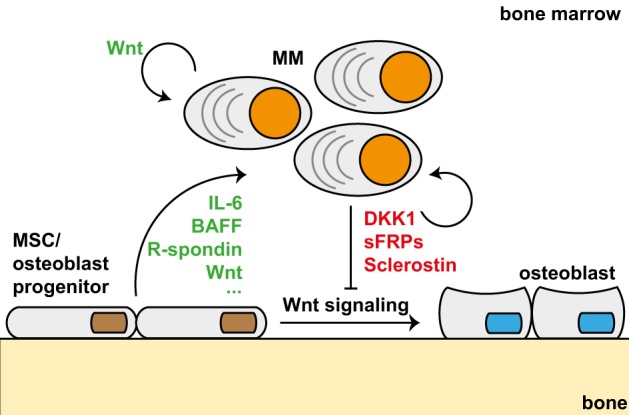
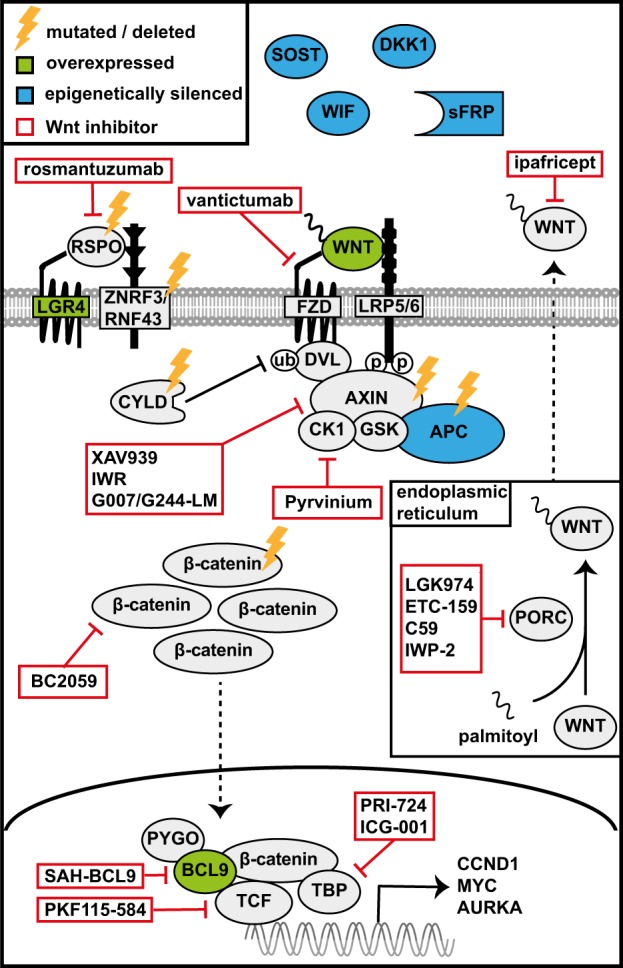
Aberrant activation of Wnt/β-catenin signaling plays a central role in the pathogenesis of a wide variety of malignancies and is typically caused by mutations in core Wnt pathway components driving constitutive, ligand-independent signaling. In multiple myelomas (MMs), however, these pathway intrinsic mutations are rare despite the fact that most tumors display aberrant Wnt pathway activity. Recent studies indicate that this activation is caused by genetic and epigenetic lesions of Wnt regulatory components, sensitizing MM cells to autocrine Wnt ligands and paracrine Wnts emanating from the bone marrow niche. These include deletion of the tumor suppressor CYLD, promotor methylation of the Wnt antagonists WIF1, DKK1, DKK3, and sFRP1, sFRP2, sFRP4, sFRP5, as well as overexpression of the co-transcriptional activator BCL9 and the R-spondin receptor LGR4. Furthermore, Wnt activity in MM is strongly promoted by interaction of both Wnts and R-spondins with syndecan-1 (CD138) on the MM cell-surface. Functionally, aberrant canonical Wnt signaling plays a dual role in the pathogenesis of MM: (I) it mediates proliferation, migration, and drug resistance of MM cells; (II) MM cells secrete Wnt antagonists that contribute to the development of osteolytic lesions by impairing osteoblast differentiation. As discussed in this review, these insights into the causes and consequences of aberrant Wnt signaling in MM will help to guide the development of targeting strategies. Importantly, since Wnt signaling in MM cells is largely ligand dependent, it can be targeted by drugs/antibodies that act upstream in the pathway, interfering with Wnt secretion, sequestering Wnts, or blocking Wnt (co)receptors.
Wnt/β-catenin 信号通路的异常激活在多种恶性肿瘤的发病机制中起着核心作用,通常是由于核心 Wnt 通路成分的突变导致组成性、配体非依赖性信号的产生。然而,在多发性骨髓瘤(MM)中,尽管大多数肿瘤表现出异常的 Wnt 通路活性,但这些通路内在突变却很少见。最近的研究表明,这种激活是由 Wnt 调节成分的遗传和表观遗传损伤引起的,使 MM 细胞对自分泌 Wnt 配体和来自骨髓龛的旁分泌 Wnt 敏感。这些包括肿瘤抑制因子 CYLD 的缺失、Wnt 拮抗剂 WIF1、DKK1、DKK3 和 sFRP1、sFRP2、sFRP4、sFRP5 的启动子甲基化,以及共转录激活因子 BCL9 和 R-spondin 受体 LGR4 的过表达。此外,Wnt 在 MM 中的活性受到 Wnt 和 R-spondin 与 MM 细胞表面的 syndecan-1(CD138)相互作用的强烈促进。功能上,异常的经典 Wnt 信号在 MM 的发病机制中起双重作用:(I)它介导 MM 细胞的增殖、迁移和耐药性;(II)MM 细胞分泌 Wnt 拮抗剂,通过损害成骨细胞分化,促进溶骨性病变的发展。正如本综述中所讨论的,这些对 MM 中异常 Wnt 信号的原因和后果的深入了解将有助于指导靶向策略的制定。重要的是,由于 MM 细胞中的 Wnt 信号主要依赖于配体,因此可以通过作用于通路上游的药物/抗体来靶向该信号,干扰 Wnt 分泌、隔离 Wnt 或阻断 Wnt(共)受体。