Program in Neuroscience and Center for BioDynamics, Boston University, Boston, Massachusetts, United States of America.
PLoS One. 2010 Nov 4;5(11):e13697. doi: 10.1371/journal.pone.0013697.
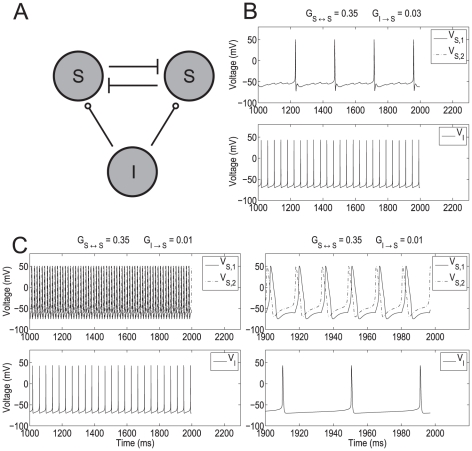
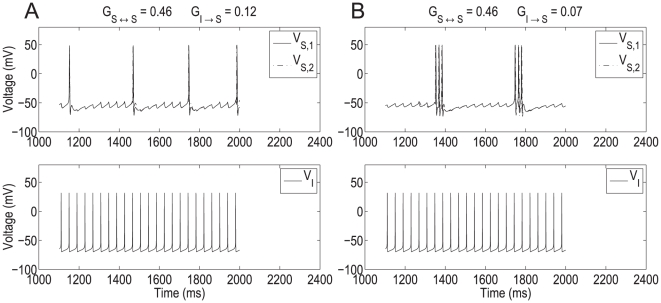
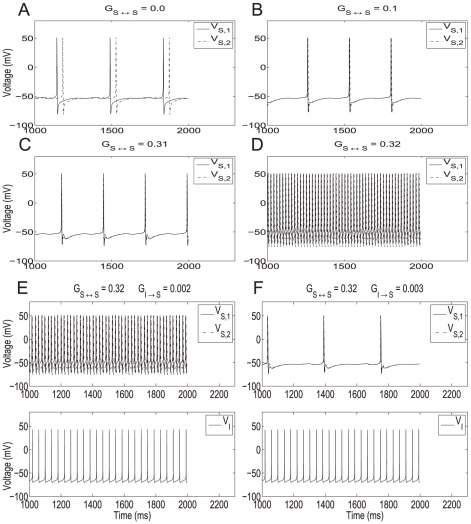
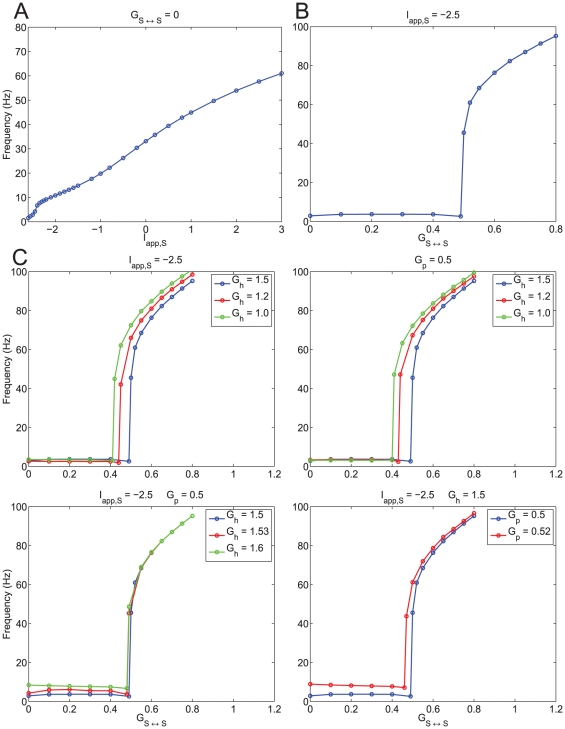
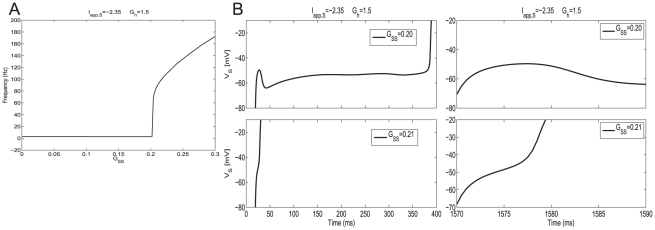
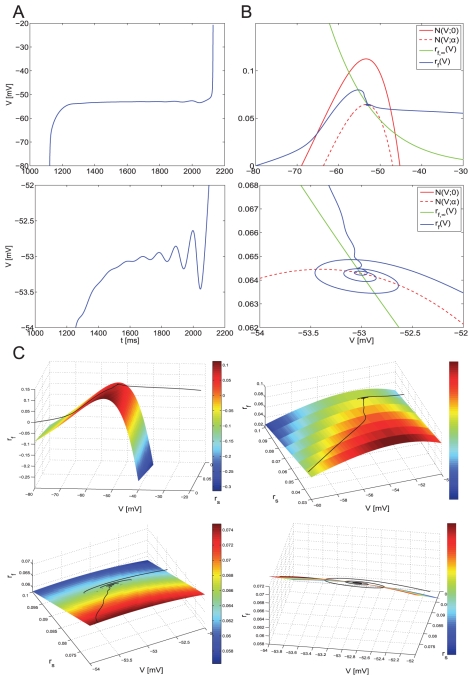
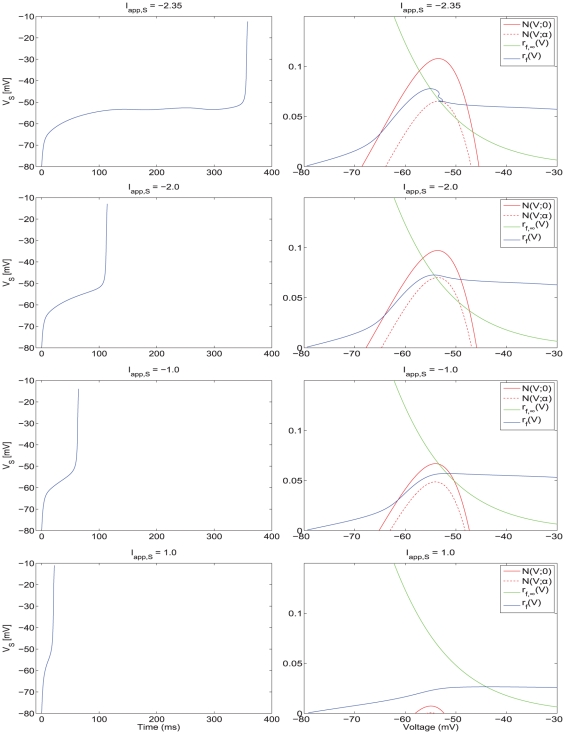
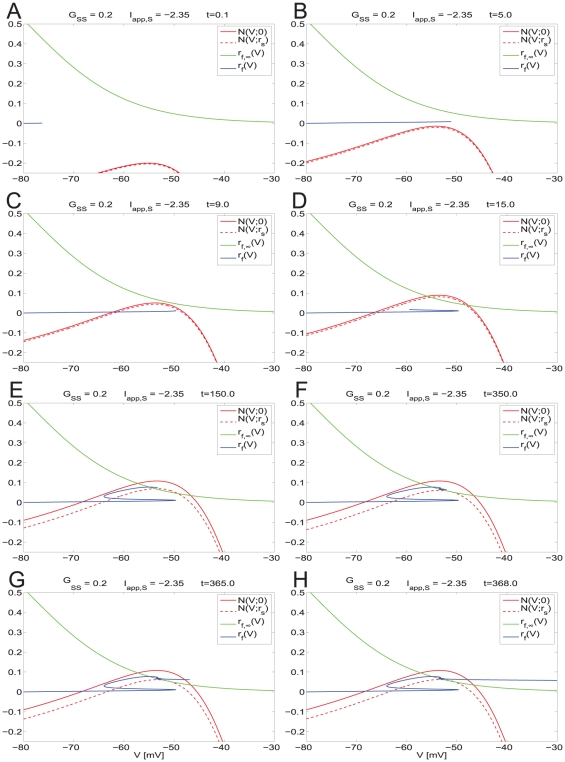
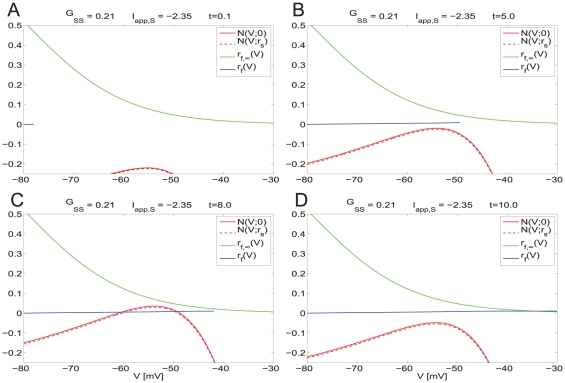
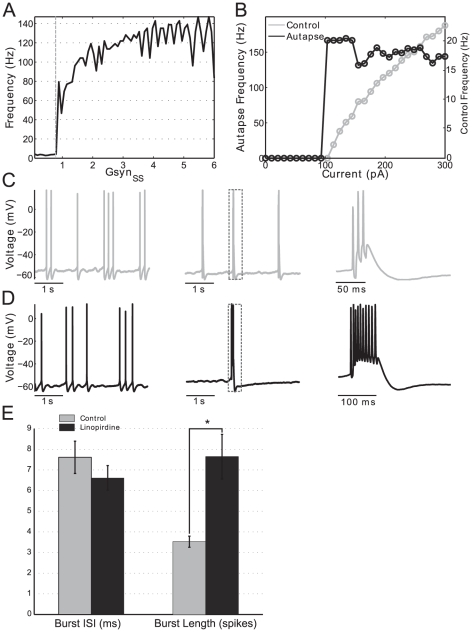
Recent studies have shown that stellate cells (SCs) of the medial entorhinal cortex become hyper-excitable in animal models of temporal lobe epilepsy. These studies have also demonstrated the existence of recurrent connections among SCs, reduced levels of recurrent inhibition in epileptic networks as compared to control ones, and comparable levels of recurrent excitation among SCs in both network types. In this work, we investigate the biophysical and dynamic mechanism of generation of the fast time scale corresponding to hyper-excitable firing and the transition between theta and fast firing frequency activity in SCs. We show that recurrently connected minimal networks of SCs exhibit abrupt, threshold-like transition between theta and hyper-excitable firing frequencies as the result of small changes in the maximal synaptic (AMPAergic) conductance. The threshold required for this transition is modulated by synaptic inhibition. Similar abrupt transition between firing frequency regimes can be observed in single, self-coupled SCs, which represent a network of recurrently coupled neurons synchronized in phase, but not in synaptically isolated SCs as the result of changes in the levels of the tonic drive. Using dynamical systems tools (phase-space analysis), we explain the dynamic mechanism underlying the genesis of the fast time scale and the abrupt transition between firing frequency regimes, their dependence on the intrinsic SC's currents and synaptic excitation. This abrupt transition is mechanistically different from others observed in similar networks with different cell types. Most notably, there is no bistability involved. 'In vitro' experiments using single SCs self-coupled with dynamic clamp show the abrupt transition between firing frequency regimes, and demonstrate that our theoretical predictions are not an artifact of the model. In addition, these experiments show that high-frequency firing is burst-like with a duration modulated by an M-current.
最近的研究表明,在颞叶癫痫的动物模型中,内侧脑岛皮层的星状细胞(SCs)变得过度兴奋。这些研究还表明,SCs 之间存在反复连接,与对照网络相比,癫痫网络中的反复抑制减少,而两种网络类型中的SCs 之间的反复兴奋水平相当。在这项工作中,我们研究了产生快速时间尺度的生物物理和动态机制,该时间尺度对应于SCs 中的过度兴奋发射以及θ和快速发射频率活动之间的转换。我们表明,反复连接的最小 SC 网络表现出θ和超兴奋发射频率之间的突然、阈值样的转变,作为最大突触(AMPA 能)电导的微小变化的结果。这种转变所需的阈值受突触抑制的调节。在单个自耦 SC 中也可以观察到类似的突然发射频率转变,单个自耦 SC 代表相位同步的反复耦联神经元网络,但在突触隔离的 SC 中则不会,因为紧张驱动的水平发生了变化。使用动力系统工具(相空间分析),我们解释了快速时间尺度产生和发射频率转变之间突然转变的动态机制,以及它们对内在 SC 电流和突触兴奋的依赖性。这种突然转变在具有不同细胞类型的类似网络中观察到的其他转变机制不同。值得注意的是,不存在双稳态。使用单个 SC 与动态钳位自耦进行的“体外”实验显示了发射频率转变之间的突然转变,并证明我们的理论预测不是模型的人为产物。此外,这些实验表明,高频发射具有爆发式,其持续时间由 M 电流调制。