Department of Otolaryngology Head and Neck Surgery, Center for Hearing and Balance, Johns Hopkins University School of Medicine, Baltimore, Maryland, United States of America.
PLoS One. 2010 Nov 4;5(11):e13836. doi: 10.1371/journal.pone.0013836.
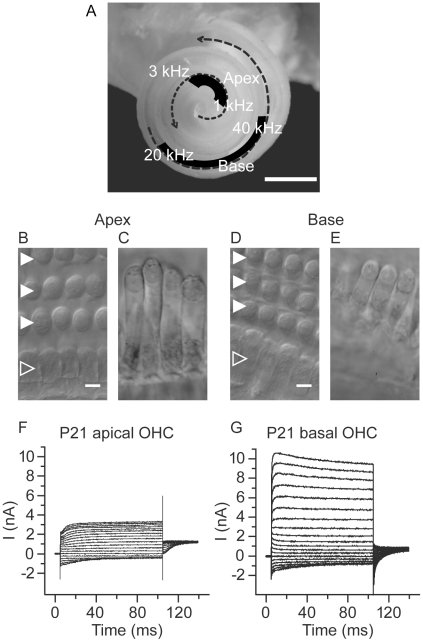
Outer hair cells are the specialized sensory cells that empower the mammalian hearing organ, the cochlea, with its remarkable sensitivity and frequency selectivity. Sound-evoked receptor potentials in outer hair cells are shaped by both voltage-gated K(+) channels that control the membrane potential and also ligand-gated K(+) channels involved in the cholinergic efferent modulation of the membrane potential. The objectives of this study were to investigate the tonotopic contribution of BK channels to voltage- and ligand-gated currents in mature outer hair cells from the rat cochlea.
METHODOLOGY/PRINCIPAL: Findings In this work we used patch clamp electrophysiology and immunofluorescence in tonotopically defined segments of the rat cochlea to determine the contribution of BK channels to voltage- and ligand-gated currents in outer hair cells. Although voltage and ligand-gated currents have been investigated previously in hair cells from the rat cochlea, little is known about their tonotopic distribution or potential contribution to efferent inhibition. We found that apical (low frequency) outer hair cells had no BK channel immunoreactivity and little or no BK current. In marked contrast, basal (high frequency) outer hair cells had abundant BK channel immunoreactivity and BK currents contributed significantly to both voltage-gated and ACh-evoked K(+) currents.
CONCLUSIONS/SIGNIFICANCE: Our findings suggest that basal (high frequency) outer hair cells may employ an alternative mechanism of efferent inhibition mediated by BK channels instead of SK2 channels. Thus, efferent synapses may use different mechanisms of action both developmentally and tonotopically to support high frequency audition. High frequency audition has required various functional specializations of the mammalian cochlea, and as shown in our work, may include the utilization of BK channels at efferent synapses. This mechanism of efferent inhibition may be related to the unique acetylcholine receptors that have evolved in mammalian hair cells compared to those of other vertebrates.
外毛细胞是赋予哺乳动物听觉器官——耳蜗其卓越灵敏度和频率选择性的特化感觉细胞。外毛细胞中的声诱发受体电位既受控制膜电位的电压门控 K(+)通道调控,也受参与膜电位胆碱能传出调制的配体门控 K(+)通道调控。本研究的目的是研究 BK 通道对成熟大鼠耳蜗外毛细胞电压门控和配体门控电流的音位贡献。
方法/原理:在这项工作中,我们使用膜片钳电生理学和免疫荧光技术,在大鼠耳蜗的音位定义段确定 BK 通道对毛细胞电压门控和配体门控电流的贡献。尽管以前已经在大鼠耳蜗毛细胞中研究过电压和配体门控电流,但对它们的音位分布或对传出抑制的潜在贡献知之甚少。我们发现,顶端(低频)外毛细胞没有 BK 通道免疫反应性,几乎没有或没有 BK 电流。相比之下,基底(高频)外毛细胞具有丰富的 BK 通道免疫反应性,BK 电流对电压门控和 ACh 诱发的 K(+)电流都有显著贡献。
结论/意义:我们的发现表明,基底(高频)外毛细胞可能采用替代的传出抑制机制,由 BK 通道介导,而不是 SK2 通道。因此,传出突触可能在发育和音位上使用不同的作用机制来支持高频听觉。高频听觉需要哺乳动物耳蜗的各种功能特化,正如我们的工作所示,可能包括在传出突触利用 BK 通道。这种传出抑制机制可能与哺乳动物毛细胞中进化而来的独特乙酰胆碱受体有关,而这些受体与其他脊椎动物的受体不同。