Department of Community Health, Alpert Medical School, Brown University, Providence, RI, USA.
J Acquir Immune Defic Syndr. 2011 Feb 1;56(2):151-65. doi: 10.1097/QAI.0b013e318202c82c.
With increasing calls for linking HIV-infected individuals to treatment and care via expanded testing, we examined sociodemographic and behavioral characteristics associated with HIV testing among men and women in Soweto, South Africa.
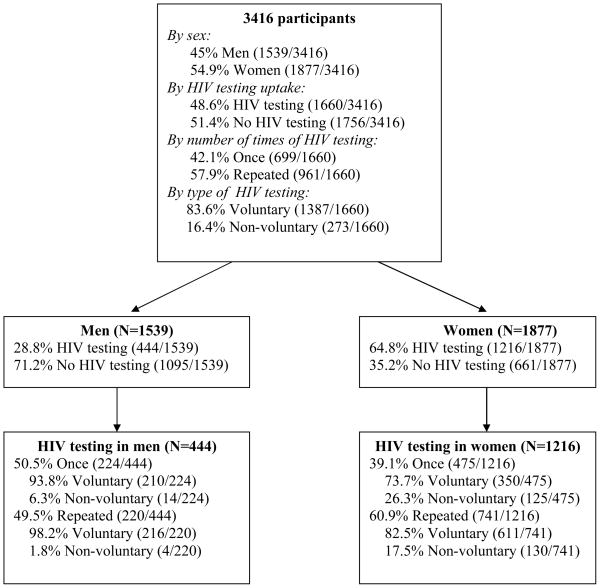
We conducted a cross-sectional household survey involving 1539 men and 1877 women as part of the community-randomized prevention trial Project ACCEPT/HPTN043 between July 2007 to October 2007. Multivariable logistic regression models, stratified by sex, assessed factors associated with HIV testing and then repeated testing.
Most women (64.8%) and 28.9% of men reported ever having been tested for HIV, among whom 57.9% reported repeated HIV testing. In multivariable analyses, youth and students had a lower odds of HIV testing. Men and women who had conversations about HIV/AIDS with increasing frequency and who had heard about antiretroviral therapy were more likely to report HIV testing, and repeated testing. Men who had ≥ 12 years of education and who were of high socioeconomic status, and women who were married, who were of low socioeconomic status, and who had children under their care had a higher odds of HIV testing. Women, older individuals, those with higher levels of education, married individuals, and those with children under their care had a higher odds of reporting repeated HIV testing. Uptake of HIV testing was not associated with condom use, having multiple sex partners, and HIV-related stigma.
Given the low uptake of HIV testing among men and youth, further targeted interventions could facilitate a test and treat strategy among urban South Africans.
随着越来越多的人呼吁通过扩大检测将艾滋病毒感染者与治疗和护理联系起来,我们研究了与南非索韦托的男性和女性艾滋病毒检测相关的社会人口学和行为特征。
我们进行了一项横断面家庭调查,涉及 1539 名男性和 1877 名女性,作为 2007 年 7 月至 2007 年 10 月期间社区随机预防试验项目 ACCEPT/HPTN043 的一部分。多变量逻辑回归模型,按性别分层,评估了与 HIV 检测相关的因素,然后重复检测。
大多数女性(64.8%)和 28.9%的男性报告曾经接受过艾滋病毒检测,其中 57.9%报告了重复艾滋病毒检测。在多变量分析中,年轻人和学生接受 HIV 检测的可能性较低。与艾滋病毒/艾滋病进行越来越频繁对话的男性和女性,以及听说过抗逆转录病毒疗法的男性和女性,更有可能报告 HIV 检测和重复检测。受过 12 年以上教育且社会经济地位较高的男性,以及已婚、社会经济地位较低且有子女的女性,接受 HIV 检测的可能性更高。女性、年龄较大的个体、受教育程度较高的个体、已婚个体以及有子女的个体,重复 HIV 检测的可能性更高。艾滋病毒检测的采用与避孕套使用、多个性伴侣和与艾滋病毒相关的耻辱感无关。
鉴于男性和年轻人中 HIV 检测率较低,进一步有针对性的干预措施可以促进南非城市地区的检测和治疗策略。