Laboratoire Psychologie de la Perception, CNRS and Université Paris Descartes, Paris, France.
PLoS Comput Biol. 2010 Nov 11;6(11):e1000993. doi: 10.1371/journal.pcbi.1000993.
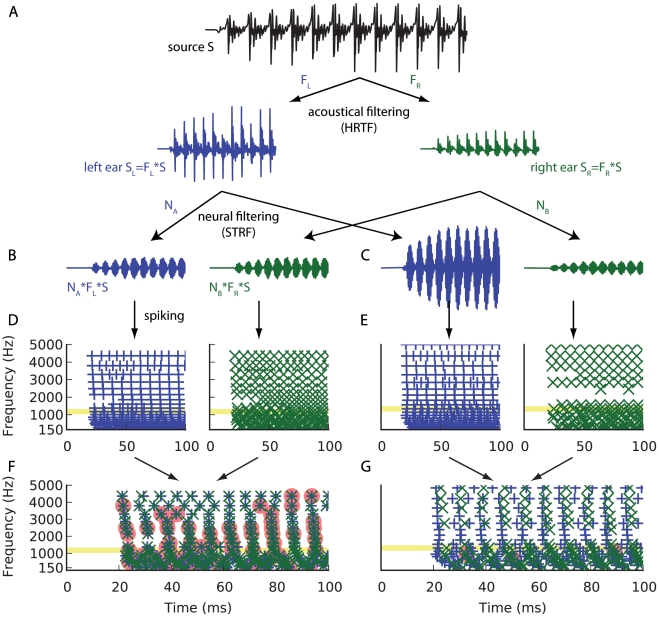
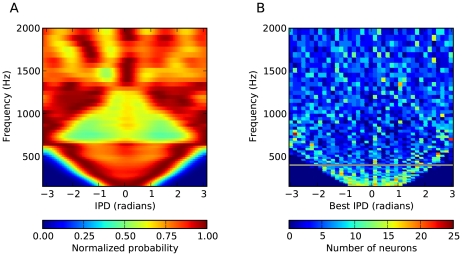
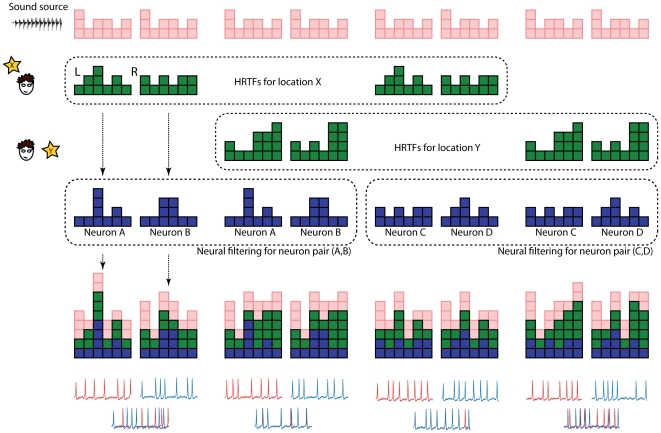
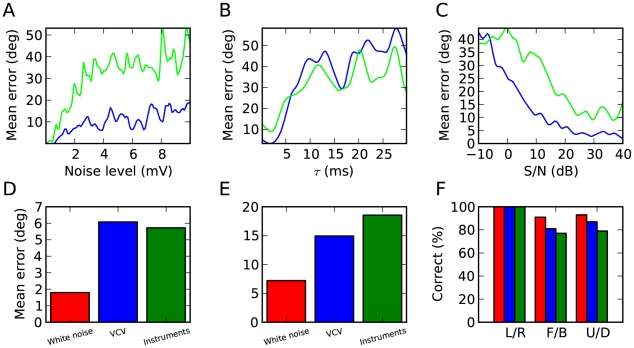
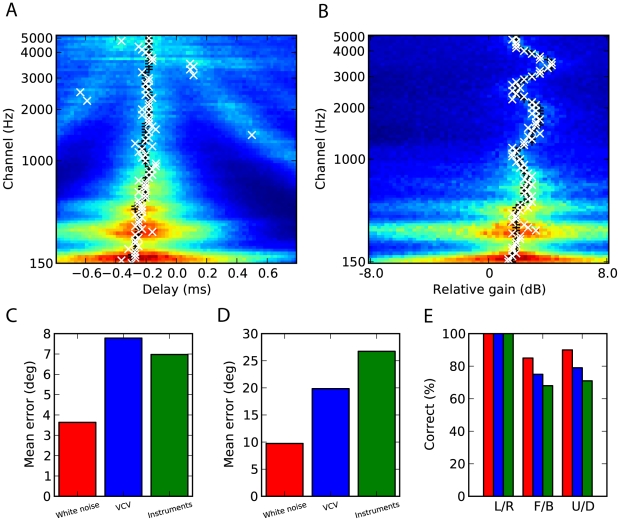
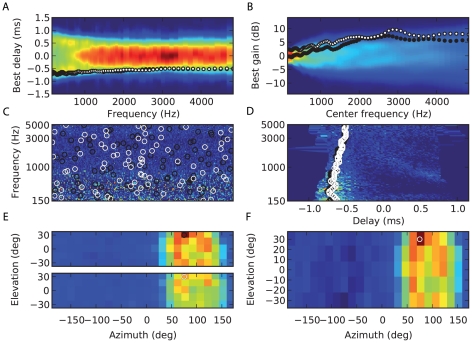
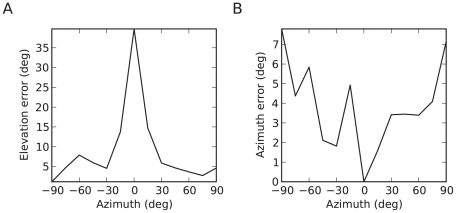
Spike timing is precise in the auditory system and it has been argued that it conveys information about auditory stimuli, in particular about the location of a sound source. However, beyond simple time differences, the way in which neurons might extract this information is unclear and the potential computational advantages are unknown. The computational difficulty of this task for an animal is to locate the source of an unexpected sound from two monaural signals that are highly dependent on the unknown source signal. In neuron models consisting of spectro-temporal filtering and spiking nonlinearity, we found that the binaural structure induced by spatialized sounds is mapped to synchrony patterns that depend on source location rather than on source signal. Location-specific synchrony patterns would then result in the activation of location-specific assemblies of postsynaptic neurons. We designed a spiking neuron model which exploited this principle to locate a variety of sound sources in a virtual acoustic environment using measured human head-related transfer functions. The model was able to accurately estimate the location of previously unknown sounds in both azimuth and elevation (including front/back discrimination) in a known acoustic environment. We found that multiple representations of different acoustic environments could coexist as sets of overlapping neural assemblies which could be associated with spatial locations by Hebbian learning. The model demonstrates the computational relevance of relative spike timing to extract spatial information about sources independently of the source signal.
听觉系统中的尖峰时间是精确的,有人认为它传递了有关听觉刺激的信息,特别是有关声源位置的信息。然而,除了简单的时间差异之外,神经元提取这种信息的方式尚不清楚,潜在的计算优势也未知。对于动物来说,这项任务的计算难度在于从两个高度依赖未知声源信号的单耳信号中定位意外声源的位置。在由频谱-时变滤波和尖峰非线性组成的神经元模型中,我们发现空间化声音引起的双耳结构被映射到依赖于声源位置而不是声源信号的同步模式。然后,特定于位置的同步模式将导致特定于位置的突触后神经元集合的激活。我们设计了一个尖峰神经元模型,该模型利用这一原理,使用测量的人类头部相关传递函数,在虚拟声环境中定位各种声源。该模型能够在已知声环境中准确估计先前未知声音的方位和仰角(包括前后区分)位置。我们发现,不同声学环境的多种表示形式可以作为重叠神经网络集合同时存在,并通过赫布学习与空间位置相关联。该模型证明了相对尖峰时间的计算相关性,可用于独立于声源信号提取有关声源的空间信息。