
酿酒酵母 RecQ 解旋酶 SGS1 在减数分裂基因组监测中的作用。
The roles of the Saccharomyces cerevisiae RecQ helicase SGS1 in meiotic genome surveillance.
机构信息
Department of Genetics, University of Leicester, Leicester, United Kingdom.
出版信息
PLoS One. 2010 Nov 9;5(11):e15380. doi: 10.1371/journal.pone.0015380.
BACKGROUND
The Saccharomyces cerevisiae RecQ helicase Sgs1 is essential for mitotic and meiotic genome stability. The stage at which Sgs1 acts during meiosis is subject to debate. Cytological experiments showed that a deletion of SGS1 leads to an increase in synapsis initiation complexes and axial associations leading to the proposal that it has an early role in unwinding surplus strand invasion events. Physical studies of recombination intermediates implicate it in the dissolution of double Holliday junctions between sister chromatids.
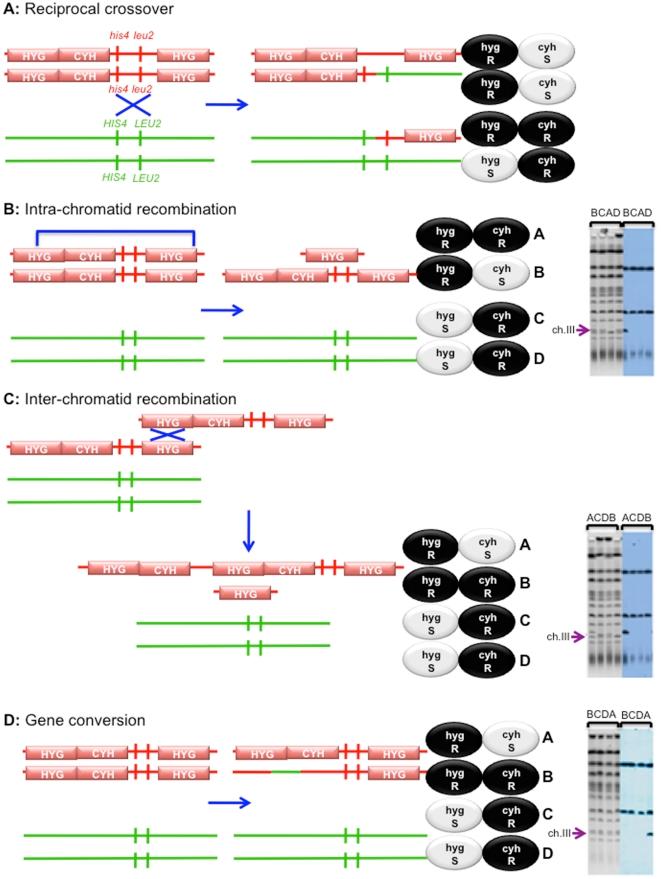
METHODOLOGY/PRINCIPAL FINDINGS: In this work, we observed an increase in meiotic recombination between diverged sequences (homeologous recombination) and an increase in unequal sister chromatid events when SGS1 is deleted. The first of these observations is most consistent with an early role of Sgs1 in unwinding inappropriate strand invasion events while the second is consistent with unwinding or dissolution of recombination intermediates in an Mlh1- and Top3-dependent manner. We also provide data that suggest that Sgs1 is involved in the rejection of 'second strand capture' when sequence divergence is present. Finally, we have identified a novel class of tetrads where non-sister spores (pairs of spores where each contains a centromere marker from a different parent) are inviable. We propose a model for this unusual pattern of viability based on the inability of sgs1 mutants to untangle intertwined chromosomes. Our data suggest that this role of Sgs1 is not dependent on its interaction with Top3. We propose that in the absence of SGS1 chromosomes may sometimes remain entangled at the end of pre-meiotic replication. This, combined with reciprocal crossing over, could lead to physical destruction of the recombined and entangled chromosomes. We hypothesise that Sgs1, acting in concert with the topoisomerase Top2, resolves these structures.
CONCLUSIONS
This work provides evidence that Sgs1 interacts with various partner proteins to maintain genome stability throughout meiosis.
背景
酿酒酵母 RecQ 解旋酶 Sgs1 对有丝分裂和减数分裂的基因组稳定性至关重要。Sgs1 在减数分裂中发挥作用的阶段存在争议。细胞学实验表明,SGS1 的缺失会导致联会起始复合物和轴突联会的增加,从而提出它在解开多余的链入侵事件中具有早期作用。对重组中间体的物理研究表明,它参与姐妹染色单体之间双链 Holliday 结的溶解。
方法/主要发现:在这项工作中,我们观察到当 SGS1 缺失时,同源序列之间的减数分裂重组(同源重组)增加,以及姐妹染色单体不等事件增加。这些观察结果中的第一个最符合 Sgs1 在解开不合适的链入侵事件中的早期作用,而第二个则符合以 Mlh1 和 Top3 依赖的方式解开或溶解重组中间体。我们还提供的数据表明,当存在序列差异时,Sgs1 参与了对“第二链捕获”的排斥。最后,我们发现了一类新的四分体,其中非姐妹孢子(每对孢子中各含有一个来自不同亲本的着丝粒标记)是不可存活的。我们基于 sgs1 突变体无法解开缠绕的染色体的能力,提出了一种新的四合体不可存活模式。我们的数据表明,Sgs1 的这种作用不依赖于其与 Top3 的相互作用。我们提出,在没有 SGS1 的情况下,染色体有时可能在减数分裂前复制结束时仍然缠绕在一起。这与相互交叉结合在一起,可能导致重组和缠绕的染色体发生物理破坏。我们假设 Sgs1 与拓扑异构酶 Top2 协同作用,解决这些结构。
结论
这项工作提供了证据表明,Sgs1 与各种伴侣蛋白相互作用,以在整个减数分裂过程中维持基因组稳定性。


 Zotero 插件