Molecular Biophysics & Biochemistry, Yale School of Medicine, New Haven, Connecticut.
Yale J Biol Med. 2013 Dec 13;86(4):453-61.
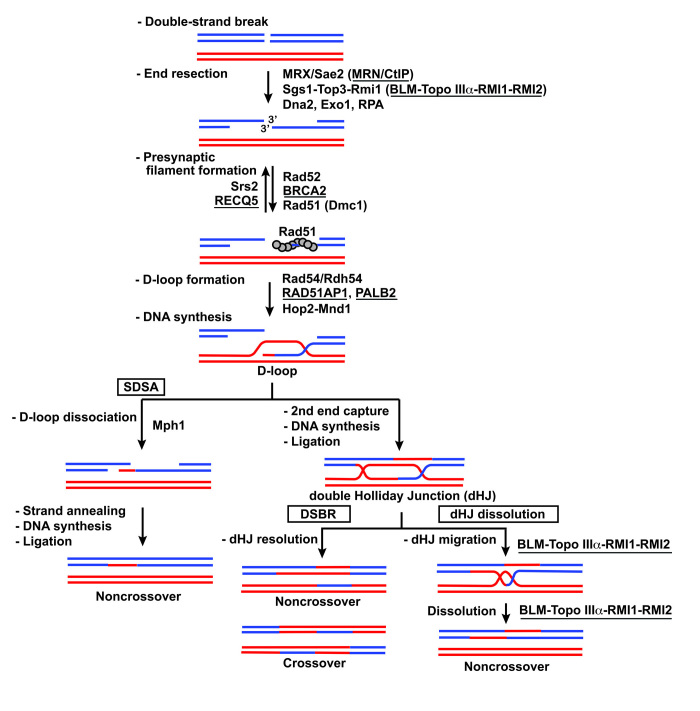
The DNA double-strand break (DSB), arising from exposure to ionizing radiation or various chemotherapeutic agents or from replication fork collapse, is among the most dangerous of chromosomal lesions. DSBs are highly cytotoxic and can lead to translocations, deletions, duplications, or mutations if mishandled. DSBs are eliminated by either homologous recombination (HR), which uses a homologous template to guide accurate repair, or by nonhomologous end joining (NHEJ), which simply rejoins the two broken ends after damaged nucleotides have been removed. HR generates error-free repair products and is also required for generating chromosome arm crossovers between homologous chromosomes in meiotic cells. The HR reaction includes several distinct steps: resection of DNA ends, homologous DNA pairing, DNA synthesis, and processing of HR intermediates. Each occurs in a highly regulated fashion utilizing multiple protein factors. These steps are being elucidated using a combination of genetic tools, cell-based assays, and in vitro reconstitution with highly purified HR proteins. In this review, we summarize contributions from our laboratory at Yale University in understanding HR mechanisms in eukaryotic cells.
DNA 双链断裂 (DSB) 是由电离辐射或各种化疗药物暴露或复制叉崩溃引起的,是最危险的染色体损伤之一。如果处理不当,DSB 高度细胞毒性,并可能导致易位、缺失、重复或突变。DSB 可通过同源重组 (HR) 或非同源末端连接 (NHEJ) 消除,前者使用同源模板来指导精确修复,后者在去除受损核苷酸后简单地重新连接两个断裂末端。HR 产生无错误的修复产物,并且还需要在减数分裂细胞中同源染色体之间产生染色体臂交叉。HR 反应包括几个不同的步骤:DNA 末端的切除、同源 DNA 配对、DNA 合成和 HR 中间产物的处理。每个步骤都以高度调控的方式利用多种蛋白质因子进行。我们使用遗传工具、基于细胞的测定和高度纯化的 HR 蛋白的体外重建相结合,来阐明这些步骤。在这篇综述中,我们总结了耶鲁大学实验室在理解真核细胞 HR 机制方面的贡献。