Khorshid Mohsen, Rodak Christoph, Zavolan Mihaela
Biozentrum, University of Basel and Swiss Institute of Bioinformatics, Klingelbergstrasse 50-70, 4056 Basel, Switzerland.
Nucleic Acids Res. 2011 Jan;39(Database issue):D245-52. doi: 10.1093/nar/gkq940. Epub 2010 Nov 17.
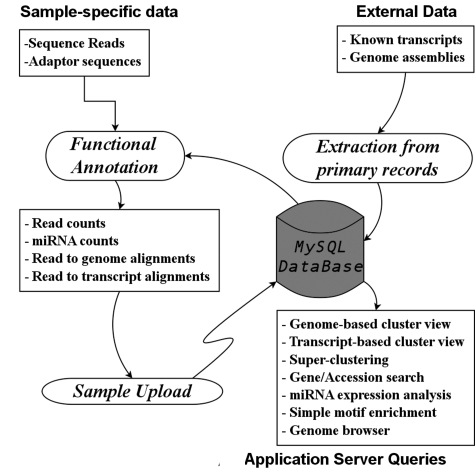
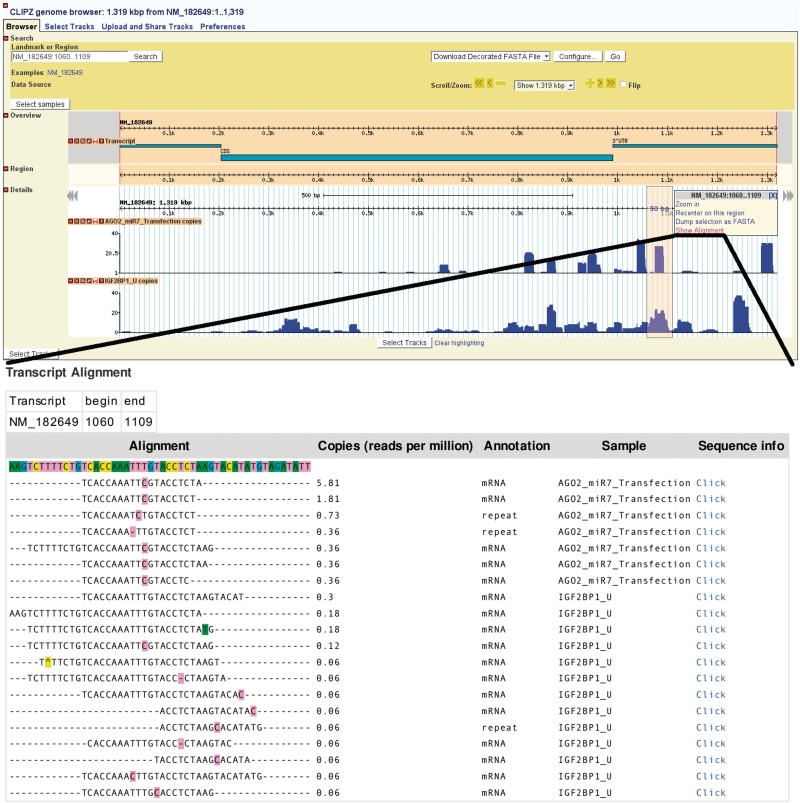
The stability, localization and translation rate of mRNAs are regulated by a multitude of RNA-binding proteins (RBPs) that find their targets directly or with the help of guide RNAs. Among the experimental methods for mapping RBP binding sites, cross-linking and immunoprecipitation (CLIP) coupled with deep sequencing provides transcriptome-wide coverage as well as high resolution. However, partly due to their vast volume, the data that were so far generated in CLIP experiments have not been put in a form that enables fast and interactive exploration of binding sites. To address this need, we have developed the CLIPZ database and analysis environment. Binding site data for RBPs such as Argonaute 1-4, Insulin-like growth factor II mRNA-binding protein 1-3, TNRC6 proteins A-C, Pumilio 2, Quaking and Polypyrimidine tract binding protein can be visualized at the level of the genome and of individual transcripts. Individual users can upload their own sequence data sets while being able to limit the access to these data to specific users, and analyses of the public and private data sets can be performed interactively. CLIPZ, available at http://www.clipz.unibas.ch, aims to provide an open access repository of information for post-transcriptional regulatory elements.
mRNA的稳定性、定位和翻译速率受多种RNA结合蛋白(RBP)调控,这些蛋白可直接或借助导向RNA找到其靶标。在绘制RBP结合位点的实验方法中,交联免疫沉淀(CLIP)结合深度测序可实现全转录组覆盖及高分辨率。然而,部分由于数据量巨大,迄今为止CLIP实验产生的数据尚未以一种能够快速且交互式探索结合位点的形式呈现。为满足这一需求,我们开发了CLIPZ数据库及分析环境。诸如AGO1 - 4、胰岛素样生长因子II mRNA结合蛋白1 - 3、TNRC6蛋白A - C、Pumilio 2、Quaking和多嘧啶序列结合蛋白等RBP的结合位点数据可在基因组和单个转录本水平可视化。个人用户可上传自己的序列数据集,同时能够将对这些数据的访问限制给特定用户,并且可以交互式地对公共和私有数据集进行分析。CLIPZ可通过http://www.clipz.unibas.ch获取,旨在为转录后调控元件提供一个开放获取的信息库。