Guangxi Key Laboratory of Subtropical Bioresources Conservation and Utilization, College of Life Science and Technology, Guangxi University, 100 Daxue East Road, Nanning, Guangxi, 530004, People's Republic of China.
Microb Cell Fact. 2010 Nov 23;9:91. doi: 10.1186/1475-2859-9-91.
Fumarase catalyzes the reversible hydration of fumarate to L-malate and is a key enzyme in the tricarboxylic acid (TCA) cycle and in amino acid metabolism. Fumarase is also used for the industrial production of L-malate from the substrate fumarate. Thermostable and high-activity fumarases from organisms that inhabit extreme environments may have great potential in industry, biotechnology, and basic research. The marine environment is highly complex and considered one of the main reservoirs of microbial diversity on the planet. However, most of the microorganisms are inaccessible in nature and are not easily cultivated in the laboratory. Metagenomic approaches provide a powerful tool to isolate and identify enzymes with novel biocatalytic activities for various biotechnological applications.
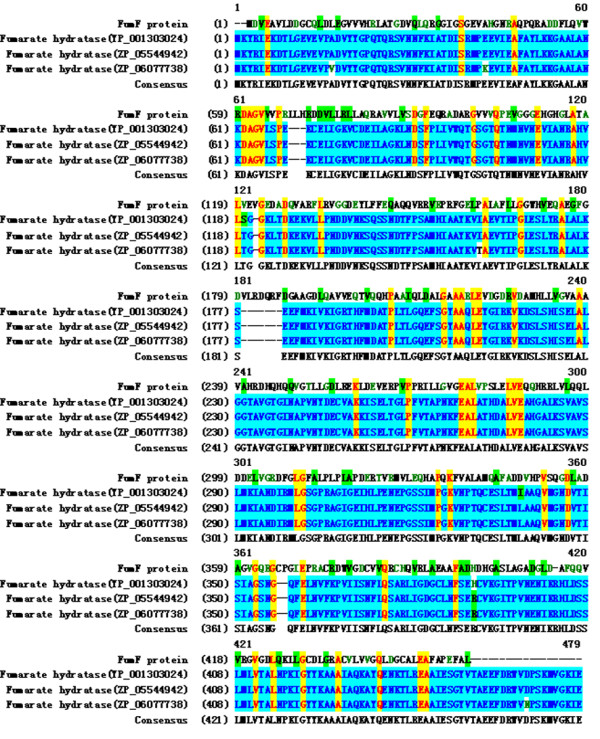
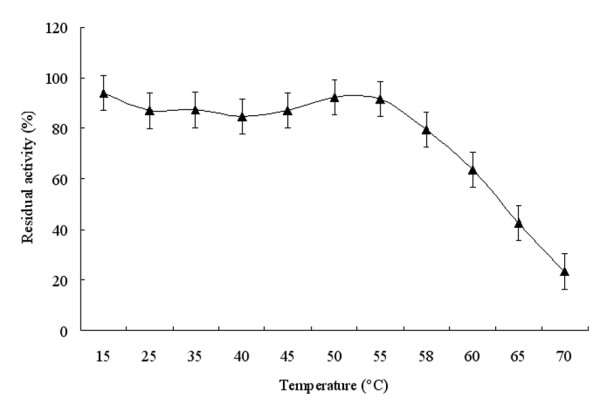
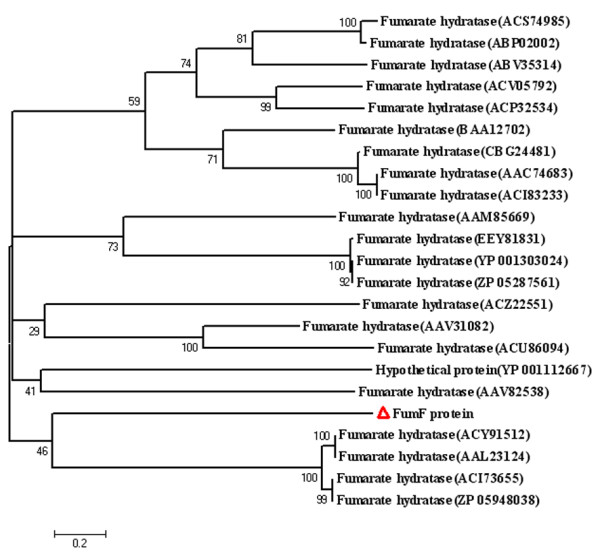
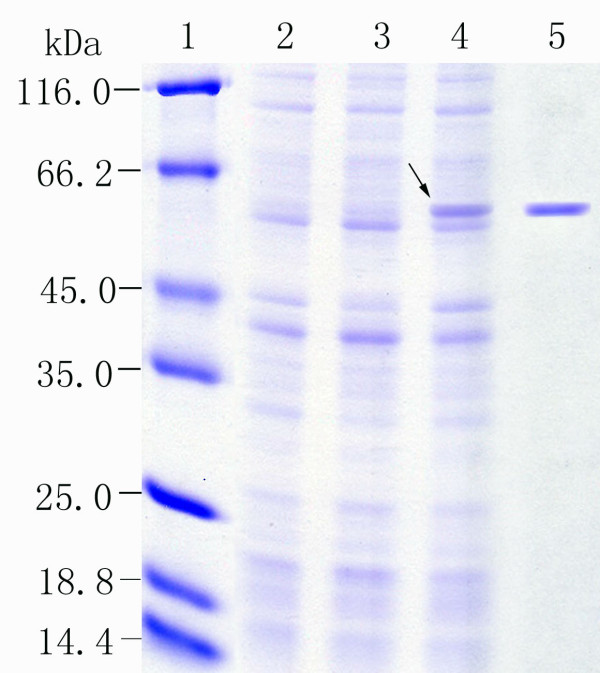
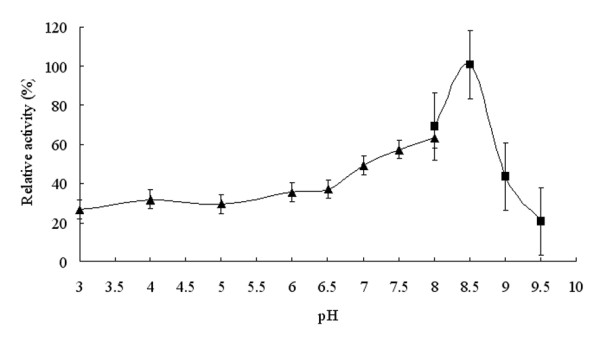
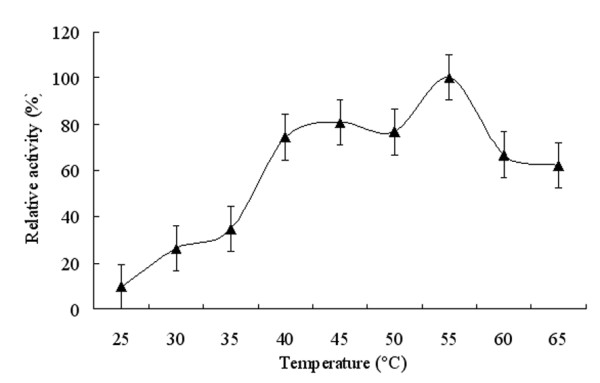
A plasmid metagenomic library was constructed from uncultivated marine microorganisms within marine water samples. Through sequence-based screening of the DNA library, a gene encoding a novel fumarase (named FumF) was isolated. Amino acid sequence analysis revealed that the FumF protein shared the greatest homology with Class II fumarate hydratases from Bacteroides sp. 2_1_33B and Parabacteroides distasonis ATCC 8503 (26% identical and 43% similar). The putative fumarase gene was subcloned into pETBlue-2 vector and expressed in E. coli BL21(DE3)pLysS. The recombinant protein was purified to homogeneity. Functional characterization by high performance liquid chromatography confirmed that the recombinant FumF protein catalyzed the hydration of fumarate to form L-malate. The maximum activity for FumF protein occurred at pH 8.5 and 55°C in 5 mM Mg(2+). The enzyme showed higher affinity and catalytic efficiency under optimal reaction conditions: K(m) = 0.48 mM, V(max) = 827 μM/min/mg, and k(cat)/K(m) = 1900 mM/s.
We isolated a novel fumarase gene, fumF, from a sequence-based screen of a plasmid metagenomic library from uncultivated marine microorganisms. The properties of FumF protein may be ideal for the industrial production of L-malate under higher temperature conditions. The identification of FumF underscores the potential of marine metagenome screening for novel biomolecules.
延胡索酸酶催化延胡索酸可逆水合生成 L-苹果酸,是三羧酸 (TCA) 循环和氨基酸代谢中的关键酶。延胡索酸酶也用于工业上从底物延胡索酸生产 L-苹果酸。来自栖息在极端环境中的生物体的耐热和高活性延胡索酸酶在工业、生物技术和基础研究中可能具有巨大的潜力。海洋环境高度复杂,被认为是地球上微生物多样性的主要储存库之一。然而,自然界中大多数微生物是无法接近的,并且在实验室中不易培养。宏基因组学方法为分离和鉴定具有各种生物技术应用的新型生物催化活性的酶提供了强大的工具。
从海洋水样中未培养的海洋微生物构建了质粒宏基因组文库。通过对 DNA 文库的基于序列的筛选,分离到一个编码新型延胡索酸酶 (命名为 FumF) 的基因。氨基酸序列分析表明,FumF 蛋白与来自拟杆菌 sp. 2_1_33B 和副拟杆菌 distasonis ATCC 8503 的 II 类延胡索酸水合酶具有最大同源性(26%相同,43%相似)。推定的延胡索酸酶基因被亚克隆到 pETBlue-2 载体中,并在 E. coli BL21(DE3)pLysS 中表达。重组蛋白被纯化至均一性。高效液相色谱功能表征证实,重组 FumF 蛋白催化延胡索酸水合形成 L-苹果酸。FumF 蛋白的最大活性出现在 pH 8.5 和 55°C 下的 5 mM Mg2+。在最佳反应条件下,酶表现出更高的亲和力和催化效率:K(m) = 0.48 mM,V(max) = 827 μM/min/mg,和 k(cat)/K(m) = 1900 mM/s。
我们从未培养海洋微生物的质粒宏基因组文库的基于序列的筛选中分离到一个新型的延胡索酸酶基因,fumF。FumF 蛋白的性质可能非常适合在较高温度条件下工业生产 L-苹果酸。FumF 的鉴定突出了海洋宏基因组筛选新型生物分子的潜力。