Department of Biochemistry and Molecular Biology, Federal University of Paraná, Curitiba/PR, Brazil.
Microb Cell Fact. 2011 Jul 15;10:54. doi: 10.1186/1475-2859-10-54.
Metagenomics, the application of molecular genomics to consortia of non-cultivated microbes, has the potential to have a substantial impact on the search for novel industrial enzymes such as esterases (carboxyl ester hydrolases, EC 3.1.1.1) and lipases (triacylglycerol lipases, EC 3.1.1.3). In the current work, a novel lipase gene was identified from a fosmid metagenomic library constructed with the "prokaryotic-enriched" DNA from a fat-contaminated soil collected from a wastewater treatment plant.
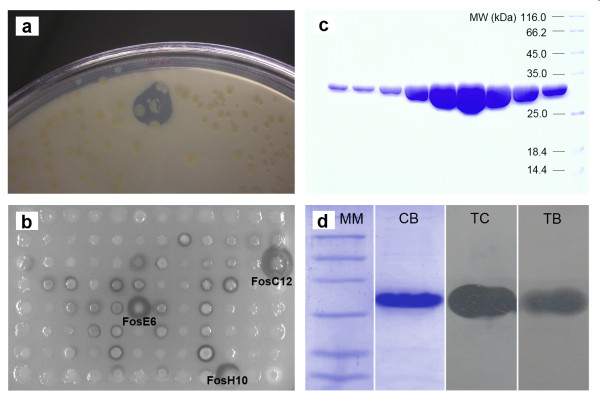
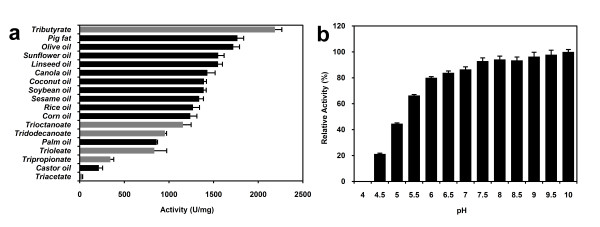
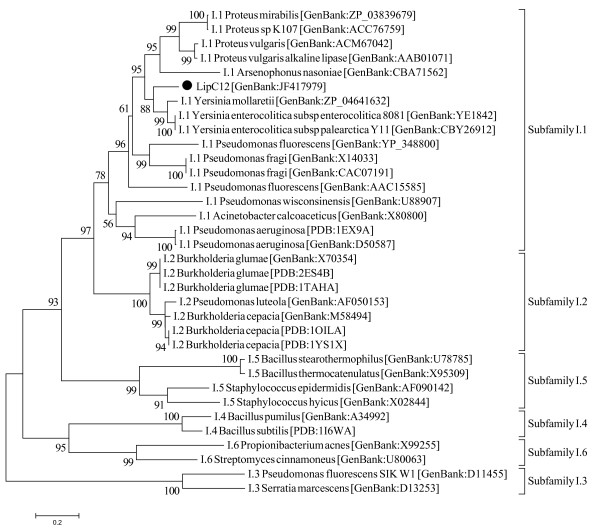
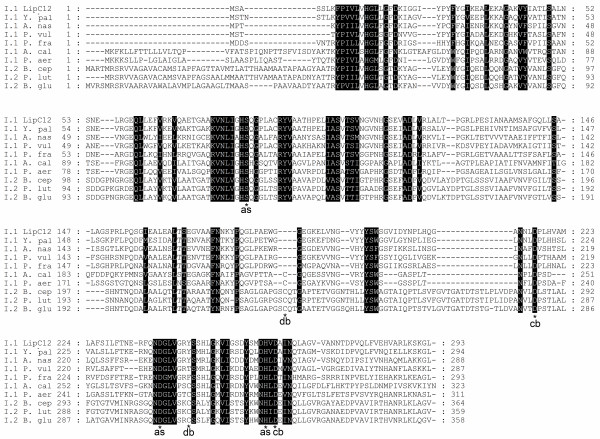
In preliminary screening on agar containing 1% tributyrin, 2661 of the approximately 500,000 clones in the metagenomic library showed activity. Of these, 127 showed activity on agar containing 1% tricaprylin, while 32 were shown to be true lipase producers through screening on agar containing 1% triolein. The clone with the largest halo was further characterized. Its lipase gene showed 72% identity to a putative lipase of Yersinia enterocolitica subsp. palearctica Y11. The lipase, named LipC12, belongs to family I.1 of bacterial lipases, has a chaperone-independent folding, does not possess disulfide bridges and is calcium ion dependent. It is stable from pH 6 to 11 and has activity from pH 4.5 to 10, with higher activities at alkaline pH values. LipC12 is stable up to 3.7 M NaCl and from 20 to 50°C, with maximum activity at 30°C over a 1 h incubation. The pure enzyme has specific activities of 1722 U/mg and 1767 U/mg against olive oil and pig fat, respectively. Moreover, it is highly stable in organic solvents at 15% and 30% (v/v).
The combination of the use of a fat-contaminated soil, enrichment of prokaryotic DNA and a three-step screening strategy led to a high number of lipase-producing clones in the metagenomic library. The most notable properties of the new lipase that was isolated and characterized were a high specific activity against long chain triacylglycerols, activity and stability over a wide range of pH values, good thermal stability and stability in water-miscible organic solvents and at high salt concentrations. These characteristics suggest that this lipase has potential to perform well in biocatalytic processes, such as for hydrolysis and synthesis reactions involving long-chain triacylglycerols and fatty acid esters.
宏基因组学是将分子基因组学应用于未培养微生物的联合体,它有可能对寻找新型工业酶(如酯酶(羧酸酯水解酶,EC 3.1.1.1)和脂肪酶(三酰基甘油脂肪酶,EC 3.1.1.3))产生重大影响。在当前的工作中,从从污水处理厂采集的受脂肪污染的土壤中富集的“原核生物” DNA 构建的 fosmid 宏基因组文库中鉴定出了一种新型脂肪酶基因。
在含有 1%三丁酸甘油酯的琼脂初步筛选中,约 500,000 个克隆的宏基因组文库中有 2661 个显示出活性。其中,有 127 个在含有 1%三辛酸甘油酯的琼脂上显示出活性,而 32 个通过在含有 1%三油酸甘油酯的琼脂上筛选被证明是真正的脂肪酶生产者。具有最大晕圈的克隆进一步进行了表征。其脂肪酶基因与 palearctica Y11 亚种肠耶尔森氏菌的推定脂肪酶显示出 72%的同一性。脂肪酶命名为 LipC12,属于细菌脂肪酶家族 I.1,具有无伴侣蛋白独立折叠的特性,不具有二硫键并且依赖钙离子。它在 pH 6 到 11 之间稳定,在 pH 4.5 到 10 之间具有活性,在碱性 pH 值下具有更高的活性。LipC12 在高达 3.7 M NaCl 和 20 到 50°C 的温度下稳定,在 30°C 下孵育 1 小时时具有最大活性。纯酶对橄榄油和猪油的比活性分别为 1722 U/mg 和 1767 U/mg。此外,它在 15%和 30%(v/v)的有机溶剂中高度稳定。
使用受脂肪污染的土壤、富集原核 DNA 和三步筛选策略的组合,导致宏基因组文库中产生了大量产脂肪酶的克隆。分离和表征的新型脂肪酶最显著的特性是对长链三酰基甘油具有高比活性、在较宽的 pH 值范围内具有活性和稳定性、良好的热稳定性以及在水混溶性有机溶剂和高盐浓度下的稳定性。这些特性表明,该脂肪酶在涉及长链三酰基甘油和脂肪酸酯的水解和合成反应等生物催化过程中具有潜在的应用前景。