Surgical Research Laboratories, Department of Surgery, University Medical Center Groningen (Hanzeplein 1), University of Groningen, Groningen (9713 GZ), The Netherlands.
Mol Cancer. 2010 Nov 23;9:301. doi: 10.1186/1476-4598-9-301.
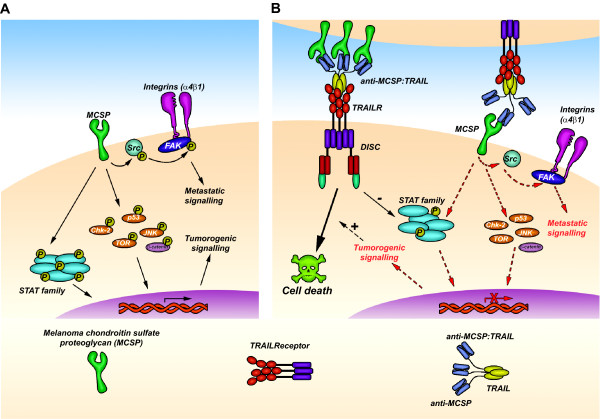
Advanced melanoma is characterized by a pronounced resistance to therapy leading to a limited patient survival of ~6 - 9 months. Here, we report on a novel bifunctional therapeutic fusion protein, designated anti-MCSP:TRAIL, that is comprised of a melanoma-associated chondroitin sulfate proteoglycan (MCSP)-specific antibody fragment (scFv) fused to soluble human TRAIL. MCSP is a well-established target for melanoma immunotherapy and has recently been shown to provide important tumorigenic signals to melanoma cells. TRAIL is a highly promising tumoricidal cytokine with no or minimal toxicity towards normal cells. Anti-MCSP:TRAIL was designed to 1. selectively accrete at the cell surface of MCSP-positive melanoma cells and inhibit MCSP tumorigenic signaling and 2. activate apoptotic TRAIL-signaling.
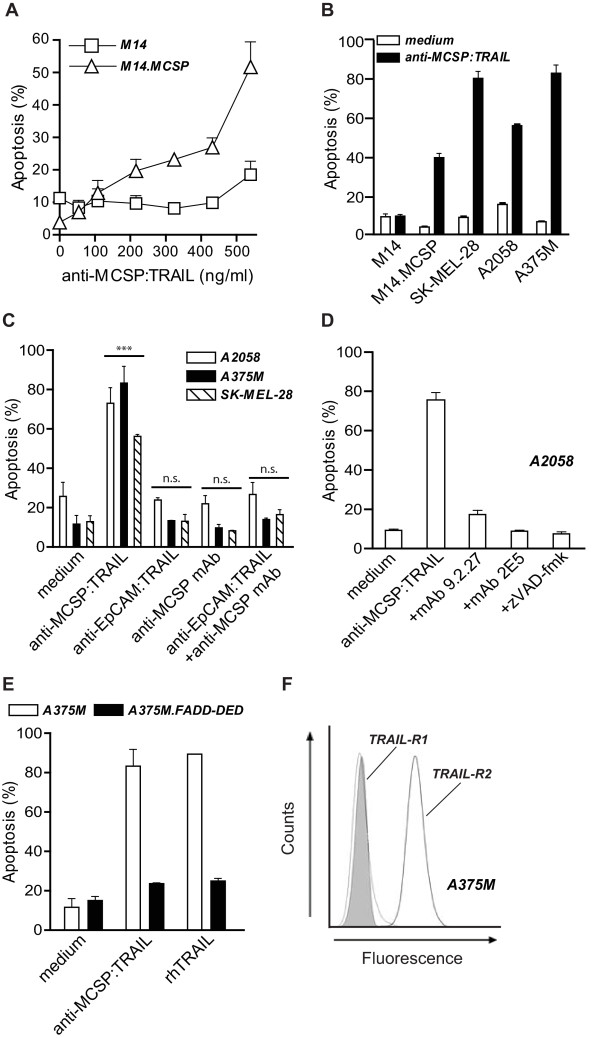
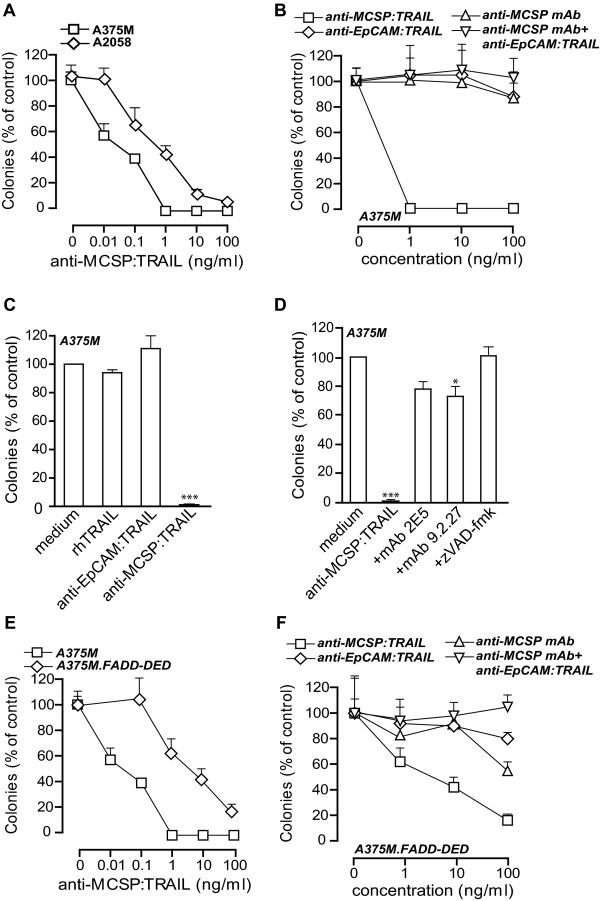
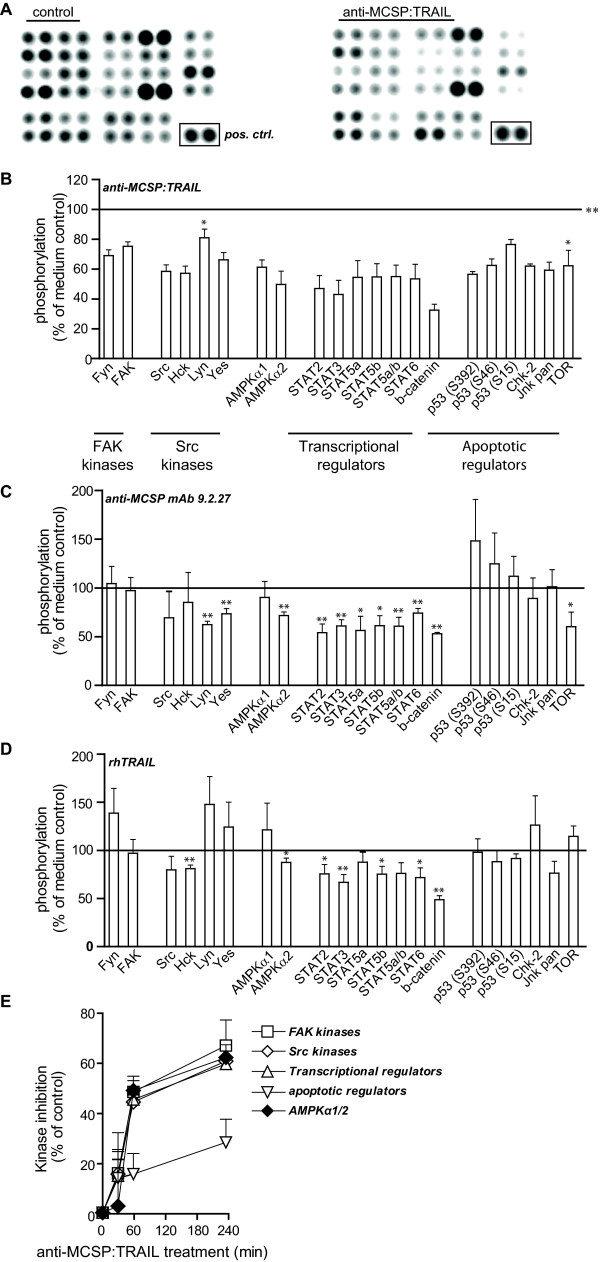
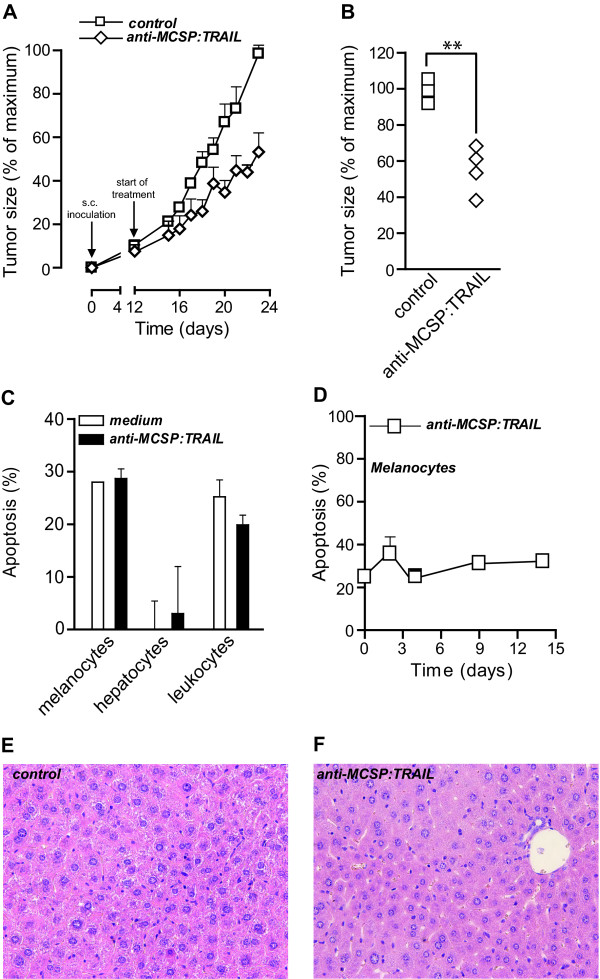
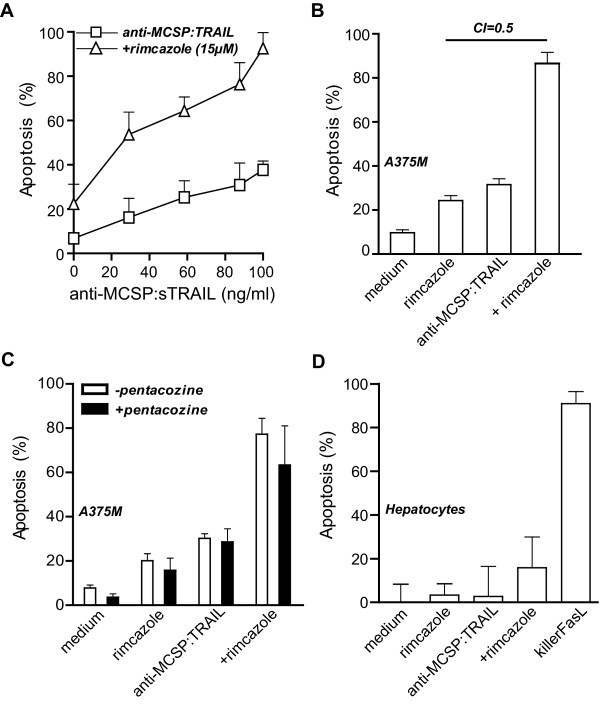
Treatment of a panel of MCSP-positive melanoma cell lines with anti-MCSP:TRAIL induced TRAIL-mediated apoptotic cell death within 16 h. Of note, treatment with anti-MCSP:sTRAIL was also characterized by a rapid dephosphorylation of key proteins, such as FAK, implicated in MCSP-mediated malignant behavior. Importantly, anti-MCSP:TRAIL treatment already inhibited anchorage-independent growth by 50% at low picomolar concentrations, whereas > 100 fold higher concentrations of non-targeted TRAIL failed to reduce colony formation. Daily i.v. treatment with a low dose of anti-MCSP:TRAIL (0.14 mg/kg) resulted in a significant growth retardation of established A375 M xenografts. Anti-MCSP:TRAIL activity was further synergized by co-treatment with rimcazole, a σ-ligand currently in clinical trials for the treatment of various cancers.
Anti-MCSP:TRAIL has promising pre-clinical anti-melanoma activity that appears to result from combined inhibition of tumorigenic MCSP-signaling and concordant activation of TRAIL-apoptotic signaling. Anti-MCSP:TRAIL alone, or in combination with rimcazole, may be of potential value for the treatment of malignant melanoma.
晚期黑色素瘤的特点是对治疗有明显的耐药性,导致患者的生存时间有限,约为 6-9 个月。在这里,我们报告了一种新型的双功能治疗融合蛋白,命名为抗-MCSP:TRAIL,它由一个黑色素瘤相关的软骨素硫酸盐蛋白聚糖(MCSP)特异性抗体片段(scFv)与可溶性人 TRAIL 融合而成。MCSP 是黑色素瘤免疫治疗的一个成熟靶点,最近已被证明为黑色素瘤细胞提供重要的肿瘤发生信号。TRAIL 是一种很有前途的肿瘤杀伤细胞因子,对正常细胞没有或几乎没有毒性。抗-MCSP:TRAIL 的设计目的是 1. 选择性地积累在 MCSP 阳性黑色素瘤细胞的细胞表面,抑制 MCSP 肿瘤发生信号;2. 激活凋亡的 TRAIL 信号。
用抗-MCSP:TRAIL 处理一组 MCSP 阳性黑色素瘤细胞系,在 16 小时内诱导 TRAIL 介导的细胞凋亡。值得注意的是,用抗-MCSP:sTRAIL 治疗还伴有关键蛋白的快速去磷酸化,如 FAK,这些蛋白与 MCSP 介导的恶性行为有关。重要的是,抗-MCSP:TRAIL 治疗在低皮摩尔浓度下已经抑制了 50%的无锚定依赖性生长,而 >100 倍高浓度的非靶向 TRAIL 未能减少集落形成。每天静脉注射低剂量的抗-MCSP:TRAIL(0.14mg/kg)导致已建立的 A375M 异种移植物的生长明显延迟。抗-MCSP:TRAIL 的活性进一步与 rimcazole 协同作用,rimcazole 是一种 σ 配体,目前正在临床试验中用于治疗各种癌症。
抗-MCSP:TRAIL 具有有前途的临床前抗黑色素瘤活性,这似乎是由于联合抑制肿瘤发生的 MCSP 信号和一致激活 TRAIL 凋亡信号的结果。抗-MCSP:TRAIL 单独使用,或与 rimcazole 联合使用,可能对恶性黑色素瘤的治疗有潜在价值。